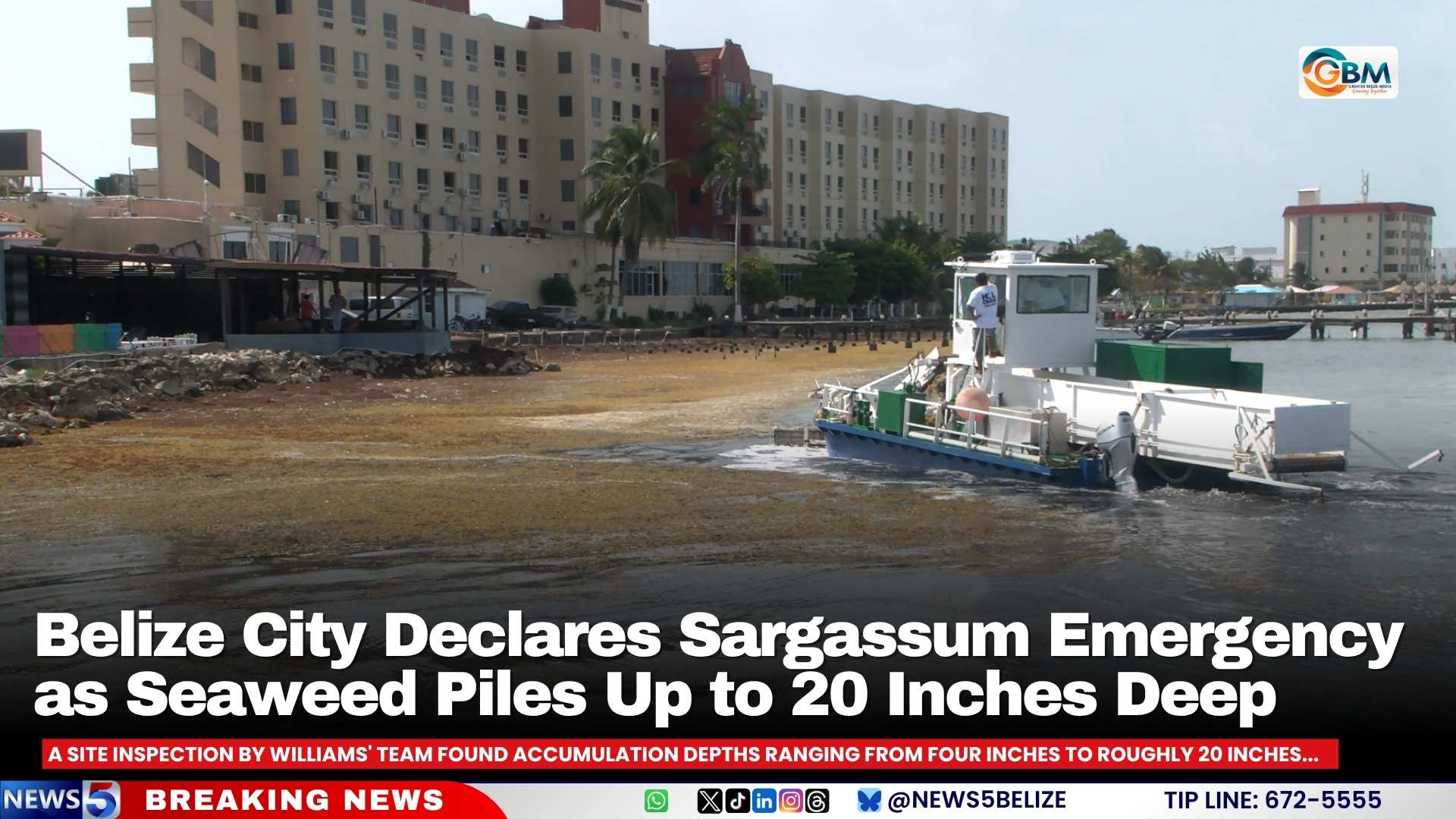
In July 2026, Belize City is confronting an unprecedented environmental crisis as massive piles of invasive sargassum seaweed have choked the city’s popular waterfront, prompting municipal officials to move forward with a declaration of a high-priority environmental emergency. An official engineering assessment released by the city government confirms that the volume of accumulated seaweed far outpaces the capacity of natural tidal action to clear the shoreline on its own, triggering urgent calls for a coordinated, funded response to mitigate cascading public health, ecological and economic harms.
City Engineer Floyd Williams laid out the full scope of the crisis in a formal situation report (SITREP) submitted to Mayor Bernard Wagner, which focuses on the heavily impacted Sandlighter’s Promenade and surrounding coastal areas. Williams’ inspection team documented sargassum accumulation depths ranging from 4 inches to a shocking 20 inches across the affected waterfront stretch. As the thick seaweed masses begin to decompose, they have already begun releasing toxic hydrogen sulfide that creates overwhelming offensive odors along the popular public shoreline. Inspectors also found significant volumes of human-made debris, including plastic waste and glass bottles, trapped within the sargassum mats, and confirmed that the dense buildup has severely restricted nearshore water circulation.
A key finding from the assessment notes that between 70 and 80 percent of the total sargassum biomass is located beyond the city’s existing seawall, with the thickest deposits forming directly adjacent to the structure and thinning gradually as the mats extend out into open water. Without immediate, large-scale intervention, Williams warns the city will face compounding risks that stretch across multiple sectors. For public health, the rotting seaweed will drive sharp increases in fly and mosquito populations alongside persistent foul odors that make the waterfront uninhabitable for visitors. Ecologically, the decomposition process will deplete oxygen levels in nearshore waters and degrade water quality, threatening native marine species that inhabit the coastal ecosystem. Economically, the crisis poses a major threat to Belize’s core tourism sector: the sargassum creates an unappealing visual blight on one of the city’s most valuable public waterfront assets, and will eliminate recreational opportunities that draw both local residents and international visitors.
Looking ahead, regional oceanographic forecasts predict additional waves of sargassum will make landfall along Belize’s coast over the coming months, leading Williams to frame the current event not as a one-time disaster, but as the start of an ongoing seasonal challenge that requires long-term planning. His report formalizes the recommendation that the Belize City Council officially classify the sargassum buildup as a High Priority Municipal Environmental Incident, and approve a two-phase Emergency Sargassum Management Programme to address the crisis.
The proposed cleanup strategy is designed to minimize disruption to the Sandlighter’s Promenade and speed up removal operations. In the first phase, local commercial fishermen will deploy vessels and floating containment nets to corral the sargassum mats offshore and maneuver them toward the seawall. In the second phase, a long-reach excavator will load the concentrated seaweed directly into dump trucks for offsite disposal, cutting down on cleanup time and avoiding damage to the promenade’s infrastructure.
The emergency removal operation carries an estimated price tag of BZ$170,000, and a year-round seasonal maintenance program to address recurring sargassum events brings the total projected budget for the program to between BZ$250,000 and BZ$250,000. Beyond the cleanup plan, the engineering report also recommends establishing a dedicated dedicated funding stream for future sargassum seasons, formalizing partnerships with local fishing communities, and coordinating response efforts with national government agencies to streamline the response.
In a show of regional support, the Hol Chan Marine Reserve has already offered the use of its purpose-built sargassum harvester to assist Belize City’s cleanup efforts for a cost of BZ$10,000. Mayor Wagner has welcomed the offer, as the city grapples with a volume of sargassum that local leaders describe as unprecedented in modern records.