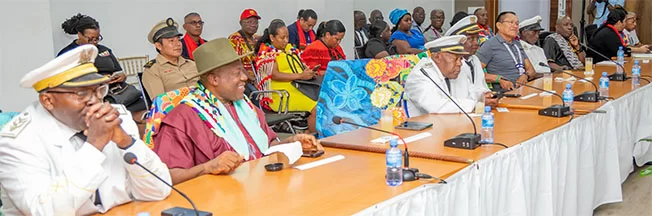
On July 10, 2026, Suriname President Jennifer Simons announced that the planned proclamation of the groundbreaking **Law on the Protection of Residential and Living Areas** will be delayed, after a high-level consultation with representatives of Indigenous and Tribal communities held at the President’s Cabinet Thursday. The temporary legislation, designed to block unvetted third-party rights grants on traditional Indigenous and Tribal lands, will not move forward until traditional governing authorities have completed their full review of the bill’s provisions, goals, and implementation mechanisms.
Presidential advisor Edgar Dikan, who also chairs the working group on Decentralization and Land Rights, confirmed that while the Surinamese government remains fully committed to enacting the legislation, President Simons has formally approved the request from Traditional Authority leaders for extended review time. Dikan shared this update via Suriname’s Communication Service, noting that no official proclamation date has been set as of yet.
President Simons emphasized that Thursday’s talks were focused on exchanging perspectives on land protection priorities and the government’s proposed regulatory adjustments. “We are monitoring developments across Suriname, and we do have some concerns about what is taking place in these traditional territories,” Simons said during the consultation. “We have discussed this issue with Indigenous and Tribal leaders before, and now we have once again asked them to examine the full text of the bill. Technical experts will continue engaging with community representatives, and I will await their final feedback before moving forward.”
The president clarified that the draft law is not intended to resolve the broader, long-standing issue of formal Indigenous and Tribal land rights recognition nationwide. Instead, it is structured as an interim protective measure to prevent harmful government actions while a permanent, comprehensive land rights framework is negotiated and finalized. This timeline aligns with Suriname’s international obligations, including requirements to implement rulings from the Inter-American Court of Human Rights on Indigenous territorial protection.
Once enacted, the legislation will immediately end the practice of issuing new mining concessions — most notably for gold mining — within protected residential and living areas. All future concession applicants will be required to submit geocoordinate documentation proving their proposed site falls outside the boundaries of protected traditional territories. Government officials note that this requirement will increase transparency in the concession application process and eliminate the current loophole that allows unvetted rights grants to be approved without territorial checks.
The new rules will primarily reshape processes overseen by the Ministry of Land Policy and Forest Management and the Ministry of Natural Resources, the two government bodies currently authorized to issue third-party land rights. Under the new framework, all applications will be made public, with formal documentation required for all proposed land uses within the country.
Concurrent discussions between the government and Traditional Authority representatives are also focused on clarifying the formal role and legal powers of traditional Indigenous and Tribal governing bodies. With support from the President’s Cabinet and the Ministry of Regional Development, existing traditional governance procedures will be formally codified to establish clear criteria for legitimate traditional leaders, including captains and other community representatives. The government frames this codification work as a critical incremental step toward the full legal recognition of collective land rights for Indigenous and Tribal peoples across Suriname.