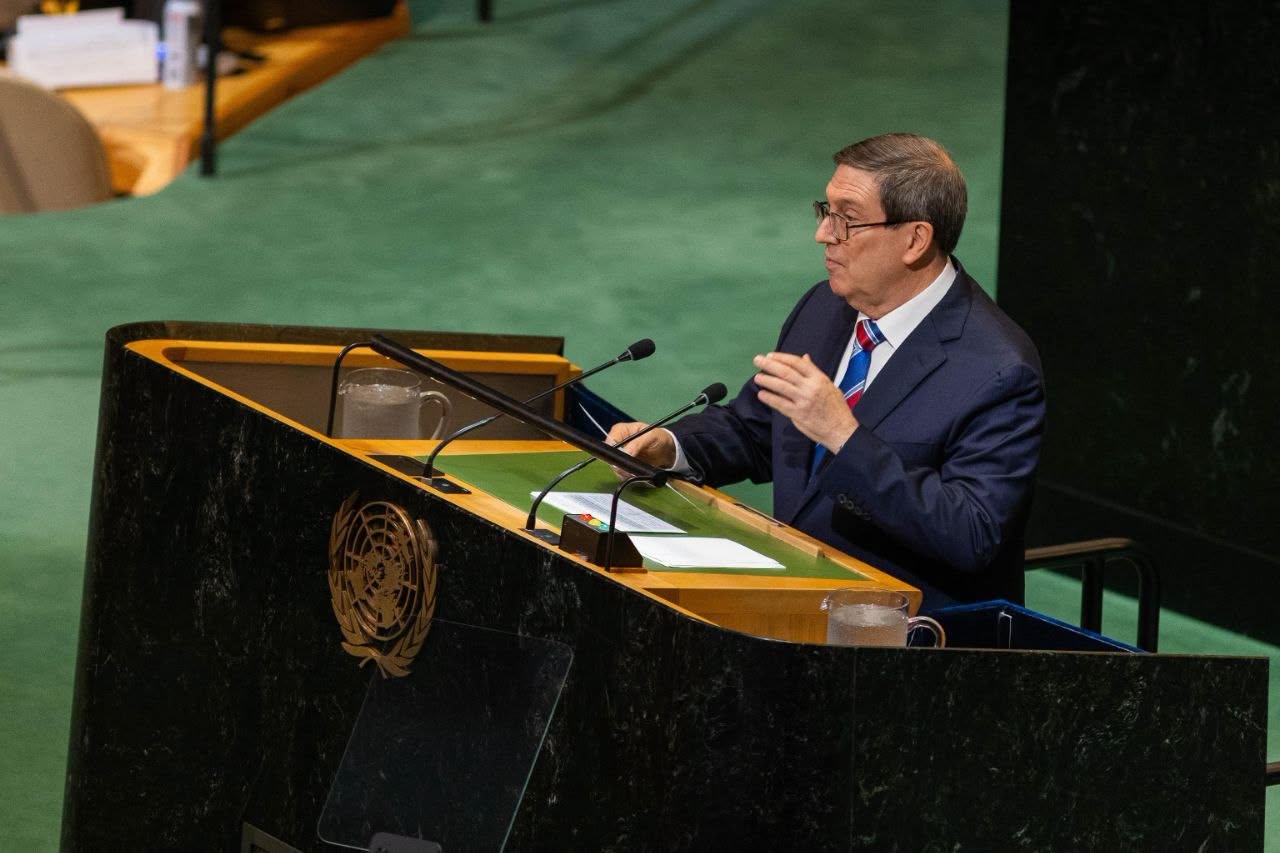
In a bold rebuke of decades of unilateral U.S. policy, the United Nations General Assembly voted 136 in favor to greenlight a long-sought debate on the U.S. economic, commercial and financial blockade against Cuba, overcoming strenuous lobbying efforts by Washington to block the discussion. The overwhelming vote outcome reaffirms the deep global rejection of the U.S. policy, leaving Washington increasingly politically isolated on the global stage while validating Havana’s decades of denunciations of the punitive measures.
Cuba’s Foreign Minister Bruno Rodríguez opened the debate with a scathing condemnation of the decades-long blockade, framing it as a multi-dimensional act of aggression that has escalated in recent years into a full-scale energy siege functionally equivalent to a traditional naval blockade. Rodríguez stressed that the coercive unilateral measures are intentionally designed to cripple Cuba’s economy, inflict widespread hardship on the island’s 11 million residents, and hide the true humanitarian cost of the sanctions from the international community.
Beyond its direct harm to Cuban civilians, Rodríguez noted the blockade imposes sweeping extraterritorial sanctions that penalize third-party countries and businesses for maintaining normal trade ties with Havana, forcing many to cut off economic relations against their will. He emphasized that this long-running policy systematically violates core tenets of international law and foundational principles of the UN Charter, qualifying as an act of collective punishment and genocide against the Cuban people.
Closing his opening remarks, Rodríguez extended gratitude to the vast majority of UN member states that defied U.S. pressure to support the debate, and reiterated that Cuba poses no security threat to any nation. Instead, he emphasized, it is the blockade that constitutes a direct threat to the lives and well-being of millions of Cubans, calling on the global community to unite in defense of national sovereignty and global social justice.
The UN debate was marked by an outpouring of cross-regional support for Cuba from dozens of countries and major regional blocs. Russia’s representative told the assembly that fuel shipments to Cuba are no longer a routine commercial transaction, but an urgent humanitarian issue. Speaking on behalf of the 120-member Non-Aligned Movement, Uganda’s delegate called on the General Assembly to mobilize collective action to prevent any form of military aggression against Cuba.
Mexico’s representative affirmed that the right to determine Cuba’s political and economic future belongs exclusively to the Cuban people, free from external interference or coercive impositions. Major regional and national groups including the African Group, China, the Association of Southeast Asian Nations, and Pakistan joined the chorus of condemnation, warning that the blockade is pushing Cuba toward a severe humanitarian crisis and noting that it has devastated critical public sectors including health care, education, and energy infrastructure.
The debate laid bare the catastrophic daily human toll of the decades-long siege across Cuban society. Delegates detailed widespread, prolonged power outages that have disrupted daily life for millions of Cubans, brought public transportation systems to a standstill, and created severe challenges to preserving critical food supplies. Hospitals and community health centers across the island have been forced to rely on emergency backup generators amid crippling shortages of life-saving medications and essential medical supplies.
The successful vote to hold the debate marks a major diplomatic victory for Cuba, which successfully rallied global support to open the issue for formal UN discussion despite intense opposition from Washington. The outcome of the vote confirms broad, cross-regional consensus in the international community that all peoples have the inherent right to live free from coercive unilateral sanctions imposed by foreign powers. As Rodríguez emphasized in his closing remarks, “Cuba is not a threat; the blockade is.”