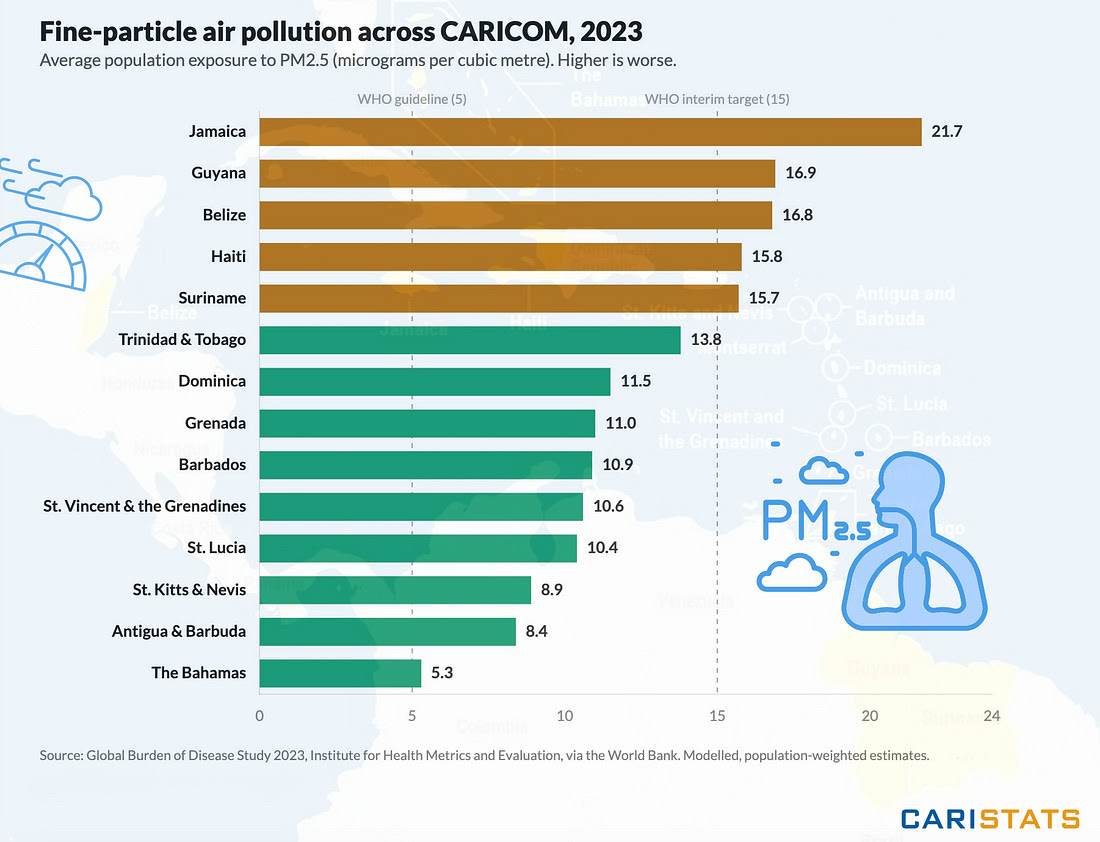
New 2023 population-weighted data collected from the Global Burden of Disease Study, run by the Institute for Health Metrics and Evaluation, has mapped fine particulate matter (PM2.5) air pollution levels across 14 member states of the Caribbean Community (CARICOM), revealing clear geographic patterns in air quality that hold more weight than national income levels.
PM2.5, a category of tiny airborne pollutants small enough to penetrate deep into human lung tissue and enter the bloodstream, poses well-documented long-term risks to cardiovascular and respiratory health. The latest analysis places the entire CARICOM region in the low-to-middle tier of global air pollution rankings, with 2023 average annual exposure levels ranging from 5.3 micrograms per cubic meter in The Bahamas to 21.7 micrograms per cubic meter in Jamaica.
Small island nations surrounded entirely by open ocean recorded the cleanest air in the bloc. Beyond The Bahamas, Antigua and Barbuda posted an average PM2.5 concentration of 8.4 micrograms per cubic meter, while Saint Kitts and Nevis came in at 8.9 micrograms. Experts attribute these low readings to consistent regional trade winds, which efficiently disperse accumulated particulates out into the open ocean before they can build up to dangerous levels.
In contrast, the highest pollution levels are concentrated among CARICOM’s larger landmass and mainland economies. Guyana recorded an average of 16.9 micrograms per cubic meter, followed closely by Belize at 16.8 micrograms and Suriname at 15.7 micrograms. Local human activities drive these higher readings: regular agricultural burning, deforestation for land clearing, and growing industrial activity all add significant volumes of PM2.5 to the regional atmosphere. Most other CARICOM member states included in the study fall somewhere between these two extremes.
When compared to global pollution benchmarks, the CARICOM region’s readings count as moderate. The world’s most polluted nations report annual average PM2.5 levels that exceed 60 micrograms per cubic meter, far above the highest reading recorded in Jamaica. Even so, the analysis confirms a critical public health gap: every single CARICOM member state exceeds the World Health Organization’s strict recommended maximum guideline of 5 micrograms per cubic meter, meaning all regional populations face at least some elevated long-term health risk from poor air quality.