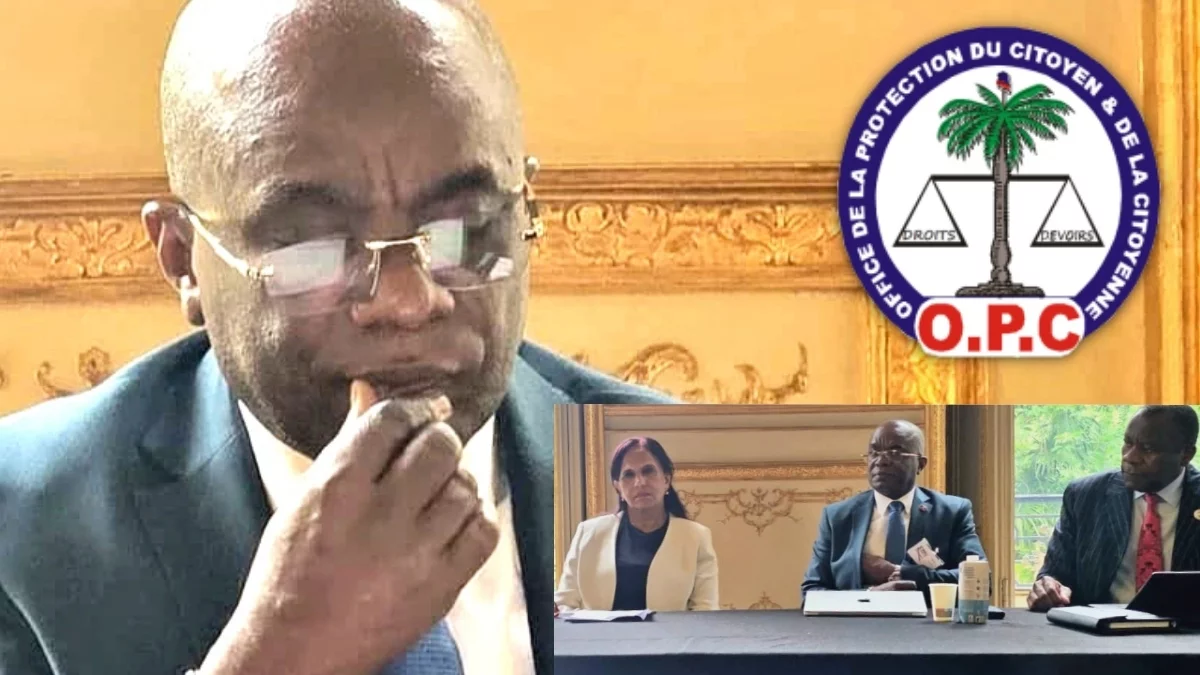
When global anti-death penalty advocates gathered in Paris last week for the 9th World Congress Against the Death Penalty, Haiti’s top human rights oversight official brought a urgent, nuanced message from his violence-plagued nation: the hard-won abolition of capital punishment must be defended, even as the country grapples with a systemic breakdown that threatens the fundamental right to life every day.
Jean Wilner Morin, Haiti’s Ombudsman, addressed a dedicated congress session focused on advancing life protection and the global elimination of capital punishment, delivering a talk titled “The Right to Life and the Abolition of the Death Penalty in Haiti: A Commitment to Uphold.” Morin opened his remarks grounding his advocacy in universal human rights principles: the right to life, he emphasized, serves as the irreplaceable foundation of all other fundamental human freedoms, a value formally codified in every core international human rights agreement. This universal recognition, he argued, places a non-negotiable legal and moral obligation on all sovereign states to shield every individual within their borders from arbitrary deprivation of life.
Turning to Haiti’s own legal history, Morin walked the audience through the decades-long process that removed capital punishment from the country’s framework. Formal abolition was first enshrined as a constitutional principle in Article 20 of Haiti’s 1987 constitution, adopted nearly 40 years ago after the end of decades of authoritarian rule. That landmark constitutional commitment was solidified a year later, when a government decree issued in June 1988 fully struck all references to the death penalty from the country’s national legal code. Morin framed this step as one of the most significant advances for fundamental human rights in Haiti’s modern democratic history.
But the ombudsman did not shy away from the profound challenges that now undermine that progress, laying bare the grim reality of the country’s ongoing security and institutional collapse. Haiti is currently grappling with an unprecedented security crisis marked by the rapid expansion of violent armed groups, widespread and repeated violations of basic human rights, and a judicial system that has been weakened to the point of near collapse. This confluence of crises has created a pervasive culture of impunity, Morin explained, that has opened the door to a surge in extrajudicial killings, mob lynchings, and vigilante justice – all practices that systematically violate the fundamental right to life that abolition was meant to protect.
Morin stressed that the Haitian state’s obligation to protect the right to life extends far beyond simply maintaining the formal abolition of capital punishment. Upholding that core principle requires far more systemic action: active prevention of summary executions, aggressive prosecution of perpetrators of human rights abuses, sustained efforts to root out systemic impunity, and guarantees that all victims of violence have meaningful access to fair and effective justice.
In closing, Morin outlined the defining challenge facing Haiti today: rebuilding respect for the rule of law by reconstructing a judicial system that is independent, accessible to all Haitian citizens, and effective at upholding the law. He reaffirmed that consistent respect for the right to life – from ending capital punishment to curbing extrajudicial violence – remains an essential precondition for consolidating Haiti’s fragile democracy, protecting all fundamental human rights, and rebuilding the Haitian people’s shattered trust in their public institutions.