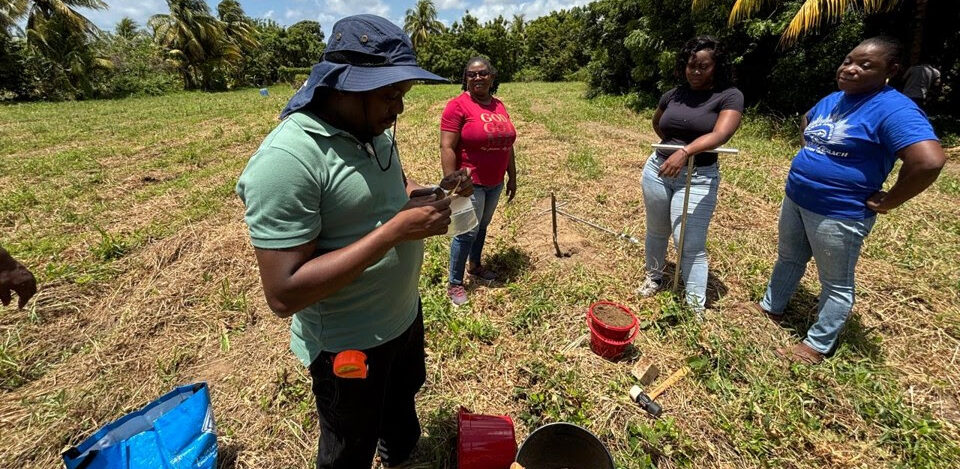
As climate change continues to intensify threats to Caribbean agricultural systems, a regional initiative centered on improving soil health and building climate resilience is rolling out targeted training to farming communities across St. Vincent and the Grenadines. Forty-nine local farmers and agricultural technical officers have recently graduated from the first round of hands-on training organized under the ADOPT Caribbean – Soil Health for Climate Resilient Agriculture project, a program designed to embed sustainable production practices and boost the agricultural sector’s ability to withstand climate shocks. The initiative is led by the Inter-American Institute for Cooperation on Agriculture (IICA) in collaboration with a network of national and regional partners, with a current focus on expanding outreach and support to small-scale farming communities in the northeast of St. Vincent and the Grenadines.
Unlike traditional theoretical-only training programs, the recent ADOPT Caribbean sessions blended structured classroom learning with immersive field-based practice to ensure participants gained both foundational knowledge and actionable, on-the-ground experience. As part of the program’s initial assessment work, technical teams collected soil samples from two key local districts—Langley Park and Orange Hill—to generate baseline data that will inform evidence-based soil management strategies for the region moving forward. Specialized training for technical officers was delivered by leading industry experts: Ronen Francis from the Partnership Initiative for Sustainable Landscape Management (PISLM) and Chaney St. Martin, IICA’s International Specialist in Water and Soil Management. Course content focused heavily on evidence-based soil health improvement techniques and the development of dedicated demonstration plots that will serve as living examples of climate-smart agriculture for local producers.
Local farmers also participated in hands-on practical workshops led by St. Martin, with support from IICA’s in-country Technical Specialist Michael Dalton and project consultant Michael Delpeche. The training curriculum covered the full cycle of crop production, from initial land preparation and optimized planting methods to ongoing crop maintenance and climate-adapted harvesting practices. According to Dalton, the program is already filling a critical gap by building specialized, context-relevant skills for both local producers and agricultural support professionals.
“ADOPT Caribbean provides an important platform for capacity building for farmers and agricultural technicians,” Dalton explained in an official IICA press statement. “We have been able to expose our local technical team to key considerations for experimental plot establishment and provided information for our farmers which gives a sound basis for their operations on their farms. We intend to further advance our interventions through forums such as these for stakeholders, with the intention to promote such practices across the country.”
Looking ahead, the next phase of the project will focus on establishing permanent demonstration plots across St. Vincent and the Grenadines, where local farmers can observe climate-smart farming techniques in action and learn how to adapt these methods to their own smallholdings. Beyond St. Vincent and the Grenadines, ADOPT Caribbean is also active in Guyana and Jamaica, forming part of a broader regional push to improve regional soil health, cut greenhouse gas emissions originating from agricultural activity, and scale up climate resilience across the Caribbean agricultural sector.
The initiative receives funding through the New Zealand Government’s Climate Smart Agriculture Initiative (NZCSA-LAC), which is New Zealand’s official contribution to the Global Research Alliance on Agricultural Greenhouse Gases (GRA). All project funding is administered through the Ag Emissions Centre. Looking forward, IICA has confirmed that the project will continue to support farmers and agricultural stakeholders across all three participating countries, with a long-term goal of mainstreaming sustainable farming practices that strengthen regional food security while preserving critical natural ecosystems.