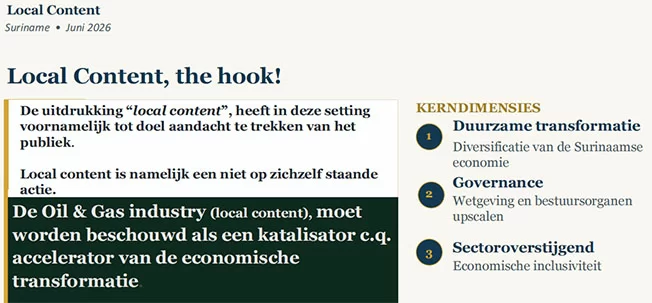
At a recent policy discussion hosted by the newly launched Surinamese foundation Stichting Passie voor Land en Volk, leading policy analysts and sector experts have called for a paradigm shift in how the nation approaches its emerging oil and gas industry, arguing that debates over local content requirements must extend far beyond simply creating jobs for Surinamese workers or awarding contracts to domestic firms.
Three presenters — Antoon Karg, Sieglien Burleson and Wilgo Bilkerdijk — delivered insights from legal-governance, economic and strategic perspectives respectively. While their approaches differed, all three reached the same core conclusion: local content policies should not be treated as an end goal in themselves, but rather a targeted tool to build long-term, structural strength for Suriname’s entire economy.
Central to the group’s argument is the framing that oil and gas are not the end point of Suriname’s economic development, but a temporary accelerant that should open doors for broader growth. Revenue generated from fossil fuel extraction, they argue, must be strategically deployed to boost competitiveness across other key sectors, including agriculture, manufacturing, technology, services and export-oriented industries. Without this intentional reallocation of resources, experts warn that Suriname risks locking itself into an oil-dependent economic model that will leave non-resource sectors stagnant and vulnerable once oil reserves are depleted.
The presenters drew heavily on lessons from resource-rich nations around the world, highlighting that the discovery of large natural resource reserves rarely delivers broad, sustained prosperity automatically. In many cases, it has instead led to crippling economic dependence, rising import reliance, growing social inequality and the erosion of other productive domestic industries. The group specifically warned Suriname against the risk of “Dutch disease”, a well-documented economic phenomenon where a booming resource sector pushes up exchange rates and production costs, crowding out growth in other tradable sectors of the economy.
To avoid these common pitfalls, speakers emphasized that Suriname must make early, targeted investments in public education, technological innovation, entrepreneurship, vocational skills training and institutional capacity building. They also noted that while a formal Local Content law is a necessary starting point, it is not sufficient on its own to deliver broad-based transformation. Instead, the experts called for a holistic national development strategy that aligns multiple government ministries, implementing agencies and civil society partners around shared long-term goals.
Concrete policy proposals put forward during the discussion include the establishment of a National Development and Implementation Coordination Council, which would be tasked with strategic planning, cross-agency policy coordination, performance monitoring and delivery of national development targets. The group also recommended strengthening existing core institutions including the Chamber of Commerce and Industry, the Suriname Standards Bureau, the Suriname National Training Authority and the Economic Control Service.
On the topic of managing future oil revenue, the presenters laid out a three-fund framework. In addition to the standard stabilization and savings funds that most resource-rich nations maintain, they proposed the creation of a dedicated National Development and Transformation Fund. This fund would allocate capital to high-priority long-term investments: public education, core infrastructure, national digitalization, clean energy transition, innovation capacity, agro-industrial development, and support for small and medium-sized enterprises. This structure, they argue, would convert temporary oil revenue into permanent, self-sustaining economic growth that outlasts the age of fossil fuel extraction.
Opening the event, Jennifer van Dijk-Silos, chair of Stichting Passie voor Land en Volk, emphasized that Suriname currently faces a historic, once-in-a-generation policy choice. She called on all national stakeholders to leverage the new opportunities created by the emerging oil and gas sector to advance sustainable development, strengthen good governance, and build an economy that delivers inclusive prosperity for all Surinamese over the long term.