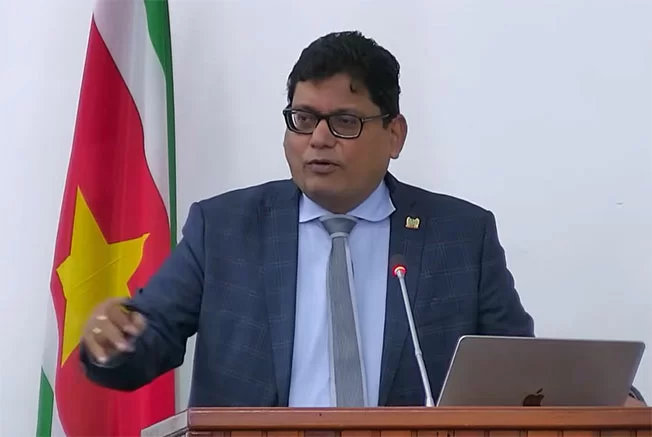
During parliamentary budget deliberations in Suriname, Asis Gajadien, leader of the VHP faction and a sitting assembly member, has delivered sharp criticism of the core financial assumptions underpinning the government’s 2026 draft budget. Gajadien argues that the administration paints an unrealistically rosy picture of the country’s economic outlook, while public finances remain deeply fragile and the entire budget framework leans heavily on unproven projected oil revenues.
When accounting for all off-budget and financing components that the government excluded from its official calculations, Gajadien’s own analysis puts the actual budget deficit at roughly 7.7% of gross domestic product, far higher than the 5.1% figure the government has publicly reported. This discrepancy, he says, means the state’s actual financial standing is significantly weaker than official presentations have claimed.
Beyond headline deficit figures, Gajadien points out that even the budget documents released by the government confirm that purchasing power for workers, pensioners, and all other income groups has still not recovered to pre-crisis levels. He pressed the administration to answer when ordinary citizens will actually feel the benefits of reported economic growth in their household budgets. “Society continues to struggle under the weight of persistently high consumer prices,” Gajadien told the assembly. “Glowing growth statistics mean little if working families do not see any improvement in their daily finances.”
A major focus of Gajadien’s critique was the country’s growing public debt burden. He warned that a large share of Suriname’s external debt is denominated in foreign currencies, leaving the national economy extremely vulnerable to sudden exchange rate fluctuations. What is more, he noted, the structure of current debt agreements will leave future generations of Surinamese saddled with crippling repayment obligations that will constrain their economic options.
Gajadien also took aim at the government’s recent sovereign debt refinancing operation. He argued that the administration failed to provide sufficient justification for choosing relatively high-cost borrowing options, even when cheaper international financing alternatives were reportedly available. He also raised questions about the unusually high transaction costs associated with the refinancing deal, calling for greater transparency around the process.
Turning to long-term economic strategy, Gajadien emphasized that the government is placing far too much reliance on future oil revenues to balance the budget and drive growth. Instead, he called for targeted investment and policy support to diversify Suriname’s economy by boosting non-oil sectors including agriculture, tourism, manufacturing, and small and medium-sized enterprises. Reducing overreliance on the volatile oil and gas sector, he argued, would make the country’s economic foundation more stable and resilient.
Gajadien also highlighted a series of persistent structural bottlenecks that are holding back development of both the oil and gas sector and the broader local economy. Key challenges he named include crumbling nationwide infrastructure, glacial government permit approval processes, labor market imbalances, a widespread housing shortage, and the urgent need for a more efficient and streamlined public administration.
To attract much-needed private investment and lay the groundwork for sustainable long-term growth, Gajadien called for a series of governance reforms: strengthening the country’s Court of Audit, improving internal financial controls across government, fully implementing the existing Public Procurement Act, and increasing transparency in all government operations. All of these steps, he argued, are non-negotiable preconditions for inclusive, sustained growth.
On social policy, Gajadien noted that the 2026 draft budget allocates no room for meaningful increases to old-age pensions, child benefits, and other critical social welfare payments. He did, however, express support for further digitalization of social welfare programs and greater community oversight of benefit allocation to root out fraud and misuse of public funds.
In closing, Gajadien called on the Surinamese government to adopt a more realistic approach to addressing the country’s pressing economic challenges, implement deep structural reforms, and strengthen public governance. Only through these changes, he argued, can Suriname deliver sustainable economic development and shared prosperity for both current and future generations.