A leaked internal document from the emergency department (SEH) of the Academic Hospital Paramaribo (AZP) in Suriname has sparked public debate over strained acute care capacity, even as hospital leadership insists no formal “code black” has been declared for the emergency wing.
The controversy erupted after a draft document prepared by SEH management began circulating among medical specialists before being leaked to the public. The internal note outlined specific scenarios where the department would be forced to temporarily stop accepting new patients, triggered by persistent staffing shortages, limited overall capacity, and unresolved logistical bottlenecks. In the document, these extreme, full-capacity conditions were explicitly labeled a “code black” situation for the SEH.
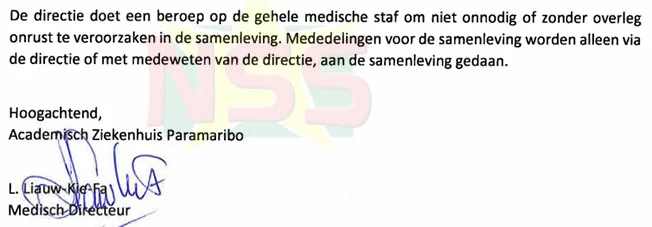
Once the document’s content became public, AZP’s executive board issued an internal circular to medical specialists clarifying that the draft had never been discussed with or approved by senior hospital leadership. Per hospital management, the text was merely a working draft created as part of ongoing interdepartmental discussions to develop contingency protocols for future scenarios where care capacity could be pushed to its breaking point.
Fauzia Poese, head of the SEH, later confirmed to the Suriname Communication Service (CDS) that no code black has been enacted for the general public, and that the emergency department continues to operate its services as normal. Poese emphasized that the document was only an internal preparedness exercise to plan for potential worst-case outcomes if maximum capacity is ever reached in the future.
However, official reassurances have not fully alleviated concerns among frontline medical staff. In interviews with Starnieuws, multiple practicing physicians at AZP confirmed that the SEH and other critical care departments are already operating under significant, unsustainable pressure. These clinicians pointed to long-running staffing shortfalls, soaring patient demand for care, and limited capacity to accommodate severely ill patients as ongoing, daily challenges. They noted that the scenarios outlined in the leaked draft are not hypothetical: they reflect the very real barriers that care teams confront every day at the hospital.
Even AZP’s executive board acknowledged in its circular that the current operating environment for the hospital is extremely challenging. Leadership confirmed that the institution is actively working on a series of interventions to ease strain on the emergency department, including expanding available bed capacity and improving patient flow through the facility to reduce bottlenecks.
Ultimately, the debate sparked by the leak is less about the technical question of whether a formal code black has been declared, and more about the underlying message of the document: frontline care providers are already being forced to plan for emergency contingency plans because existing capacity is under unprecedented, sustained strain.