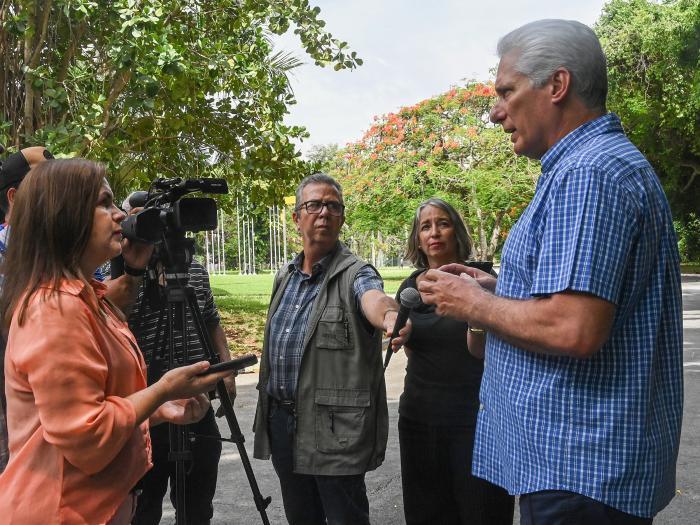
In an exclusive address to the press corps of the Cuban Presidency published on June 12, 2026, Miguel Díaz-Canel Bermúdez, First Secretary of the Central Committee of the Communist Party of Cuba and President of the Republic, laid out a comprehensive strategy to sustain national development and overcome the long-standing, punitive U.S. imperial blockade that has strained every sector of Cuban life.
Díaz-Canel opened his remarks by invoking a core principle from the era of revolutionary leader Fidel Castro: that in times of unprecedented complexity, a relentless passion for development and creative problem-solving is non-negotiable. Framing the U.S. blockade as a multidimensional, interventionist act of aggression that has disrupted daily life for every Cuban family and created deep systemic stress across the national economy, he emphasized that the resilience of the Cuban people has already defied Washington’s expectations.
“A failed state could not have survived even a few weeks of the pressure we have endured for decades,” Díaz-Canel noted, pointing out that the continued existence of the Cuban Revolution and the functioning of the Cuban state directly contradicts repeated U.S. claims of imminent collapse. Drawing on Castro’s teachings, he stressed that crises must be seized as opportunities for growth, and that collective unity and popular will will carry the nation through current challenges.
To meet this moment, the Cuban government has established two overarching national priorities. The first is robust defense preparedness. Díaz-Canel detailed ongoing work to strengthen the country’s territorial defense system, leveraging weekly Defense Days to refine operational plans, adapt to new lessons learned, and expand civilian participation and protection within a people-centered defense strategy.
The second, and most transformative priority, is the implementation of the 2026 Cuban Economic and Social Program, a set of sweeping reforms that emerged from months of nationwide public debate. Díaz-Canel explained that public input broadened and strengthened the initial policy framework, with experts refining proposals through comparative analysis of socialist transition experiences in China and Vietnam, and even leveraging artificial intelligence tools to test policy outcomes. The final version of the program is now being finalized for approval by the Communist Party Political Bureau and the National Assembly of People’s Power, after which a nationwide public outreach campaign will begin to ensure broad buy-in for the changes.
The reforms target more than 20 key areas of economic and governance transformation, starting with a restructuring of the national economic management system to resolve long-standing tensions between central planning and productive incentives. Díaz-Canel emphasized that the core goal of all proposed changes is to drive national production, generate shared wealth, and distribute that wealth through principles of social justice — a necessary step to expand social programs and address growing inequalities and community vulnerabilities exacerbated by the blockade.
A central pillar of the reform agenda is expanding autonomy to two key drivers of growth: municipal governments and state-owned enterprises. Díaz-Canel argued that national strength grows from strong local governance, proposing that municipalities gain full authority to manage their own economic ecosystems, approve local investments, facilitate partnerships between economic actors, and engage directly in import and export activity, including managing foreign direct investment and projects with Cubans residing abroad. These powers, he stressed, do not conflict with national priorities, but reinforce them by unlocking untapped local endogenous potential.
For state-owned enterprises, the reforms grant sweeping operational autonomy free from unnecessary bureaucratic interference. Enterprises will be able to set their own size, design worker-centered salary systems, control the use of their profits, engage directly in import and export activity, retain a share of foreign currency earnings for expansion, form partnerships with any domestic or foreign economic actor, and choose their own clients and suppliers. They will also gain direct access to the national foreign exchange market, putting them on an equal competitive footing with non-state economic actors, a long-called-for change by sector stakeholders. Díaz-Canel added that state enterprises will be permitted to open foreign currency bank accounts, removing a major barrier to operational flexibility.
The reform package also includes a major restructuring of the state and party apparatus, with a draft bill already published for public comment on the National Assembly website that will cut the number of ministries and senior administrative positions significantly. The resulting budget savings will be redirected to support social programs and long-overdue salary reform, particularly for budget-dependent public sector workers, while eliminating bureaucratic bloat to create a more agile, responsive governance system.
To revitalize Cuba’s critical agricultural sector and advance toward food sovereignty, the reforms grant new powers to streamline land use, putting idle land into production by transferring plots to producers with a demonstrated track record of output. All producer categories — state, cooperative, private, and foreign-invested — will be able to access input markets in both national and foreign currency, form cross-sector partnerships, and benefit from reduced bureaucratic red tape to speed up project approval.
Foreign trade will also be liberalized: mandatory intermediation for import and export activity will be eliminated, with lower tariffs applied to imported inputs and raw materials than to finished goods that can be produced domestically. Policymakers are also evaluating permitting foreign trade entities to hold overseas bank accounts, while the scope of allowed activities for non-state economic actors will be expanded, with only a limited list of prohibited activities remaining. MSME approval processes will be expedited, with authority delegated to municipal governments to speed up processing, and foreign direct investment will be incentivized through streamlined approval timelines, clearer property rights, and improved access to banking. Cubans residing both on the island and abroad will be able to participate in investment on equal terms with other economic actors.
Other key priorities outlined in the program include a rapid expansion of renewable energy to reduce dependence on imported fossil fuels, which have been severely disrupted by the blockade — Díaz-Canel noted that only one oil tanker has arrived in Cuba in the past five months. The country will also expand electric mobility, phase out universal product subsidies in favor of targeted subsidies for the most vulnerable households, restructure fiscal policy to end public financing of inefficient state enterprises, strengthen the banking and financial system, and liberalize restrictions on vehicle imports with preferential treatment for electric vehicles powered by solar energy.
For tourism, a sector hit particularly hard by the U.S. blockade and pressure on international chains to withdraw from Cuba, Díaz-Canel called for new approaches that open the sector to new non-traditional actors to leverage existing tourism infrastructure. Domestic trade will be modernized through nationwide electronic invoicing and expanded use of digital retail platforms, while targeted incentives will protect young skilled workers, retaining domestic human capital by offering competitive wages that give young Cubans the opportunity to contribute to national development without relocating abroad.
Closing his address, Díaz-Canel called for national unity, noting that Cuba has not ground to a halt under blockade pressure, but is pursuing deliberate, strategic reform. He denounced ongoing U.S. psychological warfare designed to force Cuban surrender, but emphasized that the vast majority of the Cuban people remain committed to defending their revolution and retaining sovereignty over their national development path, rejecting external interference that runs counter to the revolutionary vision of a just, independent Cuba. Open discussion of all reform proposals will continue, he added, with all constructive ideas welcome as the country moves forward together.