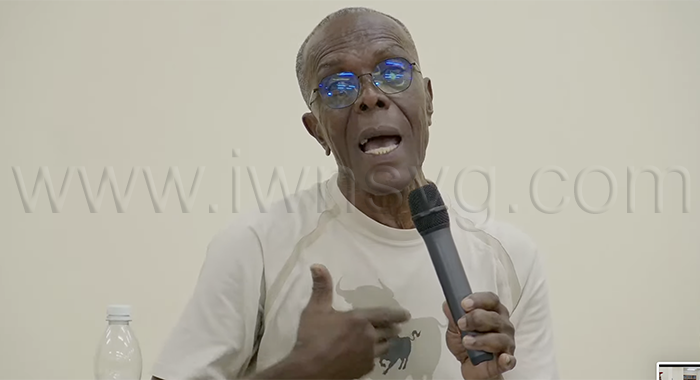
At a community gathering hosted by North Leeward Member of Parliament Kishore Shallow as part of his “North Leeward Matters” public engagement series, environmental consultant Reynold Murray has addressed long-simmering community tensions over a state-run sand and aggregate extraction project in Roseau, North Leeward, pushing back against claims of procedural recklessness while openly acknowledging gaps in the mandated environmental and social impact assessment (ESIA) he completed for project proponent BRAGSA, a state-owned national development enterprise.
Murray, who was contracted by BRAGSA to carry out the ESIA for the proposed harvesting operation, opened his remarks by reframing public debate around the project’s environmental risks, arguing that the most critical threat to local interests is not the widely cited harms of deforestation or soil erosion, but potential irreversible disruption to nearshore fisheries that support local livelihoods. He pushed back against growing comparisons between the Roseau project and the divisive, controversial Rayneau quarry operation at nearby Richmond, where residents have long accused developers and regulators of cutting corners on environmental protections. Instead, he centered local fishing communities as the key stakeholder group that must be centered in all future project planning.
During the question-and-answer portion of the meeting, North Leeward Preservation Front representative Jill Edwards pressed Murray on whether his team completed foundational baseline ecological surveys, including a full inventory of native plant species in the project area. Murray openly conceded that this work was outside the formal scope of his mandate, which prioritized analyzing the composition of the material to be extracted and potential downstream environmental impacts. Edwards countered that baseline biodiversity surveys are the foundational first step of any rigorous ESIA, describing a complete species inventory as basic industry protocol that cannot be omitted.
Murray also addressed widespread public pushback over a contentious claim in the draft ESIA that no active agricultural cultivation was taking place in the Roseau Valley following the April 2021 eruption of the La Soufriere volcano. Local activists have refuted this claim with on-the-ground videos and first-hand testimony showing farmers continue to grow peppers and tomatoes in the area. Murray explained that the conclusion was drawn from testimony delivered by a local farmer at an earlier 70-person public consultation, where the farmer stated all producers had relocated from the area after the eruption, and no other attendees objected to that claim. Acknowledging that the finding may now be inaccurate, Murray emphasized that the ESIA is not a static, unchangeable document, and that the error would be corrected to reflect ongoing cultivation if new evidence confirms it.
Critics have also charged that pre-construction site clearing began at Roseau before the ESIA was finalized, arguing this follows a pattern of breaking environmental protocols first seen at the Richmond quarry. Murray disputed this characterization, explaining that the local Physical Planning department routinely grants “approval in principle” for preliminary site work that enables surveyors to design project infrastructure, including access ramps and on-site facilities. He clarified that the limited clearing that took place was not unauthorized random tree felling, but the creation of access paths required to complete detailed site surveys, and that full formal approval from planners, followed by official gazettement, will not be granted until the final ESIA is submitted and reviewed.
The meeting also saw tensions flare over public access to the full ESIA document and associated environmental management plans. Local activist Lennox Lampinan argued that all project-related assessments, permits, meeting minutes and approvals should be made public to ensure accountability. Murray stated he supports greater transparency in principle, but noted that under prevailing regulatory practice across the Caribbean, the completed ESIA is the intellectual property of the client that paid for the work – in this case, BRAGSA – rather than the consulting expert. He explained that it falls to the local planning authority, not the consultant, to determine when and how the public can access the document, typically after it has been referenced in the official Government Gazette, pointing to a recent hotel development project he worked on in Grenada where public access required a $800 administrative fee paid to the planning department.
Throughout the meeting, Murray walked a careful line between acknowledging widespread community frustration with past environmental mismanagement, particularly around the Richmond quarry, which many residents label an environmental disaster, and defending the rigor of his team’s work on the Roseau project. He praised activists for their passion and focus on collaborative monitoring of the project, but warned against allowing political or personal interests to distort factual debate around environmental risks, noting that weaponized environmental rhetoric has long divided communities in developing nations and enabled unchecked exploitation of natural resources by bad actors.
Calling for a collaborative path forward, Murray drew on his decades of regional marine management experience, including a 2001 planning project with the Soufriere Marine Management Authority in Saint Lucia, where a multi-stakeholder co-management model brought fishers, tourism operators and other users together to develop a shared plan for the Pitons management area that allowed all groups to benefit from local marine resources. He advocated for applying this same model to Roseau Bay, arguing that the island’s small size means it cannot close the bay entirely to either extraction or fishing, and that a structured partnership between developers, fishers and other local users is the only way to fairly balance competing interests, accurately measure actual losses to fishing livelihoods, and design targeted mitigation measures rather than relying on one-size-fits-all compensation schemes.
In closing, Murray reaffirmed that the draft ESIA will be updated to address confirmed gaps and errors, and that long-term accountability will require building a formal co-management framework with local stakeholders, alongside ongoing work to reform existing laws to improve public access to environmental documentation and strengthen project oversight.