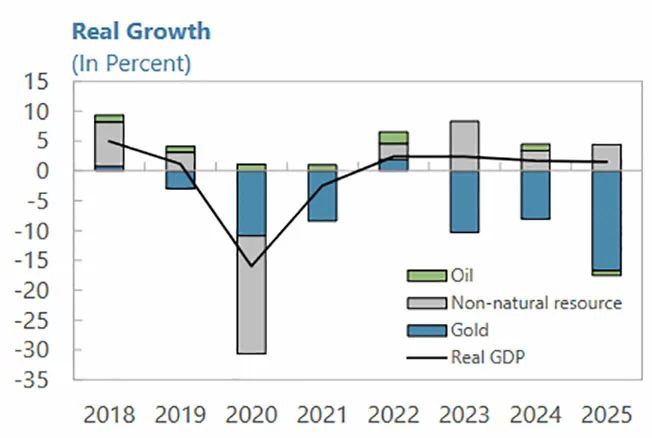
In a newly released country assessment published Wednesday, the International Monetary Fund (IMF) has drawn attention to a key imbalance in Suriname’s evolving economy: while the nation as a whole posted solid expansion in 2025, its historically critical gold sector has failed to meet performance projections, held back by systemic challenges including rampant illegal smuggling and weaker-than-expected output.
The IMF’s analysis confirms that Suriname’s 2025 economic growth was driven almost entirely by segments outside the extractive mining industry. Non-commodity sectors, in particular, delivered robust expansion, clocking in at an estimated 4.4% year-over-year growth. This positive momentum from non-resource industries stands in sharp contrast to the gold sector, where production shortfalls and unrecorded outflow of gold revenues into the informal, unregulated economy have dragged down its overall contribution to national gross domestic product.
For decades, the gold sector has occupied a central role in Suriname’s economic framework, serving as the country’s top source of export earnings and a key supplier of much-needed foreign exchange. When gold output and formal exports underperform, the ripple effects are immediately felt in public finances and the country’s balance of payments, creating unnecessary volatility that undermines broader economic stability, the IMF noted.
To address these persistent gaps, the IMF emphasizes that targeted, urgent action is required from Suriname’s government. The international financial body calls for increased transparency across all levels of the gold supply chain, more aggressive enforcement to crack down on illegal activity, enhanced monitoring systems to track gold from extraction to export, and targeted investment to strengthen the institutional capacity of state agencies tasked with regulating the sector.
Notwithstanding the gold sector’s disappointing performance, the IMF maintains an overall optimistic outlook for Suriname’s long-term economic trajectory. Upcoming development of the country’s offshore oil industry, paired with continued expansion of the non-resource sectors that drove 2025 growth, is expected to support solid economic expansion in the coming years.
Even so, the IMF issued a critical warning: Suriname must not rely exclusively on future oil revenues to secure its economic future. To deliver sustainable long-term growth and consistent, stable public revenue streams, existing core sectors including gold must be better regulated and managed, the fund stressed.
In its concluding remarks, the IMF reiterated that the performance of the gold sector will remain a decisive factor for Suriname’s economic stability over the next several years, particularly as the country prepares for the launch of full-scale offshore oil production slated to begin in 2028.