New data from Suriname’s 2026 Financial Plan has laid bare the uneven economic recovery the nation is facing following years of crippling inflation, with most worker groups still grappling with falling real purchasing power three years after peak inflationary pressures began. While overall inflation has cooled significantly from the highs seen during recent economic crisis years, the report confirms that the damage to household finances has not been undone for a large share of the working population, especially among senior public sector employees.
Between 2020 and 2025, the average consumer price index in Suriname skyrocketed from 189.7 to 885.5, translating to a cumulative inflation rate of 366.8% over the five-year period. For 2026, the government projects that inflation will stabilize around 9.2%, with annual rates settling between 6% and 8% provided global oil prices and the domestic currency’s exchange rate hold steady. Despite this cooling of price growth, an analysis of wage trends included in the plan shows that most workers have not seen real gains in their incomes compared to 2022 levels.
Only a handful of sectors have outpaced inflation to deliver actual purchasing power growth over the period. The wholesale and retail trade sector, plus the information and communications industry, recorded positive real wage growth, with information and communications workers seeing their purchasing power jump by as much as 23% since 2022. In sharp contrast, sectors including transportation, hospitality, restaurants, and recreation have experienced severe purchasing power declines, with real labor values falling by roughly 31% in these industries.
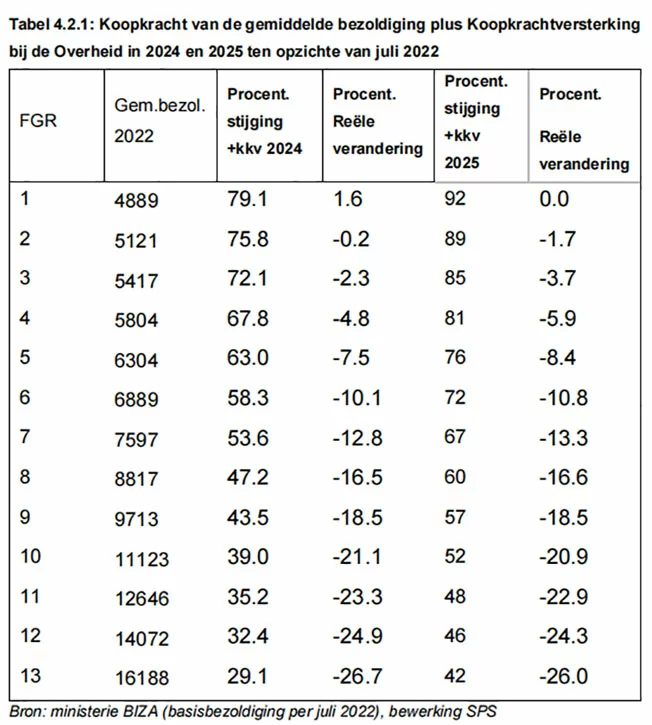
The public sector paints an equally mixed picture of recovery. Government calculations confirm that just one pay tier – entry-level Function Group 1 – has seen a small real improvement, recording a 1.6% purchasing power gain compared to July 2022. All other 12 public sector function groups, from 2 through 13, have seen real purchasing power fall even after accounting for scheduled salary adjustments and ad-hoc support measures, a trend that continues into 2025. Senior public employees in higher function groups have lost between 13% and 26% of their 2022 purchasing power, according to the analysis.
The ongoing erosion of the Surinamese dollar’s value has compounded these strains on household budgets. In 2022, one Surinamese dollar (SRD) held an average purchasing power value of 84 cents relative to the currency’s value at the start of that year. By 2025, that value had fallen to just 43 cents, meaning the same nominal amount of money buys nearly 50% less than it did just three years ago.
The only bright spot in the report is the trend for minimum wage earners. The hourly minimum wage rose sharply from SRD 20 in 2022 to SRD 52.47 in 2025, which translated to a real improvement in purchasing power for this group. Adjusted for inflation, the 2025 hourly minimum wage holds a value of roughly SRD 22.56, up from SRD 16.80 in 2022, marking a modest but tangible real gain for workers at the bottom of the income distribution.
Going forward, the 2026 Financial Plan forecasts that lower inflation in 2025 and 2026 will support gradual further recovery in purchasing power across the country. At the same time, the official data makes clear that the lasting damage of the high inflation that hit Suriname over the past three years remains far from fully resolved for most of the population.