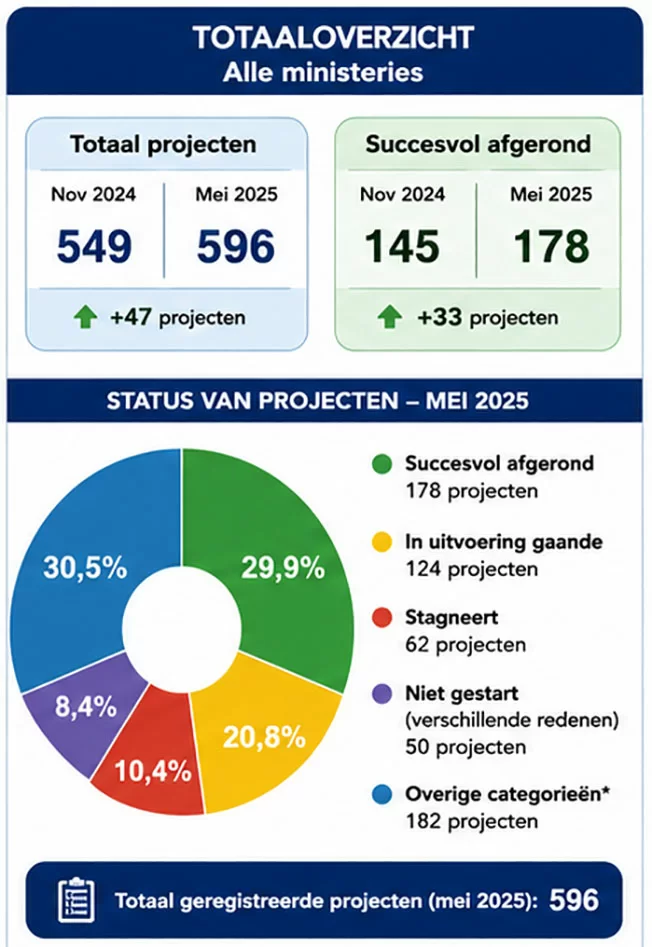
New data published in Suriname’s 2026 Financial Year Plan reveals a noticeable uptick in the number of successfully completed national development projects over the six-month period between November 2024 and May 2025, even as widespread implementation delays and structural bottlenecks continue to hold back progress toward key national development targets.
According to statistics compiled by the Planning Office of Suriname, the total number of registered development projects across all government ministries grew from 549 to 596 over the reporting period. Over the same six months, the count of fully completed, successful projects rose 22.7% from 145 to 178.
A breakdown of performance across government departments shows uneven progress, with two ministries leading in completed outputs. The Ministry of Finance and Planning tops the ranking with 38 successfully finalized projects, followed closely by the Ministry of Labor, Employment and Youth Affairs, which has wrapped up 36 projects. Two other departments have posted particularly strong gains in project completion: the Ministry of Regional Development and Sport more than doubled its completed projects from 8 to 19, while the Ministry of Agriculture, Livestock and Fisheries saw its completed count rise from 4 to 9. The Ministry of Education, Science and Culture also recorded improvement, growing its number of finished projects from 2 to 6.
Despite these incremental gains, the report makes clear that slow and uneven implementation remains a major policy challenge for the Surinamese government. As of May 2025, 124 registered projects were still active in implementation, 62 were classified as stagnant with no meaningful progress, and dozens more have not even broken ground. The report attributes these delays to a range of persistent obstacles, including unresolved financing gaps, hold-ups in pre-construction preparation, and shortages of specialized technical expertise required to advance projects.
In the 2026 Financial Year Plan document, the national government openly acknowledges that overall project implementation is falling short of official expectations. It identifies three core systemic challenges that are slowing progress: insufficient on-the-ground implementation capacity, inadequate monitoring frameworks to track project performance, and persistent bottlenecks in early-stage project planning.
The plan emphasizes that accelerating development project delivery is a non-negotiable priority if Suriname is to deliver on its core policy goals: driving broad-based economic growth, reducing widespread poverty, and raising the quality of public services for all citizens. Without meaningful reforms to speed up and improve implementation, the document warns, many of the country’s most important development targets face significant delays that could impact communities across the nation for years to come.