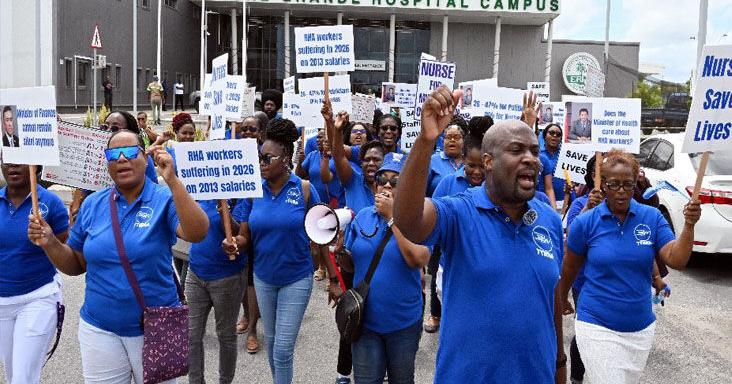
It has been just 12 months since the United National Congress (UNC) swept to power in the April 28, 2025 general election of Trinidad and Tobago, but a wave of public discontent has already swept across the nation. Multiple civil society and advocacy groups have taken to the streets and issued public challenges to a range of the new administration’s governance policies, with grievances spanning from lack of police accountability and unresolved labor disputes to persistent public transportation failures and controversial state of emergency (SoE) regulations.
Political analyst and trade unionist Dr. Indira Rampersad, who also serves on the management committee of the West Indies Group of University Teachers (WIGUT) and practices as an attorney, broke down the roots of this unrest in an interview with the *Sunday Express* this week. She explained that public expectations for the UNC-led government are inherently far higher than those placed on the long-governing People’s National Movement (PNM), the party that has held power for the vast majority of Trinidad and Tobago’s post-independence history.
“Voters hold UNC administrations to a much higher bar than PNM governments,” Rampersad noted. “The public comes in expecting progress on long-stalled salary negotiations, improved worker benefits and working conditions, upgraded public infrastructure, and more responsive delivery of critical public goods and services.”
Rampersad traced this gap in expectations to the PNM’s decades of incumbency, which had fostered a widespread sense of political complacency among the public over time. Previous changes in government in 1995 and 2010, followed by returns to PNM rule, meant that the 2025 UNC victory carried unprecedented weight: voters saw it as a rare opportunity for systemic change, and poured all their unmet demands from years of PNM governance into the new administration.
As a trade unionist, Rampersad pointed out that public protest was far less common during the PNM’s most recent term, even though workers went nearly a decade without salary increases starting in 2014. “Our union protested repeatedly because the PNM administration refused to negotiate fair settlements, but widespread national protests never gained traction,” she said. She acknowledged that the current UNC government has already moved to address many of these long-simmering issues, a point Prime Minister Kamla Persad-Bissessar highlighted in a recent parliamentary address last Friday. The PNM’s longstanding apathy toward public grievances, she argued, has created a different standard by which the UNC is judged.
“Expectations are not just higher – the public is demanding immediate, fast results,” Rampersad added. “The timeline people have set for these changes is very compressed, and in many cases, simply unrealistic, given the scale of the problems the UNC inherited.”
Not all protests reflect broad national discontent, Rampersad stressed. High-profile demonstrations calling for justice for Joshua Samaroo and Kaia Sealy, for example, are driven by a small, dedicated group rather than widespread public anger. She also emphasized that many citizens lack awareness of legal processes surrounding active court cases: the matters are currently under review by the Director of Public Prosecutions and the judiciary, and police operate as an independent branch of government, meaning the executive branch cannot intervene to direct police actions. Rampersad called for greater public education on the principle of sub judice, noting that uninformed public commentary can create prejudicial publicity that risks undermining the integrity of ongoing judicial proceedings.
Turning to objections to the current state of emergency regulations, Rampersad argued that critics must contextualize the measures within their original purpose: preventing violent unrest at key state institutions including Parliament. Far from targeting opposition voices, the regulations protect all elected officials, regardless of party affiliation, who use these public spaces. She also clarified that the SoE does not ban peaceful protest entirely – demonstrations are still permitted in unrestricted zones, as long as organizers follow legal protocols to obtain permission.
Rampersad pushed back forcefully against opposition claims that Trinidad and Tobago is sliding into a police state. If the country were a police state, she argued, violent crime would not remain one of the nation’s most pressing unresolved problems. “This is a plural democracy, and people retain full rights to express their views freely,” she said. “No one is suppressing the right to protest.”
She also pointed to a major recent diplomatic win to counter claims of widespread government unpopularity: Trinidad and Tobago recently secured a seat on the United Nations Security Council, winning 181 out of 190 total global votes – a resounding show of international confidence that would not have been possible if the nation’s government lacked broad domestic and global credibility. “A small handful of protests do not automatically mean the government is unpopular,” she concluded, reaffirming that peaceful, lawful protest remains a protected right in the country’s functioning democracy.