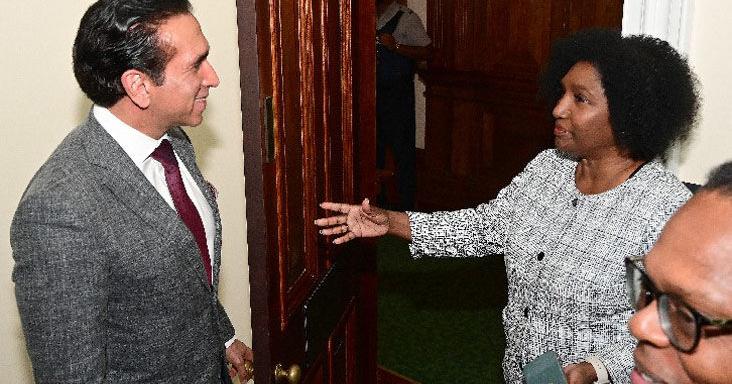
As Trinidad and Tobago’s parliament weighs the future of its active state of emergency (SoE) deployed to curb rising violent crime, lawmakers from across the political spectrum have clashed over the legality, necessity and long-term implications of extending the extraordinary measure. Speaking to reporters outside the parliamentary complex on Friday, independent senator Anthony Vieira laid out a clear challenge to the ruling administration, arguing that the government now carries the legal and political burden of proof to justify another extension of the emergency order.
Vieira emphasized that past appeals to widespread public anxiety over crime are no longer sufficient to win approval. “They can no longer simply say the country has serious crime,” he noted, calling on officials to release concrete crime data, demonstrate tangible progress from the current SoE, and outline a clear rationale for why the extraordinary step remains necessary. Under the country’s constitution, Vieira stressed, fundamental civil rights and liberties are meant to be the default governing arrangement, with emergency powers reserved only for rare, temporary exceptions that cannot become a permanent fixture of governance. “A state of emergency is the exception,” he reiterated.
His independent caucus colleague, Senator Dr. Marlene Attzs, said she fully expects the government to move forward with an extension request, pointing out that the existing SoE has so far failed to deliver meaningful reductions in crime, despite its original mandate to address public safety failures and widespread public disquiet over violence. Attzs added that it remains unclear if the administration could pursue an alternative policy path if the extension is blocked, but framed crime and emergency governance as an unavoidable priority for the national legislature. She also noted that Trinidad and Tobago’s recent seating on the United Nations Security Council adds an extra layer of global attention to the country’s domestic security policy, as security governance will be a key topic of the nation’s work during its UNSC term.
The debate over the SoE’s legality has drawn new energy from a recent landmark ruling from Jamaica, where courts struck down repeated use of targeted local states of emergency as unlawful. Political scientist Dr. Hamid Ghany drew a clear distinction between the two Caribbean nations’ constitutional frameworks to guide the current debate. In Jamaica, Ghany explained, repeated 14-day emergency proclamations were issued without the required parliamentary supermajority approval, violating core separation of powers principles. That set of circumstances, he argued, is not directly analogous to Trinidad and Tobago’s system.
Under Trinidad and Tobago’s constitution, the President can issue an initial 15-day state of emergency without prior parliamentary approval, and any subsequent extensions only require a simple majority vote rather than a two-thirds supermajority. Extensions are capped at three months per vote and a total of six months cumulative, creating a formal parliamentary oversight structure that was absent in the Jamaican case. As a result, Ghany concluded, the separation of powers challenge that succeeded in Jamaica would not carry the same legal weight in Trinidad and Tobago.
Opposition Senator Faris Al-Rawi acknowledged that Ghany’s distinction between the two legal frameworks is factually correct, but argued that the core constitutional question of whether an SoE can legitimately be used for routine crime fighting still needs to be tested in the courts. Al-Rawi pointed out that the constitution explicitly frames states of emergency as responses to extraordinary events such as natural disasters, earthquakes, floods and pestilence, not as a tool for ongoing law enforcement. “I certainly do not think that anti-crime measures, policing is what you use a state of emergency for,” Al-Rawi said, adding that the constitutional interpretation of emergency powers remains open for judicial review.