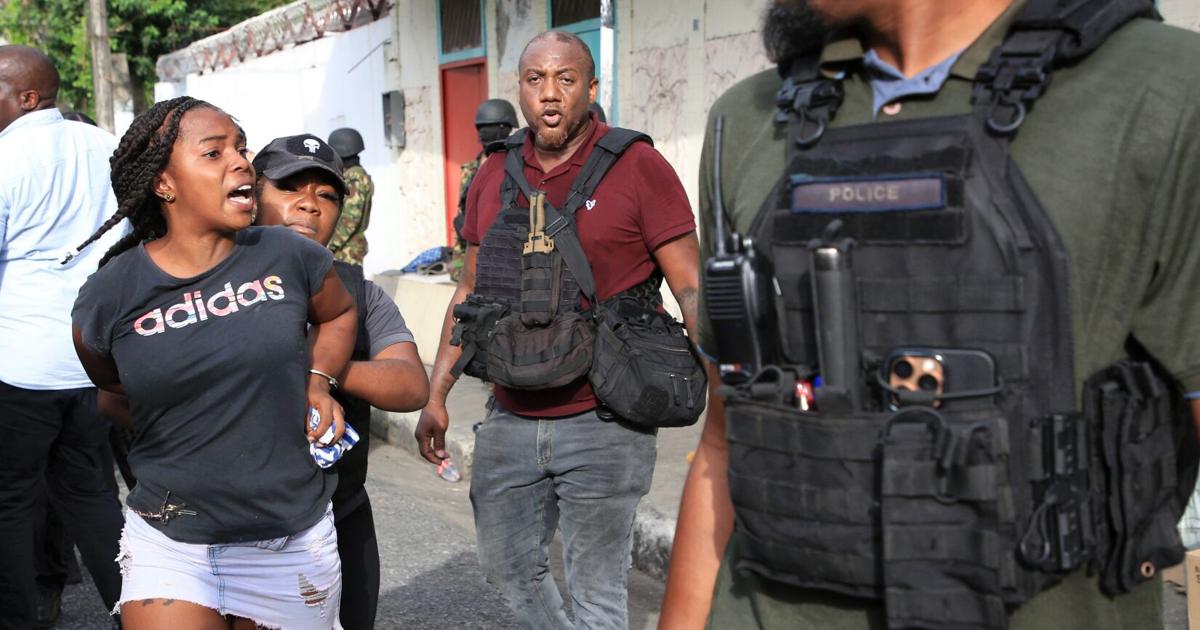
On a recent afternoon in Port of Spain, a grassroots initiative to confront rising gang violence ended in police confrontation and multiple arrests, highlighting a tense clash between community activism and public order regulations under a state of emergency.
Organized by the local group Peace Foundation TT, the peace walk was conceived as a response to a surge in brutal gang-related killings, including the recent deaths of two children in separate incidents in Belmont and Morvant. Fed up with ongoing bloodshed across Trinidad and Tobago’s communities, organizers called on residents to gather on Piccadilly Street dressed in white, to march through nearby neighborhoods and call for cross-community unity and an end to violent crime. The event was scheduled to kick off at 3 p.m., but law enforcement had advance notice and moved quickly to deploy a large contingent of uniformed police officers, supported by Defence Force soldiers, to the area ahead of the start time.
The Trinidad and Tobago Police Service (TTPS) confirmed after the incident that no formal application for the public gathering had been submitted, a requirement under the country’s current state of emergency regulations. Senior Superintendent Raymond Thom explained to reporters that without an approved application, authorities had no way to assess the size of the crowd, the scope of the march route, or the intentions of participants, making it necessary to divert resources to manage the unauthorised assembly. Thom stressed that law enforcement fully supports the goal of ending gang violence and building community peace, but noted that the unpermitted status of the event forced officers to redirect time and personnel away from existing anti-crime operations to respond. “We have to prepare to protect the public. We have no idea about the magnitude, or how large the crowd would be, the number of persons that will be gathering and exactly what is the intent,” Thom said, rejecting claims that the large police deployment was an excessive overreaction.
As participants began to assemble, officers moved through the crowd ordering attendees to disperse and return to their homes. The heavy police presence kept many prospective participants away, according to organising team member Lynelle Gaskin. She told reporters shortly after 3 p.m. that many people who had planned to attend had opted to stay away after seeing the large law enforcement deployment. “I feel it is just how the officers are around that they are not coming around as yet,” Gaskin said, adding that she remained hopeful more people would join the event. She emphasized that community residents are exhausted by constant violence and are eager to build unity and connection between neighbourhoods long divided by gang rivalry.
Despite the police order to disperse, a large group of around 200 participants did proceed with a truncated march, walking through the Mango Rose, Duncan Street, and St Paul Street communities before returning to the original gathering point on Piccadilly Street, where they were again ordered to leave by officers. One of the event’s lead organisers, Kendal Lewis, called the walk a partial success, saying “We got about 60% of what we wanted to get done.”
The confrontation turned heated when an argument broke out between police and one woman who had attempted to join the gathering. The woman was heard telling officers she was only searching for her sister, repeating, “I am not rioting,” as bystanders called on officers to leave her alone. Two female officers pinned the woman against a nearby parked car before handcuffing and arresting her. As of yesterday evening, police had not announced whether the woman would face formal charges. In addition to her arrest, two men who were standing near the assembly area were taken into custody on suspicion of robbery, police confirmed to reporters.
Among the participants was prominent local activist and businessman Fuad Abu Bakr, who said he saw a promotional flyer for the event and chose to attend because he fully supported the mission. “I believe in it 110%. I thought it was essential for me as a citizen, as someone who is very familiar with this community as well, to come and try to be a part of an initiative as such. That is what this is supposed to be about,” he said, noting that despite the standoff, officers had behaved respectfully toward participants.
Homeland Security Minister Roger Alexander, who attended the event to speak with community members, defended the police response, rejecting claims that the deployment of officers and soldiers was excessive. He emphasized that the government shares the community’s frustration with unregulated gang violence and the loss of innocent lives, including children. “We, as a Government, we’re not interested in gangs and having no conversation about gangs. I am willing to have a conversation with law-abiding citizens who have seen enough bloodshed and the lives lost of people, both old and young, including of children, on the nation’s streets to crime and violence that has no meaningful meaning at all,” Alexander said. He added that if organizers follow the formal process to register future events, the government is open to sitting down with law-abiding activists to discuss actionable changes to reduce violence across the country.
The confrontation comes as Trinidad and Tobago continues to grapple with persistently high rates of gang-related homicide, prompting widespread public calls for both government action and grassroots community intervention to curb bloodshed.