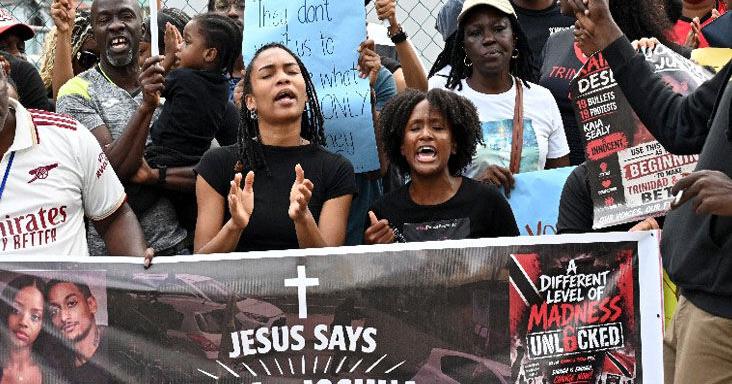
In the months after a January police-involved shooting left one person dead and another critically injured, a 24-year-old small business owner named Alyssa Phillip has emerged as the most high-profile voice demanding justice for her injured friend Kaia Sealy. As calls for accountability grow, and government moves to restrict demonstrations have sparked accusations of intimidation, a close friend and fellow activist has opened up about who Phillip really is, and what drives the ongoing protest movement.
The *Sunday Express* reached out to Phillip multiple times to request an in-person interview about her background and motivations, but she declined, prioritizing organizing actions in support of Sealy. Instead, the outlet spoke with Mariah Walcott, another leading figure in the pro-Sealy movement, who has stood alongside Phillip since the first demonstration was organized.
Walcott, Phillip, and Sealy have been tied together by a friendship spanning more than 13 years. All three 24-year-olds attended Bishop Anstey High School in Port of Spain together, and have stayed close through graduation, career building, and starting their own families.
According to Walcott, Phillip is the head of a family-owned baking business that delivers pastries across the twin-island nation of Trinidad and Tobago. The company was originally founded and run by Phillip’s father when the three were still in high school, but he handed full control over to Phillip after she graduated. Leveraging her formal education and natural business acumen, Phillip has grown the enterprise significantly, a feat that requires her to wake as early as 4 a.m. each day to prep orders and make deliveries across the country. Even with this demanding full-time role, she still carves out time to lead protests against what the group views as systemic injustice in the country.
Walcott says neither she nor Phillip see themselves as formal public activists. “We are simply people trying to do the right thing,” she explained, emphasizing that the group refuses to be silenced despite mounting pressure. She argues that the recent introduction of restricted “no-protest zones” near key government institutions, combined with Phillip’s recent arrest, are deliberate intimidation tactics designed to crush public dissent and discourage further demonstration.
Phillip was arrested on charges related to the protests, granted bail this past Wednesday – but even after her release, the movement has continued, with Walcott stepping in to lead actions when Phillip was detained. When Phillip was taken into custody, Walcott guided a march from the Office of the Director of Public Prosecutions to Port of Spain’s Woodford Square, where she told gathered supporters that attempts to muffle the movement had already failed.
Walcott recalled how the protests first came together in the days after the shooting. She was at work when she got the news that Sealy had been shot, and Sealy’s common-law husband Joshua Samaroo had been killed by police. She left work immediately to go to the hospital, but was denied access to Sealy, and no hospital or law enforcement officials would answer her questions about what had happened. That night, she called Phillip, and the pair grieved together over the phone.
A few days later, after security footage of the shooting was released to the public, Phillip reached back out to Walcott to float the idea of organizing a public demonstration. “What do you think about making some signs and getting people together to protest?” Phillip asked, and Walcott said she never hesitated to agree.
Walcott describes the longstanding dynamic of the three friends: she herself is the most outspoken of the group, Phillip is a natural, energetic “firecracker,” and Sealy has always been the calm, soft-spoken, reserved member of the trio. “That’s why seeing what happened to her has been so heartbreaking,” Walcott said.
Raised in poverty, Walcott said she has always cared deeply about fighting for better outcomes for marginalized people in her community, and her longstanding bond with Sealy made joining the protest an obvious choice. “There were times growing up when I had nowhere to go. I could always knock on Kaia’s door and I would have somewhere to sleep and something to eat. Her family became a second family to me,” she explained. The pair even experienced pregnancy around the same time, building their young families alongside one another.
Walcott acknowledged that she has received threats for her role in the movement, but she said the intimidation has not deterred her. While she is more cautious out of concern for her two young children and her public sector job, she remains committed to continuing the campaign, even with new restrictions on public gathering. “If I don’t speak up, what example am I setting for my children and the children to come?” she asked.
Sealy, who is currently facing eight charges including manslaughter and has active warrants out for her arrest, has been overwhelmed and humbled by the public support she has received, Walcott said. Sealy has never lost her religious faith through the ordeal, and constantly expresses gratitude to everyone who has sacrificed their time and energy to stand with her.
Walcott also emphasized how deeply she owes her own support to Phillip, who stepped up to help her when she was laid off from her job and struggling financially. When Walcott called Phillip distraught about her unemployment, Phillip offered her a job immediately, inviting her to come work alongside her baking and selling pastries across Port of Spain. “We are like sisters,” Walcott said of her bond with both Phillip and Sealy.
When asked if she is related to famed Trinidadian Nobel laureate Sir Derek Walcott, Mariah Walcott laughed and said she does not know for sure, but the connection would make sense: she has loved literature, poetry, writing, and music her entire life.