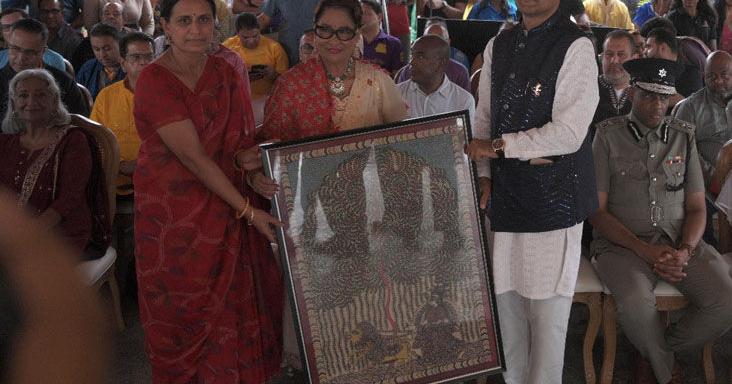
On the 181st anniversary of the first arrival of East Indian indentured laborers to Trinidad, Prime Minister Kamla Persad-Bissessar led national commemorations that blended historical reflection, personal heritage, and a celebration of Trinidad and Tobago’s multi-ethnic national identity.
The day’s events kicked off with a vivid historical re-enactment at Penal’s Heritage Dam, where Persad-Bissessar stepped aboard a full-scale replica of the *Fatel Razack* – the sailing vessel that carried the first group of indentured workers to Trinidad and Tobago on May 30, 1845, marking the start of 72 years of Indian indentureship in the country. After the landing re-creation, the Prime Minister led a public procession to the Petrotrin grounds, where hundreds of attendees gathered despite rainy weather to mark Indian Arrival Day.
Speaking to the assembled crowd, which included members of the foreign Diplomatic Corps and Trinidad and Tobago Police Commissioner Allister Guevarro, Persad-Bissessar wove the national history of indentureship together with her own family story. A 31-year incumbent representing the Siparia constituency in south Trinidad, where many descendants of indentured workers settled, she recalled her childhood growing up in Penal and shared the journey of her great-grandmother, Sumaria Seepersad, who traveled from Madras, India, to colonial Trinidad in the early 1880s.
For the Prime Minister, Indian Arrival Day is far more than a ceremonial holiday or a page from distant history. It is a living connection to the struggles and resilience of ancestors whose sacrifices shape modern Trinidad and Tobago to this day. “When we re-enact the long walk to departure ports, the boarding of the ships, and the crossing of the kala pani (dark waters), we are symbolically retracing the footsteps of our foreparents from another time, a journey once filled with fear, uncertainty, heartbreak, and sacrifice,” she explained.
Persad-Bissessar pulled back no punches in describing the exploitative, dehumanizing system that brought thousands of Indian villagers to Trinidad. Between 1845 and 1917, an estimated 144,000 indentured workers arrived in the country, recruited through a system she called effectively a form of modern human trafficking. Most were poor residents from Bihar, Uttar Pradesh, and Madras, many lured through deceptive promises into exploitative contracts. After leaving their homes and families forever, they survived dangerous transoceanic voyages only to face systemic discrimination, grueling working conditions on plantations that were barely an improvement over chattel slavery.
Sharing her great-grandmother’s story to illustrate the broader experience of the indentured generation, Persad-Bissessars recalled that 16-year-old Sumaria arrived in Trinidad with only a small traveler’s bundle, speaking no English, only Bhojpuri. Widowed at a young age, she raised her children alone in a small thatched cutya house, walking miles barefoot every day to work on sugar cane and cocoa plantations under the hot tropical sun. “Every morning, before sunrise, she got up and kept going, never realising that she and thousands like her were not merely enduring hardship. Instead, they were laying the foundation for generations they would never live to see,” the Prime Minister said.
Today, Persad-Bissessar said, the descendants of these indentured workers stand as the living fulfillment of the dreams their ancestors carried across the kala pani. She posed a rhetorical question that resonated with the crowd: Could her great-grandmother, who walked the muddy tracks of Penal in poverty and marginalization, ever have imagined that her own great-granddaughter would one day lead the nation as Prime Minister? That descendants of the jahajis (ship travelers), once mocked and excluded, would become leaders and builders of modern, independent Trinidad and Tobago? “That is their triumph, their victory, and the greatness of the jahaji legacy,” she declared.
While honoring the specific contributions of Indian indentured immigrants, the Prime Minister emphasized that their story is an integral part of Trinidad and Tobago’s broader inclusive national story. Descendants of Indian immigrants, she noted, have joined the descendants of African, European, Chinese, and Middle Eastern communities to collectively shape the country’s vibrant culture, unique national identity, and ongoing development, binding all groups together through a shared history of struggle and progress.