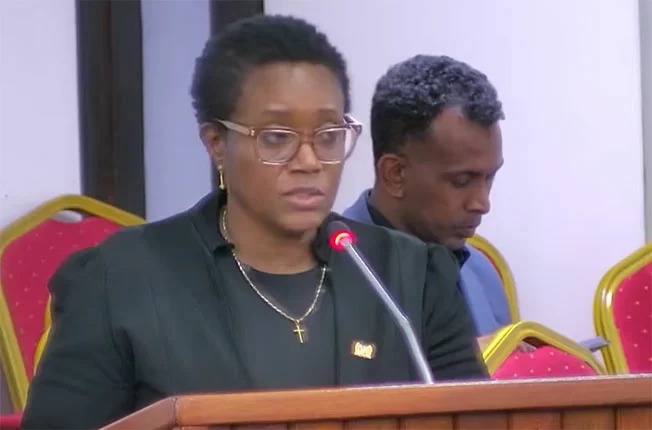
A heated public debate has emerged in Suriname over the scale and purpose of new government borrowing, after top administration officials delivered conflicting figures during parliamentary discussion of the 2024 Accountability Act. Speaking during the debate, Finance and Planning Minister Adelien Wijnerman laid out a full breakdown of national debt accumulated by both the current and preceding administrations, seeking to address mounting criticism over the current government’s rapid borrowing. Wijnerman confirmed that the previous administration took on a total of approximately $2.2 billion in new debt, split across 35 international loan agreements and 28 domestic borrowing arrangements. Since the current government took office, she added, it has raised roughly $1.8 billion through new lending, the vast majority of which comes from two large bond issuances.
Wijnerman pushed back against critics who frame the full $1.8 billion as entirely new net debt, arguing that the vast majority of the funds have been allocated to refinancing existing obligations rather than funding new government spending. Of the total $1.8 billion, she explained, around $1.2 billion has been earmarked for early repayment and replacement of maturing old debts, including the country’s 2033 sovereign bond, obligations under the VRI debt framework, and other expiring loan agreements. The remaining funds are split across three core categories: approximately $186 million allocated to high-priority social development projects, $380.5 million covering interest obligations tied to the new bond structure, and $29.6 million covering administrative costs associated with issuing the new bonds. The social projects receiving funding span key public sectors, including public healthcare, primary and secondary education, youth development and sports programming, agricultural modernization, national digitalization initiatives, and affordable public housing construction. The minister also noted that the total projected interest payments for the two new bonds over their 10-year term will amount to roughly $1.3 billion.
Acting President Gregory Rusland followed Wijnerman’s remarks to address widespread public criticism that the current government has taken on an unsustainable $1.8 billion in new debt in a short period of time. Rusland explained that the current administration inherited a debt schedule that required large principal and interest repayments starting in 2025. Without proactive refinancing, he argued, these mandatory payments would have crowded out core public spending on critical services including education and healthcare, forcing deep cuts that would harm ordinary Surinamese citizens. Echoing Wijnerman, he emphasized that most of the $1.8 billion raised through new borrowing was not directed to new government outlays, but instead went toward retiring old debts. He specifically highlighted a $1 billion debt to investment firm Oppenheimer that was fully repaid using proceeds from the new bonds. Rusland argued that critics focusing solely on the gross $1.8 billion borrowing figure are misrepresenting the government’s fiscal actions, noting that after accounting for debt repayments, only roughly $180 million in net new funds remain available for additional government spending.
However, a notable discrepancy in official calculations has intensified the ongoing debate over the actual growth of Suriname’s national debt. Shortly after Rusland’s remarks, Wijnerman presented a revised net borrowing calculation that put the effective net new debt after debt repayments and refinancing at roughly $596 million, more than three times the $180 million estimate provided by the acting president. This conflicting official data has fueled continued public and political disagreement over how much Suriname’s total debt position has actually increased under the current administration. Government officials have repeatedly defended their fiscal strategy, stressing that most of the new borrowing is part of a planned debt restructuring to ease near-term fiscal pressure and protect core public services. But critics remain concerned about the sheer size of the new bond issuances and the $1.3 billion in future interest payments that the country will be required to make over the coming decade, warning that the new debt could create long-term fiscal strain for the country.
Regering verdedigt lening van US$ 1,8 miljard: groot deel gebruikt voor oude schulden