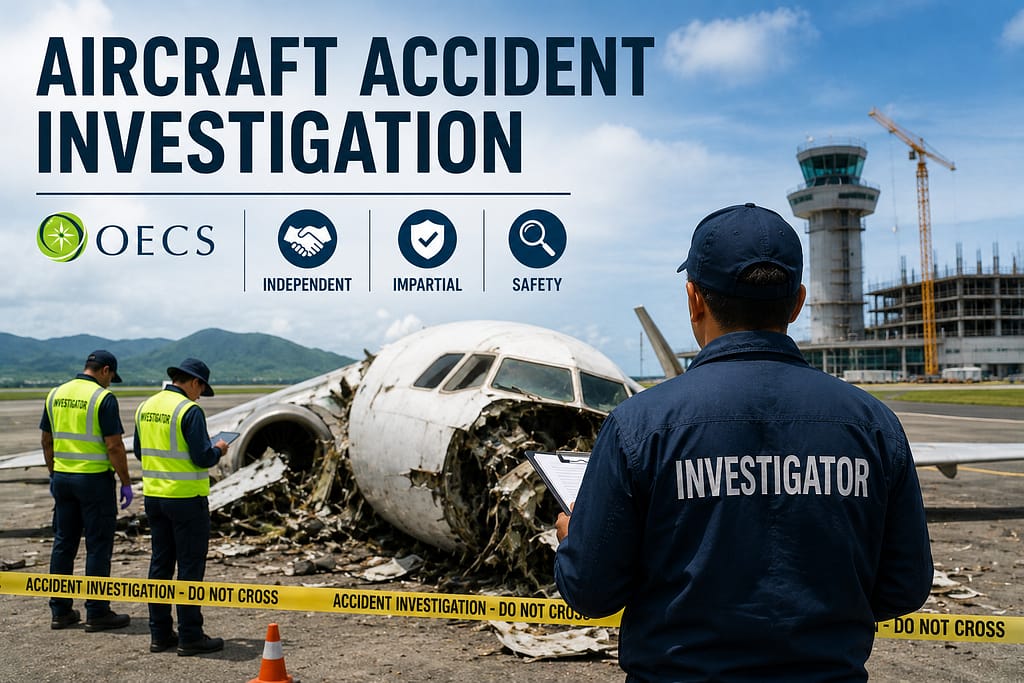
The Organisation of Eastern Caribbean States (OECS) is making significant progress toward launching the Eastern Caribbean’s first independent regional aircraft accident and incident investigation unit, a transformative infrastructure project that aviation leaders say will overhaul regional safety protocols and cut reliance on outside expertise. The development was formally announced by Eastern Caribbean Civil Aviation Authority (ECCAA) Director General Anthony Whittier, who made the disclosure Thursday during the opening ceremony for ECCAA’s newly expanded headquarters at Antigua and Barbuda’s V.C. Bird International Airport.
According to Whittier, the ambitious regional initiative has secured steady backing from the government of France as the ECCAA moves through the final stages of planning and preparation. Unlike existing investigative structures that tie probes to aviation regulators or industry operators, the new unit will operate as a fully independent body, tasked with conducting impartial probes into all aircraft accidents and incidents across participating member states.
To build a skilled, localized investigative team, the ECCAA has already identified qualified investigator candidates from two OECS member states: Dominica and St. Kitts and Nevis. The project has also earned formal backing from the government of Dominica, which has agreed to integrate the unit’s permanent headquarters into the country’s landmark new international airport development currently under construction. The new Dominica airport is on track to open in 2027, and Whittier confirmed the investigation facility will be housed on its campus once completed.
Aviation industry analysts frame the new unit as a pivotal milestone for Eastern Caribbean aviation governance. For decades, the OECS region has depended almost entirely on external assistance to conduct accident investigations, a gap that delayed response times and created barriers to aligning with global safety standards. The dedicated, regionally based investigative capacity will eliminate that gap, allowing for faster, more context-aware probes that directly support ongoing safety improvements across the bloc.
The investigation unit forms a core pillar of the ECCAA’s broader organizational modernization strategy, which Whittier outlined in detail during his Thursday address. Beyond the new investigative body, the authority is advancing multiple initiatives to upgrade regional aviation: expanding technical training programs for aviation staff, building out robust cybersecurity defenses to protect critical aviation infrastructure, strengthening oversight of aerodrome operations across member states, and coordinating preparations for an upcoming reassessment by the U.S. Federal Aviation Administration (FAA). The reassessment is tied to the region’s ongoing bid to regain FAA Category 1 status, a designation that unlocks expanded commercial air travel access to the United States.
Currently, the ECCAA provides civil aviation safety regulation and oversight for six OECS member states, and has steadily expanded its regional influence in recent years through expanded training partnerships, international collaborative agreements, and the launch of specialized aviation safety initiatives. Whittier emphasized that the creation of the independent investigation unit is more than an infrastructure project: it is a clear demonstration of growing integration and cooperation across the Eastern Caribbean, and a tangible commitment to meeting the strictest international aviation safety standards while protecting passengers and industry stakeholders across the region.