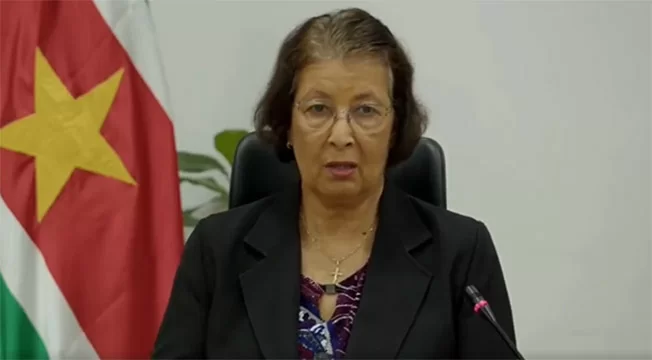
Suriname’s President Jennifer Simons is set to depart on Wednesday for two days of official working visits to Brazil and the Dominican Republic, with a clear agenda centered on expanding economic cooperation, advancing agricultural development, boosting tourism growth, and strengthening regional connectivity. The head of state outlined the key priorities of the trip during a press briefing held on the morning of May 25, noting that the visits are designed to unlock new investment inflows, expand trade access for Surinamese products, and strengthen the country’s key strategic economic sectors.
Simons confirmed that substantive preparations for talks with Brazilian authorities have been underway for months, led by Suriname’s cabinet ministers working in coordination with their Brazilian counterparts. One of the top infrastructure priorities for Suriname is the development of a shorter direct shipping route between the two countries. A more efficient shipping connection would allow cheaper imported goods to reach Suriname faster, while also cutting export costs for Surinamese producers looking to access markets across the Mercosur trade bloc.
Beyond maritime connectivity, the Surinamese delegation will also push for improved air links and deepened agricultural collaboration. A key meeting is scheduled with Brazil’s leading agricultural research agency, Embrapa, to advance cooperation on agricultural development and food security. Suriname is specifically seeking technical support, training programs, and knowledge sharing to modernize its domestic agricultural sector.
A particularly urgent topic on the agricultural agenda is the current cassava disease outbreak that has impacted large swathes of Suriname’s agricultural production. Simons noted that Brazil is actively developing disease-resistant cassava varieties, a solution that Suriname is eager to access. Cassava holds major strategic potential for Suriname, she added, supporting national food security, creating opportunities for domestic agri-processing, and opening new export revenue streams.
Border security and cross-border monitoring also feature prominently on Brazil’s meeting agenda. Suriname aims to expand joint security cooperation, including enhanced cross-border region monitoring and increased information sharing to address transnational illicit activities. Talks will also cover developments in the aviation sector, including potential Brazilian support for Suriname’s national carrier, the Surinaamse Luchtvaart Maatschappij (SLM).
In a key announcement, Simons confirmed that representatives from Suriname’s private sector will be included in the official delegation. She emphasized that meaningful progress on trade and investment requires joint action from both the public and private sectors, with business leaders on the ground to capitalize on new opportunities as they emerge.
Following the visit to Brazil, Simons will travel to the Dominican Republic, where talks will focus primarily on tourism development and agro-economic partnership. The Dominican Republic has built one of the Caribbean’s most robust and successful tourism sectors, and has already expressed clear interest in deepening bilateral cooperation with Suriname.
Suriname’s government is keen to explore interest from Dominican investors in developing new tourism projects across Suriname. Simons noted that Suriname offers a distinct tourism product compared to more traditional Caribbean vacation destinations, creating natural opportunities for complementary partnership that benefits both nations.
In the agricultural sphere, Suriname aims to leverage regional cooperation to open new export markets for its domestic agricultural goods. Simons stressed that foreign direct investment is a critical requirement to unlock the full growth potential of Suriname’s tourism sector, which remains underdeveloped relative to the country’s natural assets.
Multiple memorandums of understanding and cooperation agreements are currently in preparation to be signed during the two visits. Simons clarified that these are not formal state visits, but results-focused working visits dedicated entirely to advancing economic, social, and strategic bilateral cooperation. The Surinamese head of state is scheduled to return to Paramaribo on June 2.