GEORGETOWN, Guyana – May 22, 2026 – For nearly 60 years after gaining independence from Britain, Guyana has relied on outdated 1956 colonial-era copyright legislation to govern intellectual property rights. Now, amid growing pressure from local creators, innovators, and international stakeholders, President Irfaan Ali has announced that broad public consultations on updating the country’s IP framework will launch in the near term. The announcement comes just one day after the administration identified creative and digital industries as priority growth areas for new public financing, spotlighting the gap between economic development ambitions and outdated legal protections.
Speaking to reporters from Demerara Waves Online News on Friday, Ali confirmed that the government would prioritize stakeholder input to shape the future of copyright regulation in the South American nation. He specifically highlighted a desire to center perspectives from Guyana’s artistic community, and suggested initial discussions could open on social media platforms to expand accessibility. “Maybe, we should move this up on the agenda and start the consultation on that,” Ali stated.
The president’s commitment follows remarks Tuesday from Government Efficiency Minister Zulfikar Ally, who named creative and digital sectors among the key industries that will access financing from the upcoming Guyana Development Bank during an address to the Guyana Manufacturing and Services Association (GMSA) business luncheon. When pressed for details on how the government would address widespread gaps in creative work IP protection, Ally only acknowledged the sector is under active review, offering no concrete timeline or policy details.
Guyana’s failure to modernize intellectual property law stretches back decades. The country has never replaced the 1956 British Copyright Act it inherited at independence in 1966. Previous efforts to pass updated IP legislation in the 2000s collapsed due to lack of political will. While the ruling People’s Progressive Party Civic promised copyright reform as a core 2025 election pledge, no legislative action has been taken to date. The opposition coalition A Partnership for National Unity (APNU) has already tabled a motion calling for a bipartisan select committee to advance reform with a clear legislative timeline, but the National Assembly has yet to take up the proposal.
International pressure for reform has also mounted in recent weeks. During an official visit to Guyana on May 13, 2026, U.S. Under Secretary of State for Economic Affairs Jacob Helberg emphasized that strong intellectual property protections, as a component of private property rights, are critical to unlocking private investment and realizing Guyana’s goal of becoming one of the Western Hemisphere’s most prosperous economies, driven in large part by its emerging oil sector.
“In order to do that, certain conditions have to be met, including the right to private property, including respecting intellectual property, including different kinds of principles of governance that the private sector necessarily needs in order to have the confidence, the predictability, and the certainty to deploy and invest a lot of money. And so we focused on the goal. We agreed on the goal,” Helberg told reporters following meetings with Guyanese leadership.
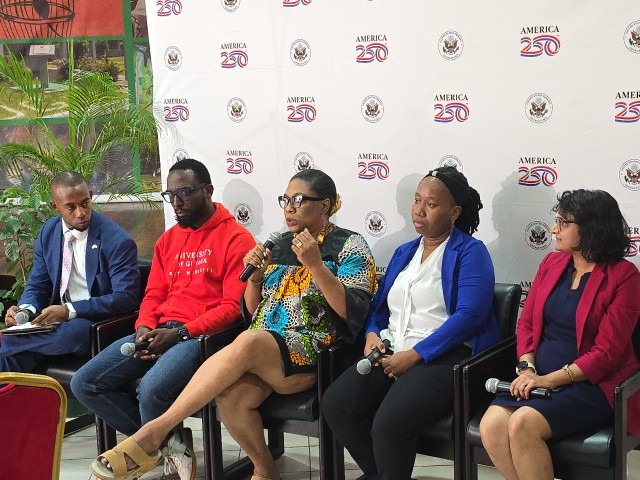
Local innovation leaders have echoed these calls, warning that weak IP protections are stifling homegrown creativity and technological development. Dr. Karen Abrams, founder and executive director of STEM Guyana, outlined the risks of the current legal framework during a U.S. Embassy-hosted panel on STEM education and innovation held at the University of Guyana.
Abrams described Guyana’s current innovation ecosystem as a shallow market constrained by a small population, widespread poverty, and no legal guardrails to protect original literary, artistic, and technological creations. “For innovators, the minute you throw out an innovation, there’s no protection, no IP protection. It’s co-opted by the powerful entities,” she told attendees.
To address gaps in the current system, Abrams proposed the creation of a national science foundation that would provide dedicated research funding for university faculty and students, while establishing clear IP frameworks for publicly supported work. She also advised local innovators to pursue IP protection in foreign jurisdictions in the near term, noting that “there’s not a whole lot of protection for ideas in Guyana but wherever you look overseas, those markets do offer protection for your ideas.”
Beyond legal reform, Abrams emphasized that long-term innovation capacity depends on addressing foundational gaps in Guyana’s education system. She noted that half of Guyana’s children struggle with basic math and literacy, and 50 percent drop out of secondary school by the ninth grade. “You can’t develop an innovative ecosystem if you lose half of your children in a tiny country where you need them to not only develop the oil industry, you need them to be thinking in 2046, what are those industries?” she said.
The opposition’s reform plan, tabled earlier this year by APNU parliamentarian Nima Flue-Bess, mirrors many of these stakeholder priorities. Flue-Bess’s motion calls for a special select committee to audit the existing 1956 copyright law, map gaps in digital rights and enforcement, and hold targeted consultations with creative industry stakeholders to ensure new legislation reflects on-the-ground needs. Under the opposition proposal, a draft updated copyright bill would be submitted to the 65-seat National Assembly for debate within six months of the committee’s work concluding.