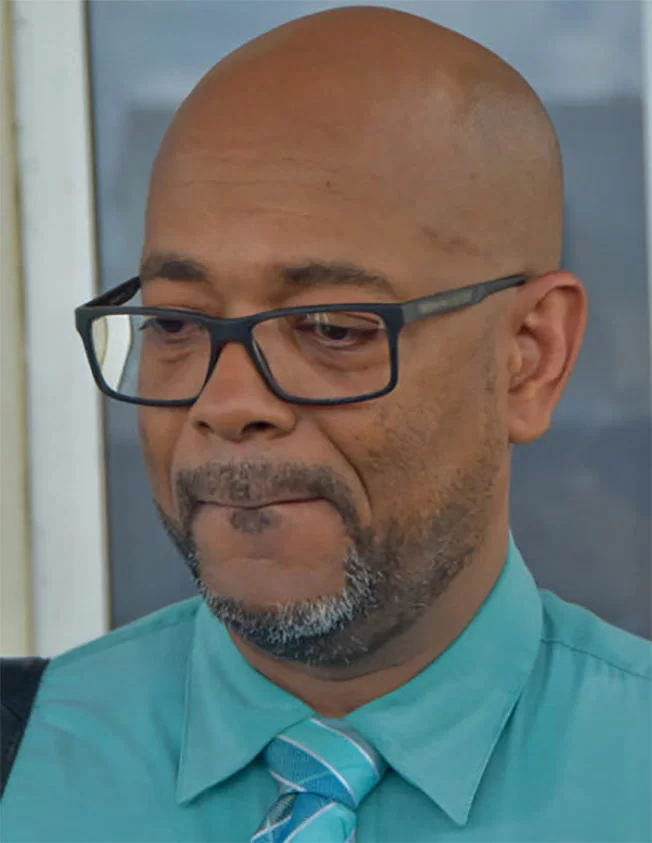
On Thursday, a parliamentary hearing committee in Suriname received a formal defense submission from fugitive former minister Gillmore Hoefdraad, filed in response to an impeachment motion brought by Prosecutor General Garcia Paragsingh. The 60-page defense document and accompanying legal arguments were presented to the committee by Hoefdraad’s legal team, led by attorneys Murwin Dubois and Milton Castelen, who represented the former minister in his absence.
According to Dubois, the legal arrangement allowing Hoefdraad’s defense to proceed without his physical presence is explicitly permitted under Article 8 of the Law on Impeachment for Political and Former Political Officeholders (WIPA). Dubois explained to local outlet Starnieuws that the statute grants sitting and former political officials the right to determine how they exercise their legal defense rights, justifying the team’s representation of Hoefdraad in his absence. This procedural move triggered immediate pushback, however: all members and observers from the opposition VHP party walked out of the hearing in protest. Only VHP committee member Mahinder Jogi remained briefly to pose one question to the defense team before departing, citing urgent prior commitments.
In a written statement included in the defense submission, Hoefdraad pushed back against assertions that his absence shows disrespect for Suriname’s parliament, the country’s highest constitutional body. “My absence cannot under any circumstances be interpreted as a lack of respect for this highest constitutional organ of our republic. On the contrary, it is precisely out of respect for the institutions of the rule of law that I feel obliged to state openly that I politically condemn policy decisions that the Public Prosecution Service (OM) and judiciary have labeled as criminal in a politically charged process,” he wrote.
The former minister made clear he has no confidence that he will receive an objective and impartial hearing from the judiciary that oversees the Public Prosecution Service. Beyond concerns about procedural fairness, Hoefdraad also said he fears for his personal safety and freedom, claiming the OM operates outside legal and ethical constraints. He further argued that Prosecutor General Paragsingh is acting on ad-hoc legislation that lacks any constitutional foundation, and that the proceedings are being carried out on the instructions of the late former president Chan Santokhi.
Hoefdraad’s defense filing goes into granular detail addressing the specific allegations leveled against him by the OM, while also laying out his account of what he calls a systematic political campaign targeted against him. The document is structured in two main sections, one of which dedicates particular attention to the international dimension of the case, after the OM requested assistance from Interpol to locate and extradite Hoefdraad back to Suriname.
Hoefdraad emphasized that Interpol has formally taken the position that his prosecution is politically motivated, riddled with falsehoods, and inconsistent with Interpol’s own governing regulations. To date, every extradition request submitted by the OM through Interpol has been rejected by the international policing body.