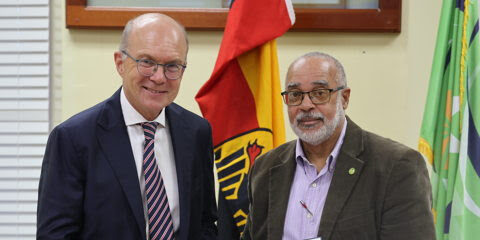
On Tuesday, May 12, a landmark diplomatic ceremony took place as Dr. Didacus Jules, Director General of the Organisation of Eastern Caribbean States (OECS), formally accepted the Letter of Credence from H.E. Dr. Christophe Nicolas Eick, the newly appointed Ambassador of the Federal Republic of Germany to the OECS. The event marked a significant milestone in the more than decade-long formal partnership between the regional bloc and Germany, drawing senior attendees including Karolin Troubetzkoy, members of the international diplomatic corps, OECS Commissioners, and the full OECS Commission leadership team.
In his opening address following the credential presentation, Ambassador Eick emphasized the solid foundation of warm, cooperative relations already established between Germany and the OECS member states, outlining his core priorities for his tenure. “As Germany’s representative to the Organisation of Eastern Caribbean States, I know I can build on long-established friendly relations between Germany and the OECS,” the ambassador stated. “And I’m committed to working closely with the Commission, particularly in areas of priority concern to the organisation and its member states.”
Eick made clear that climate action collaboration would stand as a central pillar of Germany’s engagement with the Caribbean region during his posting. “For climate issues in the Caribbean, I have a keen interest in furthering and strengthening cooperation, particularly relating to the impacts of climate change,” he said. “Germany continues to be a reliable partner in the fight against climate change.”
Responding to the ambassador’s remarks, Dr. Jules extended sincere gratitude for Germany’s unwavering commitment to multilateralism and rules-based international cooperation at a time of shifting global geopolitics. “At a time when some are retreating into narrow nationalism, we continue to deepen integration – through our Economic Union, our shared institutions, our common approaches to education, health, climate resilience, free movement, digital transformation, and regional governance,” Jules observed. “This is why Germany’s engagement with the OECS is both timely and strategically important.”
Jules went on to frame Germany as a critical strategic ally for the small island nations that make up the OECS, citing Berlin’s global leadership in climate diplomacy, environmental innovation, ecological conservation, and equitable sustainable development. “Germany’s global leadership in climate diplomacy, environmental technology, ecological conservation, and green transition positions your country as an especially valuable partner for the OECS,” he added.
The OECS Director General also laid out five key priority areas where the regional bloc is eager to expand collaboration with Germany: environmental management and climate resilience, renewable energy adoption and just energy transition, joint research and innovation partnerships, workforce skills development for green economies, and unlocking new climate finance and strategic partnership opportunities.
Jules also reaffirmed the OECS’s longstanding commitment to forging balanced, constructive diplomatic ties with the global community, while upholding the sovereignty and regional priorities of its member states. “We seek friendship with all nations while preserving our agency, our sovereignty, and our regional priorities,” he said. Addressing growing global geopolitical division, he added: “In an era of geopolitical polarisation, small states must avoid becoming satellites of competing powers. Instead, we must strengthen our strategic partnerships on the basis of mutual respect, shared values, and common interests.”
Closing his remarks, Jules stressed that collective action, rather than individual state effort, is the only path to building sustained resilience in today’s volatile global landscape.
Following the formal credential ceremony, Ambassador Eick and his delegation held a closed-door courtesy meeting with OECS Commission representatives, where the two sides delved into deeper discussions of the bloc’s ongoing regional initiatives and mapped out concrete next steps for future collaboration.
Formal diplomatic relations between the OECS and Germany were first established in 2010, building a partnership that has grown steadily over the past 16 years, particularly around shared priorities of climate action and sustainable development for small island developing states.