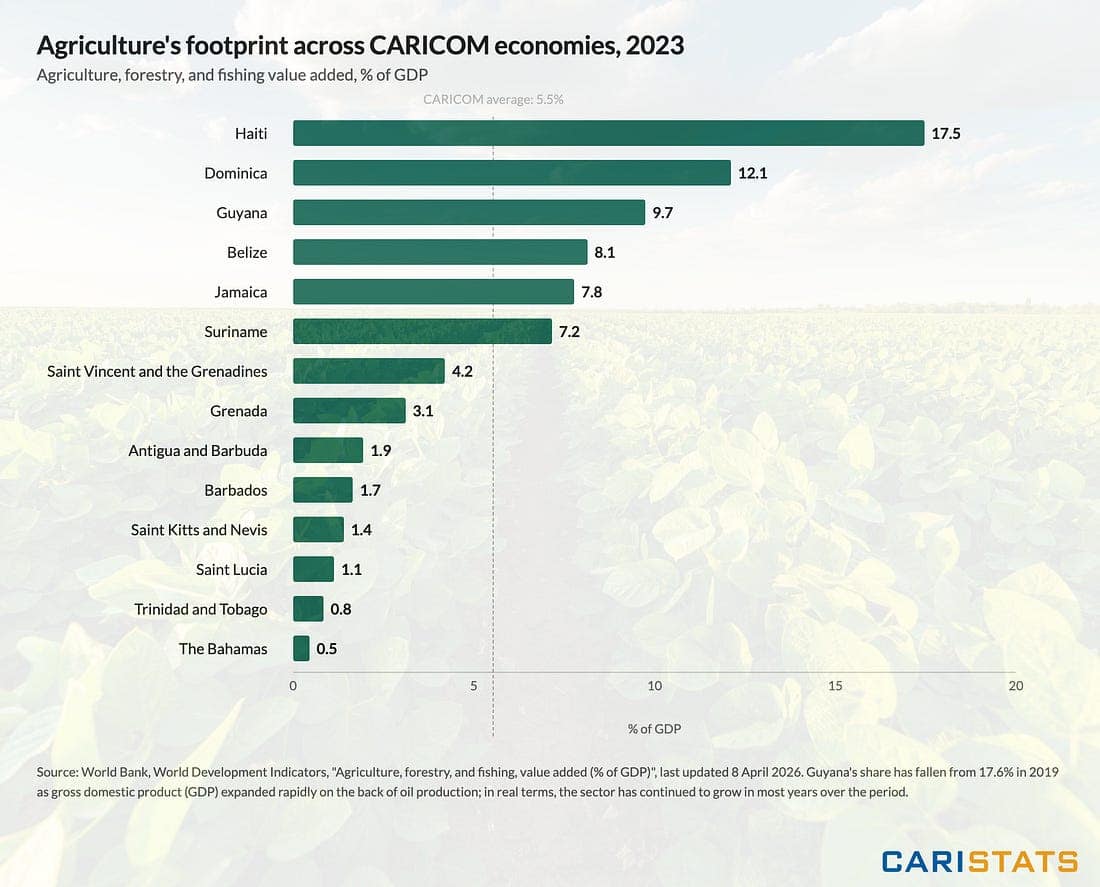
New data from the World Bank’s World Development Indicators, last updated in April 2026, reveals a striking divergence in the contribution of agriculture, forestry, and fishing to gross domestic product across the 15 member states of the Caribbean Community (CARICOM) in 2023. Percentages range from a mere 0.5% to more than 17% of total national output, reflecting the vastly different economic development trajectories and core productive foundations that define each regional economy.
At the upper end of the spectrum, Haiti retains the highest share of any CARICOM member, with the primary sector accounting for 17.5% of its total GDP. It is followed closely by Dominica at 12.1%, Belize at 8.1%, Jamaica at 7.8%, and Suriname at 7.2%. For these nations, agriculture remains a core pillar of economic activity, supporting widespread livelihoods and contributing meaningfully to overall national output.
Guyana offers a particularly illustrative example of economic transformation reshaping the agricultural sector’s share. In 2019, agriculture, forestry, and fishing made up 17.6% of the country’s GDP, but that figure fell to 9.7% by 2023. Crucially, this shift does not stem from a contraction in agricultural output: the sector has recorded consistent expansion in most years over the four-year period. Instead, the drop reflects an unprecedented boom in Guyana’s emerging oil and gas sector, which has driven exponential overall GDP growth and reduced agriculture’s proportional contribution to the national economy.
On the opposite end of the spectrum, a group of CARICOM economies built around service or extractive industries see agriculture contributing less than 2% of total GDP. The Bahamas tops this list at just 0.5%, followed by Trinidad and Tobago at 0.8%, Saint Lucia at 1.1%, Saint Kitts and Nevis at 1.4%, Barbados at 1.7%, and Antigua and Barbuda at 1.9%. These nations’ economic architectures are anchored by other high-value sectors, with tourism, hydrocarbon production, and international financial services driving the bulk of national output instead.
Overall, the data underscores CARICOM’s status as a region of highly diversified economic profiles. The relative weight of agriculture in each member state’s GDP is directly shaped by the scope and composition of their broader productive bases, from resource extraction to tourism and finance.