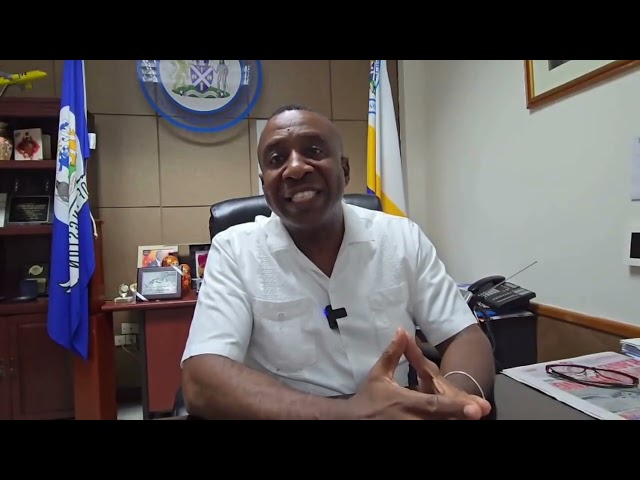
KINGSTON, Jamaica — A sharp public conflict has erupted between Kingston’s top municipal leader and a national government minister over the controversial proposed One Road Authority, with accusations of personal attacks and unaddressed infrastructure funding crises taking center stage.
The dispute began when Kingston Mayor Andrew Swaby publicly raised pressing questions during a May 13 sitting of the Kingston and St Andrew Municipal Corporation (KSAMC). Swaby argued that key details about the new authority remain undisclosed, specifically whether the institutional shift would resolve the chronic underfunding that has left local bodies unable to properly maintain and repair the road networks under their jurisdiction. He doubled down on the claim that local authorities consistently operate without budget allocations large enough to meet their road management mandates.
That criticism drew a swift rebuke this week from Robert Nesta Morgan, the Jamaican minister with oversight for public works. Morgan dismissed Swaby’s comments as contradictory and factually inaccurate, calling for pushback on what he framed as misleading claims from the municipal leadership.
But in his response to Morgan’s public criticism, Swaby has accused the minister of relying on a pattern of personal aggression to deflect legitimate policy scrutiny. The mayor argued that Morgan’s outburst fits a long-standing pattern: whenever a public figure raises constructive criticism of government policy, Morgan responds with personal attacks rather than substantive policy debate. As evidence, Swaby cited a 2023 incident where he claims Morgan attempted to publicly embarrass Opposition Leader Mark Golding after Golding raised concerns about Jamaica’s solid waste management crisis.
At the core of Swaby’s questioning is an urgent demand for clarity: will the newly proposed One Road Authority actually deliver increased financial resources to local authorities like KSAMC, which manages 70 percent of all roads across the Kingston and St Andrew region?
The mayor laid bare the stark scope of the funding gap facing his administration, revealing that KSAMC receives an average of just JMD 85 million per month from parochial revenue funds to cover all road-related work across the parishes. That allocation falls far short of what is needed: individual road repairs in the region cost between JMD 6.5 million and JMD 8 million apiece, meaning the current monthly budget only allows the municipal corporation to repair between 10 and 13 roads — despite there being 40 municipal divisions across Kingston and St Andrew that require constant maintenance.
Complicating the budget crunch further, Swaby explained that the 85 million monthly allocation is not dedicated solely to road work. The funds must also cover hurricane disaster preparedness, public employment programs, and a wide range of other core municipal responsibilities. Even if the entire monthly budget were redirected to road repairs, he added, it would still not meet the overwhelming maintenance needs of the region’s road network. Swaby also noted that KSAMC often carries out unbudgeted repairs on roads formally overseen by the National Works Agency (NWA) in downtown Kingston’s busy commercial districts, stretching the already thin budget even further.
Beyond the One Road Authority debate, Swaby also called attention to the unfair distribution of property tax revenue across Jamaican government bodies. He revealed that local authorities receive only 7.5 percent of all total property tax collections, with the bulk of funds directed instead to the National Solid Waste Management Authority. The mayor closed his remarks with a call for collaborative, substantive policy dialogue, urging Morgan to abandon personal attacks and work alongside elected officials to address the pressing infrastructure needs of Jamaican citizens.
“I’m not satisfied with the state of roads in Kingston and St Andrew and that is the reason why I am speaking up,” Swaby said. “We were both elected to serve in the best interests of Jamaicans. Let us spend our time doing that, other than calling names or describing persons.”