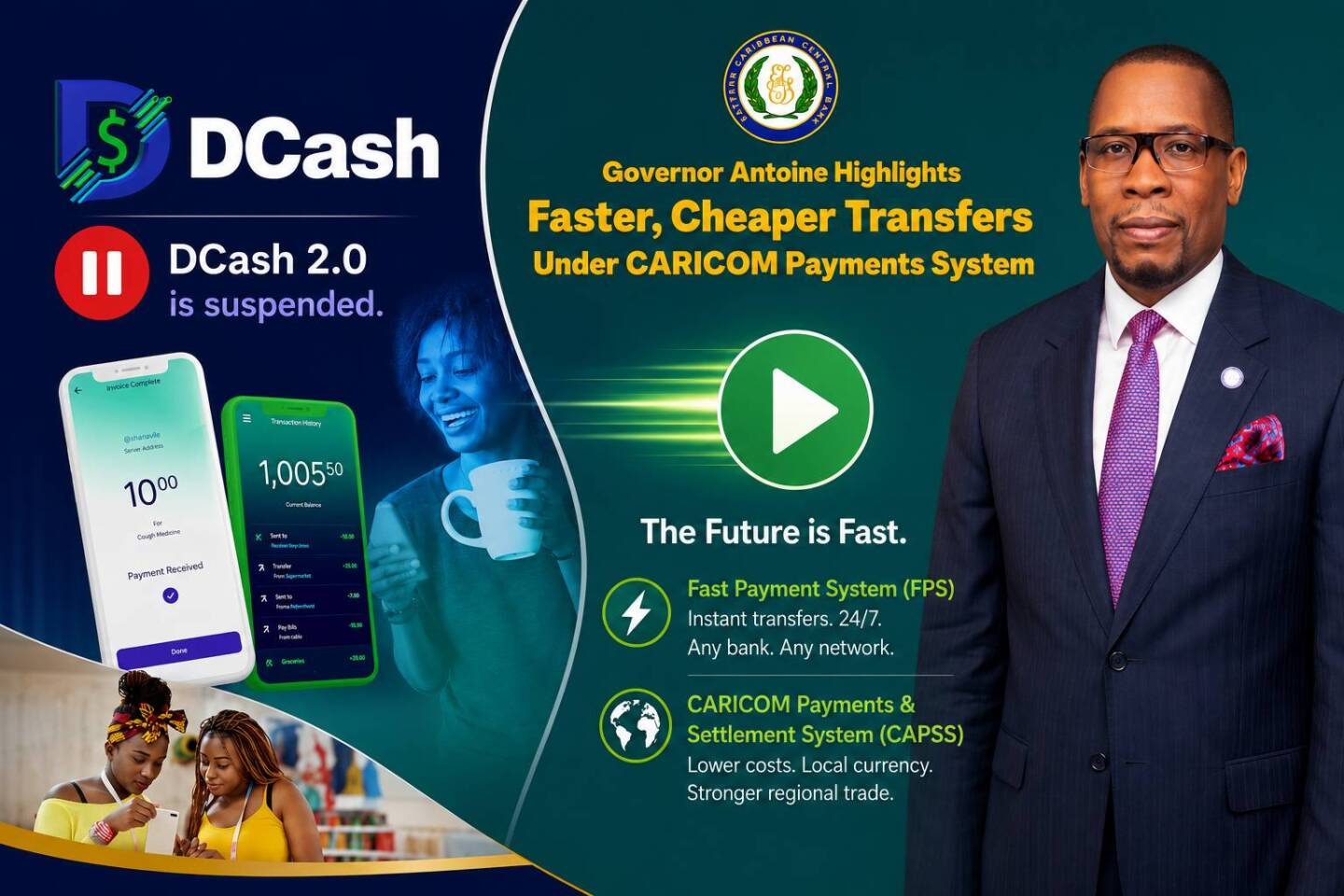
For years, regional leaders and financial experts framed DCash, the Eastern Caribbean Central Bank (ECCB)’s ambitious retail central bank digital currency (CBDC) project, as the inevitable future of finance across the Eastern Caribbean Currency Union (ECCU). Unveiled to the public in 2021, the digital wallet pilot rolled out across four founding nations — Antigua and Barbuda, Grenada, St Kitts and Nevis, and St Lucia — promising to revolutionize everyday transactions, from purchasing local produce at neighborhood markets to settling informal debts between friends. Touted as a cutting-edge leap forward for the region’s financial system, DCash was meant to position the ECCU as a global pioneer in central bank digital currency innovation.
But a quiet, transformative policy shift revealed in the ECCB Monetary Council’s 112th Meeting Communique, published on May 4, 2026, has brought the DCash 2.0 development project to an official end. What appears on the surface to be a major failure of regional digital ambition, however, is actually a pragmatic course correction that could lay stronger groundwork for long-term financial integration and growth across the Caribbean.
The decision to suspend DCash 2.0 is a quiet acknowledgment of a core reality that many fintech innovators overlook in small island economies: consumers prioritize stability and familiarity over technological novelty. Most people do not demand an entirely new currency to manage their daily finances; they simply want their existing money to move more quickly, cheaply, and reliably across accounts and borders. For populations that have long relied on established traditional banking systems to hold their salaries, savings, and essential living funds, trust in familiar infrastructure outweighs the appeal of untested new tools. Even after years of outreach and rollout, DCash never achieved the mass adoption the ECCB had hoped for, in large part because it required users to join a completely separate digital ecosystem disconnected from their existing bank accounts. The friction of learning a new system and splitting financial activity between two separate platforms proved an insurmountable barrier for most everyday users.
Rather than abandoning digital financial innovation entirely, the ECCB has shifted its focus from high-profile retail CBDC experimentation to far more practical, behind-the-scenes infrastructure upgrades. The new top priority is the Fast Payment System (FPS), a framework that improves rather than replaces the region’s existing banking structure. Unlike DCash, the FPS does not require users to adopt a new currency or a standalone digital wallet. Instead, it modernizes the core processing backbone of current banks, enabling instant, 24/7 transfers of existing Eastern Caribbean dollars between any users across the region, using nothing more than a phone number or QR code. No longer will customers have to wait multiple business days for transfers to clear just because they use different banks — a payment from a customer at Republic Bank to a merchant at Grenada Co-operative Bank will settle in seconds, not days.
This shift aligns with broader Open Banking principles designed to boost interoperability between disparate financial institutions across the Eastern Caribbean. Even more consequential for regional trade is the ECCB’s new commitment to the pilot program for the Caricom Payments and Settlement System (CAPSS), a project that aims to resolve one of the most longstanding pain points for Caribbean businesses: the exorbitant cost and friction of cross-border transactions. For decades, regional businesses that pay suppliers in other Caricom nations have been forced to convert their local currency to U.S. dollars first, paying steep conversion fees and high wire transfer charges that eat into already thin profit margins for small island enterprises. CAPSS will create a unified regional settlement layer that allows businesses to pay cross-border suppliers directly in local currency, with participating central banks handling all settlement behind the scenes, eliminating the need for costly intermediate conversions.
ECCB Governor Timothy Antoine has long articulated the goal of “The Big Push,” an ambitious plan to double the size of the ECCU’s total economy by 2035. Viewed through that lens, the pause in DCash 2.0 is no retreat from innovation — it is a strategic refocus that prioritizes tangible utility over flashy, hype-driven fintech optics. The central bank is stepping back from the crypto-adjacent excitement around standalone digital tokens and redirecting resources to the unglamorous but critical work of fixing the region’s fragmented, inefficient cross-border and inter-bank infrastructure.
In the global finance space, the most impactful, lasting changes are rarely the flashy consumer-facing apps that draw headlines. The most transformative improvements are the upgrades to the hidden “plumbing” of the financial system that make every transaction faster, cheaper, and more reliable for businesses and consumers alike. For the Eastern Caribbean, that hidden plumbing just got a much-needed overhaul.