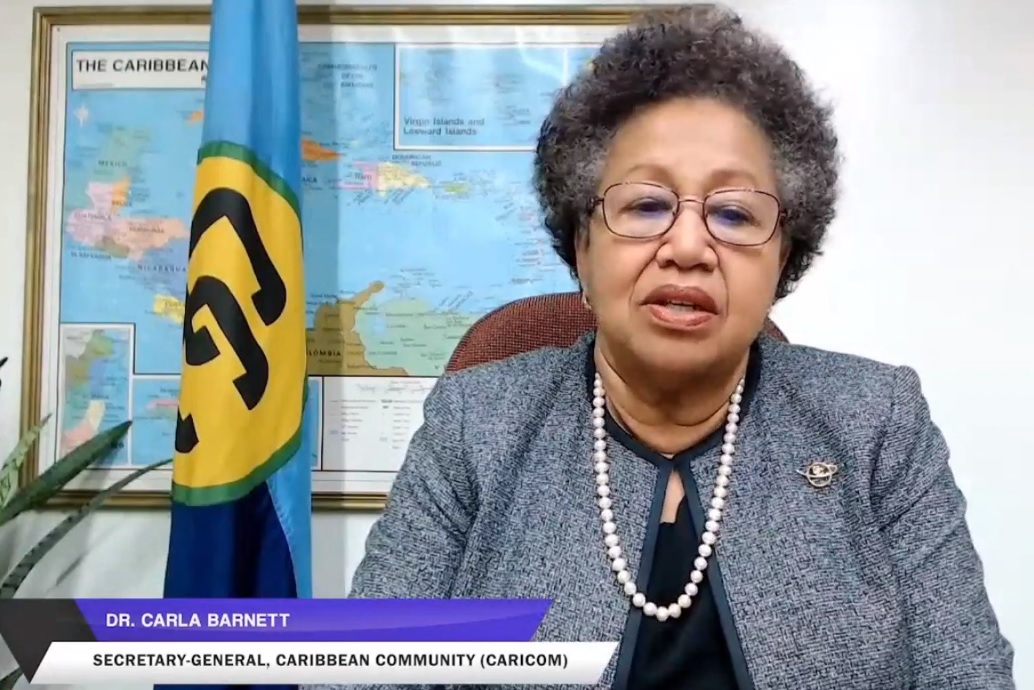
PORT OF SPAIN, Trinidad – May 13, 2026 – A deep rift has opened within the Caribbean Community (CARICOM) after Prime Minister Kamla Persad-Bissessar of Trinidad and Tobago drew a hard line in public, confirming her nation will refuse to recognize Dr. Carla Barnett’s second five-year term as Secretary-General when her first term expires this coming August.
Persad-Bissessar made the position unequivocal in an interview with the Trinidad Express, emphasizing that the stance is non-negotiable regardless of backing from other regional member states. “Trinidad and Tobago only recognises Barnett as SG until the end of her term this August 2026. All CARICOM leaders could do as they please, but Trinidad and Tobago will not recognise her as SG for a next term. That’s not going to change,” she said, adding that “this is our final position.”
The dispute traces back to a February 2026 CARICOM summit held in Basseterre, St. Kitts and Nevis, where regional leaders voted to reappoint Barnett, a Belizean economist who first took office as the bloc’s eighth Secretary-General in August 2021. CARICOM Chair and St. Kitts and Nevis Prime Minister Dr. Terrance Drew confirmed in March that Barnett secured the required majority of votes to win reappointment. But Persad-Bissessar was not present for the vote, and her government has repeatedly challenged the legitimacy of the entire process.
Trinidad and Tobago’s top objection centers on the absence of Prime Minister and Foreign Minister Sean Sobers from the key retreat where the appointment was finalized. Sobers could not attend due to a scheduling conflict: he was hosting an official visit from India’s External Affairs Minister Dr. Subrahmanyam Jaishankar and fulfilling parliamentary duties. Persad-Bissessar accuses Barnett herself of sending a WhatsApp message to disinvite Sobers from the meeting, a claim that CARICOM leadership has denied. Drew has repeatedly stated Trinidad and Tobago was never uninvited to the retreat.
The Prime Minister has also condemned what she calls deliberate lack of transparency around the process, noting that Barnett personally drafted the press release issued under Drew’s name that defended her reappointment, while intentionally omitting any reference to the disinvitation text that remains visible in the CARICOM Council for Foreign and Community Relations (COFCOR) WhatsApp group. To date, Persad-Bissessar says her government has received no answers to its formal questions about the incident, calling the lack of response “really shameful.”
Last week, Dominica Prime Minister Roosevelt Skerrit acknowledged the controversy had played out extensively in public, confirming that his government and other regional states view Barnett’s reappointment as valid. A closed-door, five-hour meeting of CARICOM leaders held over the preceding weekend addressed Trinidad and Tobago’s objections, but ultimately members voted to uphold the original February decision and rejected calls to restart the appointment process, local media reports confirm.
Persad-Bissessar stressed that while Trinidad and Tobago remains committed to the principles of regional integration within the 52-year-old bloc, she cannot stay silent about what she describes as the “dysfunctional and chaotic state” of CARICOM’s current governance. Rejecting suggestions that the dispute could be resolved through the Trinidad-based Caribbean Court of Justice (CCJ), the Prime Minister noted that Port of Spain does not recognize the CCJ as its final court of appeal, and her administration has no plans to change that status.
In a striking comment that underscores the depth of the rift, Persad-Bissessar said her government is completely unbothered by the prospect of Trinidad and Tobago being expelled from CARICOM over the dispute. “They are free to do as they wish. I’m not bothered. We have already made our position clear; they are free to expel us from CARICOM if they wish to do so. They are free to work with us if they wish to do so. Life goes on in Trinidad and Tobago, with or without CARICOM. The world stops for no one,” she said.
She added that Trinidad and Tobago is already proactively diversifying its trade partnerships to reduce reliance on the CARICOM single market, with ongoing efforts to build new economic ties with markets across the Middle East, South America, India, and Africa. The Prime Minister also clarified that the nation will continue to participate in future CARICOM meetings, so long as its representatives are not uninvited from key proceedings.