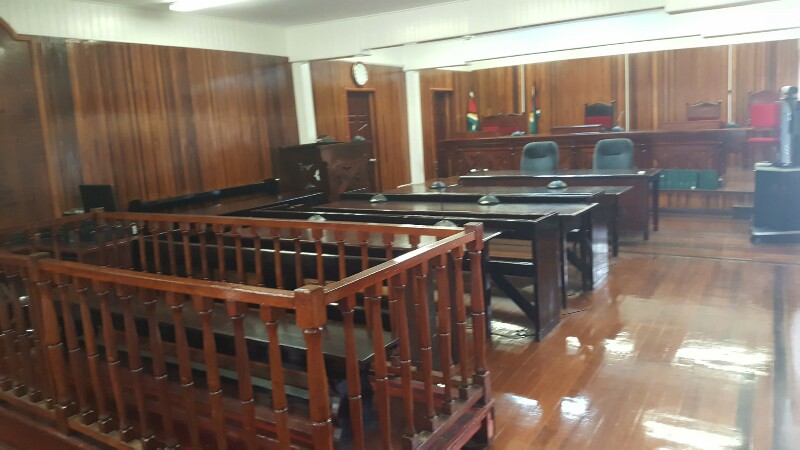
On Thursday, 7 May 2026, Guyana’s Court of Appeal delivered a unanimous landmark ruling reversing a 2023 High Court judgment that found ExxonMobil Guyana Limited and the country’s Environmental Protection Agency (EPA) in breach of statutory and environmental permit obligations. The decision, handed down by Court President Dawn Gregory Barnes alongside Justices of Appeal Nareshwar Harnanan and Priya Sewnarine-Beharry, marks a major resolution to a high-stakes legal dispute over environmental liability rules for the country’s offshore petroleum operations.
The case originated in 2023, when activists Frederick Collins and Godfrey Whyte brought a legal challenge against Exxon and the EPA. Then-High Court Justice Sandil Kissoon ruled in the claimants’ favor, accepting the argument that Exxon’s liability for environmental damage from its offshore work must be unlimited, and thus the financial guarantee required under the company’s environmental permit also needed to be uncapped. Justice Kissoon found that Exxon had knowingly violated its obligations by only submitting a US$2 billion capped guarantee, and the EPA had breached its own statutory duties by approving this limited financial assurance. He ordered the EPA to issue an enforcement notice forcing Exxon to secure an unlimited guarantee within 30 days, and threatened to suspend the company’s operating permit if it failed to comply.
Both Exxon and the EPA appealed the ruling to the Court of Appeal, which immediately granted a stay on Justice Kissoon’s orders pending the appeal outcome. The appellate court heard full legal arguments from all involved parties in February 2026. Andrew Pollard, lead defense counsel for Exxon, outlined the court’s core findings after the ruling was released.
Pollard explained that the appellate court drew a critical legal distinction between unlimited liability for environmental damage and the separate requirement of financial assurance. The court found that Justice Kissoon had made a legal error by conflating these two distinct concepts. Under the correct interpretation of the permit’s financial provisions, Exxon was only required to submit a guarantee for a fixed, defined amount. The court further held that the EPA retains discretionary authority under Guyana’s Environmental Protection Act and the terms of the permit to approve a capped guarantee, and Justice Kissoon had overstepped his jurisdiction by substituting his own judgment for the agency’s statutorily granted discretion.
The ruling also confirmed that the EPA and Exxon acted appropriately in negotiating the US$2 billion guarantee, noting that Parliament had designated the EPA as the sole authorized body to make such regulatory determinations. Additionally, the court threw out Justice Kissoon’s finding that the insurance policy submitted by Exxon and approved by the EPA did not meet international petroleum industry standards, as there was no admissible evidence presented to support that conclusion. All orders issued by the High Court in 2023 were formally set aside.
The path to the appellate ruling included a prior detour at the regional Caribbean Court of Justice (CCJ). The Guyana Court of Appeal initially blocked the country’s Attorney General from joining the case as a party, but the CCJ overturned that decision, emphasizing that the Attorney General is tasked with representing public interest, and this dispute carried significant public interest implications. That ruling cleared the way for the Attorney General to participate in the appellate proceedings and submit legal arguments.
Multiple legal teams represented the diverse parties in the case: Exxon was represented by Andrew Pollard SC, Edward Luckhoo SC, and Eleanor Luckhoo; the EPA was represented by Sanjeev Datadin and Mohanie Anganoo; claimants Collins and Whyte were represented by Seenath Jairam SC, Saevion David-Longe, Melinda Janki, and Abiola Wong-Inniss; and the state was represented by Attorney General Anil Nandlall, Arud Gossai, and Shoshanna Lall.