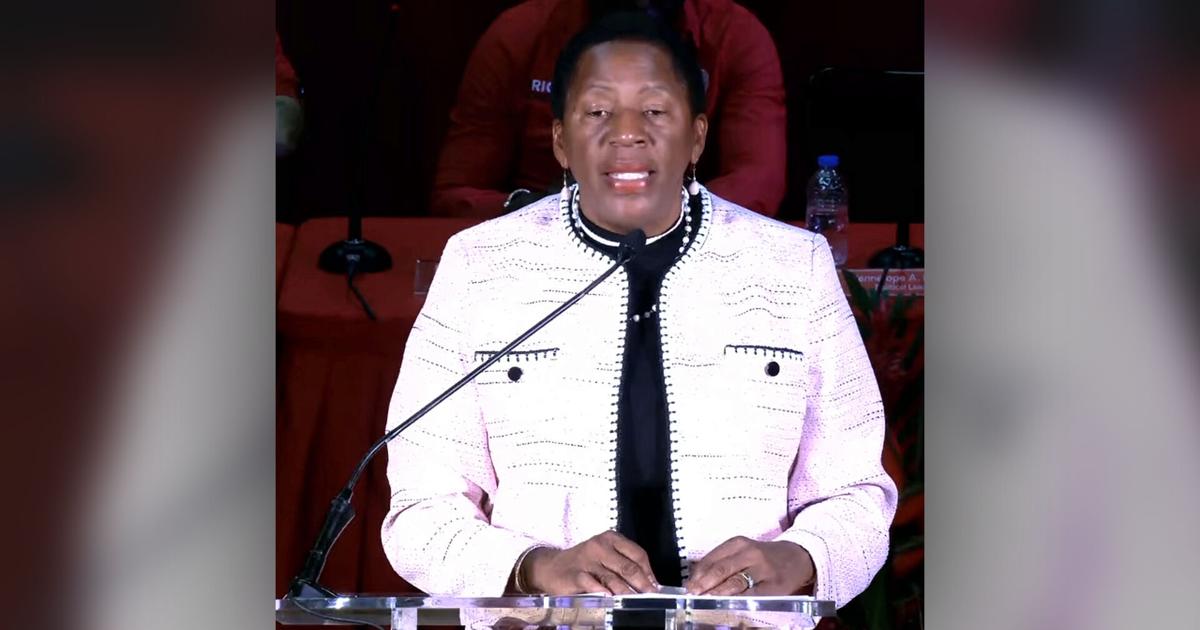
In a sharp rebuke of Trinidad and Tobago’s ruling United National Congress (UNC) administration, People’s National Movement (PNM) political leader Pennelope Beckles has raised alarms over the rapidly deteriorating diplomatic relationship between the twin-island nation and neighboring Venezuela, arguing that the fractured bilateral ties are directly undermining the country’s ability to lock in critical energy contracts that underpin its economy.
Speaking at a “State of the Economy” political gathering hosted at Port of Spain’s City Hall Monday night, Beckles emphasized that strained cross-border relations have severely eroded Trinidad and Tobago’s negotiating leverage at a moment when the energy sector remains the backbone of the country’s public revenue, export earnings, and overall economic stability. She told attendees that growing uncertainty around official engagement with Caracas has slowed progress on high-priority cross-border energy initiatives, most notably the long-planned Dragon gas project.
Beckles called out the current government for inconsistent public messaging around the status of the Dragon gas development, criticizing its clumsy handling of international diplomacy. She noted that nearly 12 months have passed since Prime Minister Kamla Persad-Bissessar announced the securing of a new Office of Foreign Assets Control (OFAC) license and the revival of the Dragon gas deal, yet administration officials have still not been able to conduct official visits to Venezuela to advance the project. She contrasted this inaction with progress under the previous PNM administration, recalling that former energy minister Stuart Young made repeated trips to Caracas to lay the critical groundwork for the agreement.
“They say the Dragon gas deal is dead, they repeat it over and over, but imagine they are so bold-faced and have no shame. All of a sudden the same deal they said was dead they supposedly revived,” Beckles said, accusing the current administration of taking credit for diplomatic and technical progress achieved by the previous government while simultaneously dismissing those past efforts.
She also reiterated criticism of Persad-Bissessar’s past confrontational approach to Venezuela, noting that the prime minister’s aggressive, undiplomatic attacks on the Venezuelan government led to her being declared persona non grata. “Be careful how you bad talk people,” Beckles warned.
Turning to the broader health of Trinidad and Tobago’s economy, Beckles underscored the outsized role the energy sector plays in sustaining national livelihoods, breaking down its contribution to key economic metrics: it accounts for one-third of total government revenue, one-fifth of overall gross domestic product, and roughly 80 percent of the country’s total export earnings. “Without the benefits of the energy sector we would not enjoy the lifestyle we have come to take for granted,” she said.
Beckles stressed that Trinidad and Tobago’s entire economic model is built around natural gas, with upstream extraction feeding a robust downstream industrial sector that includes some of the largest petrochemical facilities in the Caribbean and Latin America. This industrial estate model, she noted, relies entirely on stable, long-term access to natural gas supplies.
Against this backdrop, she explained, declining production from maturing domestic gas fields has put growing pressure on the sector, making strategic cross-border partnerships and binding international energy agreements more important than ever. Production volumes have dropped sharply from historic highs, she said, while proven domestic reserves continue to decline, creating an urgent need to develop new supply sources like the Dragon field off Venezuela’s coast.
Beckles also criticized what she described as repeated attempts by the ruling administration to misrepresent the true state of the energy sector, arguing that political messaging often disregards hard technical realities around declining production and shrinking reserves. She closed by noting that previous negotiations under the PNM administration had strengthened Trinidad and Tobago’s standing in the global energy market, securing more favorable pricing structures and expanded participation in liquefied natural gas operations that benefit the entire nation.