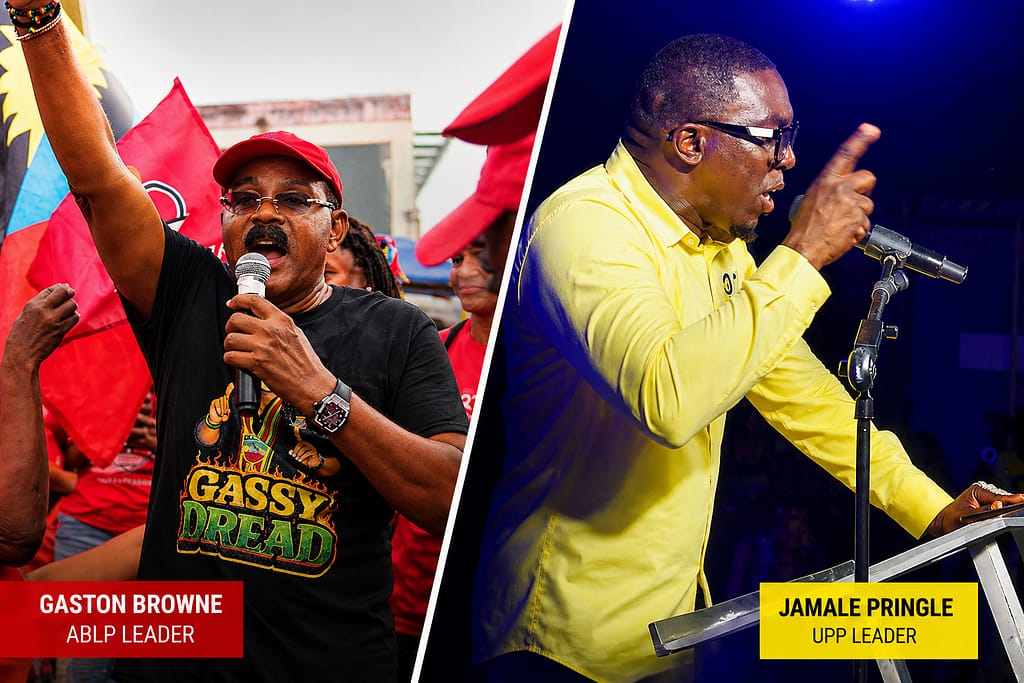
As Antigua and Barbuda prepares to head to the polls for its critical general election, the nation’s two leading political forces have laid out starkly competing visions for the country’s future in last-ditch appeals to the electorate. On the eve of voting, opposition leader Jamale Pringle of the United Progressive Party (UPP) framed the upcoming ballot as a once-in-a-five-year opportunity to reverse what he calls a 12-year downward trajectory under the incumbent administration, while sitting Prime Minister Gaston Browne of the Labour Party is begging voters for a second term to build on the national “renaissance” his government claims to have already delivered.
In a pre-election video address published Wednesday, Pringle positioned the 2023 election as a defining turning point that will touch every corner of voters’ daily lives, from household grocery bills to the quality of public infrastructure and accessible healthcare. “Tomorrow… may be your last opportunity for five years to determine the future of this nation,” Pringle told the public, urging every eligible citizen — particularly undecided voters and those planning to skip voting — to show up to their polling stations and make their voices heard.
Pringle leaned into widespread voter frustration, acknowledging that large swathes of the population have been left “deeply disappointed” over the 12 years of Labour Party rule, with many facing declining personal finances and worsening economic mobility. He listed a litany of grievances that have eroded public trust: crumbling road networks, inconsistent access to clean drinking water, a steady rise in violent and petty crime, and the skyrocketing cost of living that has stretched household budgets thin. All these issues, he argued, are clear proof that a change in leadership is long overdue.
Beyond domestic failures, Pringle also called out what he framed as governance missteps that have damaged Antigua and Barbuda’s standing on the global stage. He pointed to strained diplomatic relations with key international partners and emerging financial risks that threaten the nation’s economic stability, arguing that these challenges are “not accidental circumstances” but the direct outcome of poor policy choices by the Browne administration.
Making his pitch for the UPP, Pringle highlighted the party’s proven track record in past government roles, noting that the party has previously inherited complex national challenges and managed them effectively. He urged voters to “vote against the situations that hinder your progress and the behavior that threatens democracy,” while calling on supporters to back the UPP and hold the party accountable if it fails to deliver on its pledges to boost living standards and drive inclusive national development. To counter doubts about the opposition’s readiness to govern, Pringle emphasized the “education, experience, competence, and the character” of the UPP’s full slate of candidates, framing the team as uniquely prepared to tackle the nation’s most pressing issues.
Meanwhile, during his final pre-election televised address, Prime Minister Browne made the case that his sitting administration has already delivered tangible, measurable progress for Antigua and Barbuda, and deserves another term to deepen those gains. Centering his re-election campaign on a theme of national renewal, Browne argued that the country is already in the midst of a transformative renaissance, pointing to sustained economic growth, large-scale infrastructure upgrades, and expanded social programs as proof of positive change under his leadership. “We are already in the Renaissance,” he said, adding that continued investment in physical infrastructure and human development would unlock the “blossoming of our nation” and lift living standards for all citizens.
Browne highlighted improvements across key economic metrics, including steady GDP growth, record low unemployment, and improved fiscal performance. He claimed his administration has strengthened the country’s overall financial position and steadily reduced economic inequality over its term. He also pointed to signature policy initiatives including subsidized affordable housing, broad duty waivers on essential goods, and expanded social safety net programs, all part of a broader push to distribute national wealth more equitably and improve quality of life for all Antigua and Barbudans.
Looking ahead to a second term, Browne laid out key policy pledges: his government would raise the national minimum wage and work toward implementing a full “livable wage” for all workers, while continuing critical subsidies to shield domestic consumers from volatile global price hikes. He argued that ongoing economic expansion, backed by billions of dollars in committed domestic and foreign investment projects, will create thousands of new jobs and solidify Antigua and Barbuda’s position as an economic and political leader across the Caribbean. Browne also pushed back against claims of exclusionary governance, emphasizing that his administration’s popular policies — from duty waivers to social support — have been distributed evenly to all citizens regardless of their political party affiliation.
These sharply contrasting closing messages highlight the stark choice facing voters as they head to the polls on election day. After more than a decade of Labour Party rule, voters must decide whether to align with the opposition’s call for sweeping change after years of perceived decline, or endorse the incumbent’s argument that its policy framework has already laid a strong foundation for continued growth and shared prosperity. The closely contested election, which will set the country’s political direction for the next five years, will see voters deliver their verdict today.