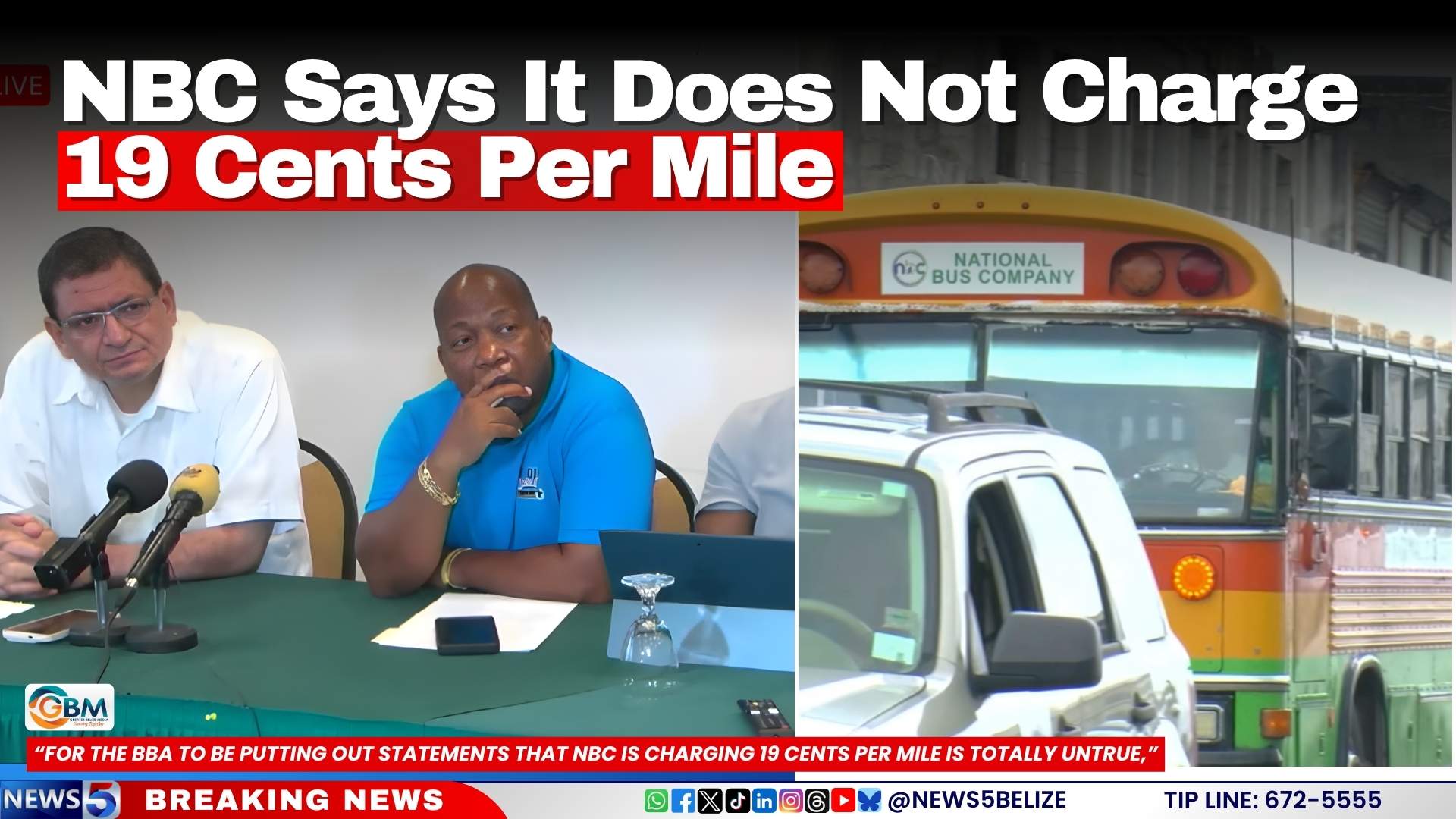
A public disagreement over bus pricing has erupted between the Belize Bus Association (BBA) and the Belizean government, centered on a widely circulated claim that the state-owned National Bus Company (NBC) charges a uniform 19 cents per mile for all routes. Government officials have pushed back hard against this assertion, labeling the figure entirely inaccurate and misleading, as negotiations over bus operator relief amid soaring fuel costs enter a new phase.
Speaking at a Saturday press briefing, Minister of Transport Louis Zabaneh clarified that NBC does not operate under a single flat-rate pricing structure. Instead, per-mile fares vary significantly based on the characteristics of each specific route, with actual average rates coming in substantially lower than the 19-cent figure cited by the BBA. On southern routes run by NBC, for example, average per-mile costs fall between 11 and 13 cents, while western route averages range from 16 to 17 cents per mile.
Chester Williams, Chief Executive Officer of the Ministry of Transport, backed up this clarification with concrete on-the-route examples to illustrate the discrepancy. Williams noted that a full one-way trip from Punta Gorda to Belize City, a journey of roughly 210 miles, carries a total ticket price of approximately $27. When calculated per mile, that works out to just 13 cents per mile. Similarly, a 105-mile trip from Dangriga to Belize City costs around $12, averaging out to 11 cents per mile. “For the BBA to be putting out statements that NBC is charging 19 cents per mile is totally untrue,” Williams emphasized.
The inaccurate 19-cent claim has served as the core of the BBA’s push for industry-wide fare adjustments. The association has argued that its member operators should be allowed to align their pricing with what they claim NBC charges, to offset soaring operating costs. But government officials explain that this cross-sector comparison is fundamentally misleading, because fare structures are shaped by route-specific conditions that differ sharply between the BBA’s primary service areas and NBC’s operating regions.
NBC’s core operational footprint is concentrated in Belize’s southern and western regions, where routes are typically longer. Longer routes naturally translate to lower average per-mile costs, even with total ticket prices factored in. By contrast, the majority of BBA-operated routes are located in northern Belize, where shorter route lengths and different operating dynamics lead to higher inherent per-mile costs. Officials added that these variable pricing differences stem from multiple tangible factors: overall route length, the number of scheduled stops along a route, and variable operating costs unique to each area, rather than a one-size-fits-all national pricing scheme for bus services.
The current dispute comes after weeks of closed-door negotiations between the BBA and the Belizean government, sparked by rising global fuel prices that have driven up operating costs for all domestic bus operators. Initially, the BBA put forward three separate requests for regulatory and financial relief: full tax exemptions on fuel and bus replacement parts, direct government subsidies to offset increased fuel costs, or permission to adjust fares up to a uniform 19 cents per mile across the board.
In a sudden policy shift following the BBA’s claims about NBC pricing, Zabaneh announced that the government would abandon plans for any fare increase for consumers. “Since the BBA is saying they don’t wish for the rates, and that they reject the rates, then we will remove the rates,” Zabaneh stated. “No increase in rates to our people. Instead, the Prime Minister has agreed we will work on a subsidy for the BBA.”
All details of the planned subsidy package for BBA member operators are set to be unveiled by Prime Minister John Briceño in an official announcement scheduled for Monday.