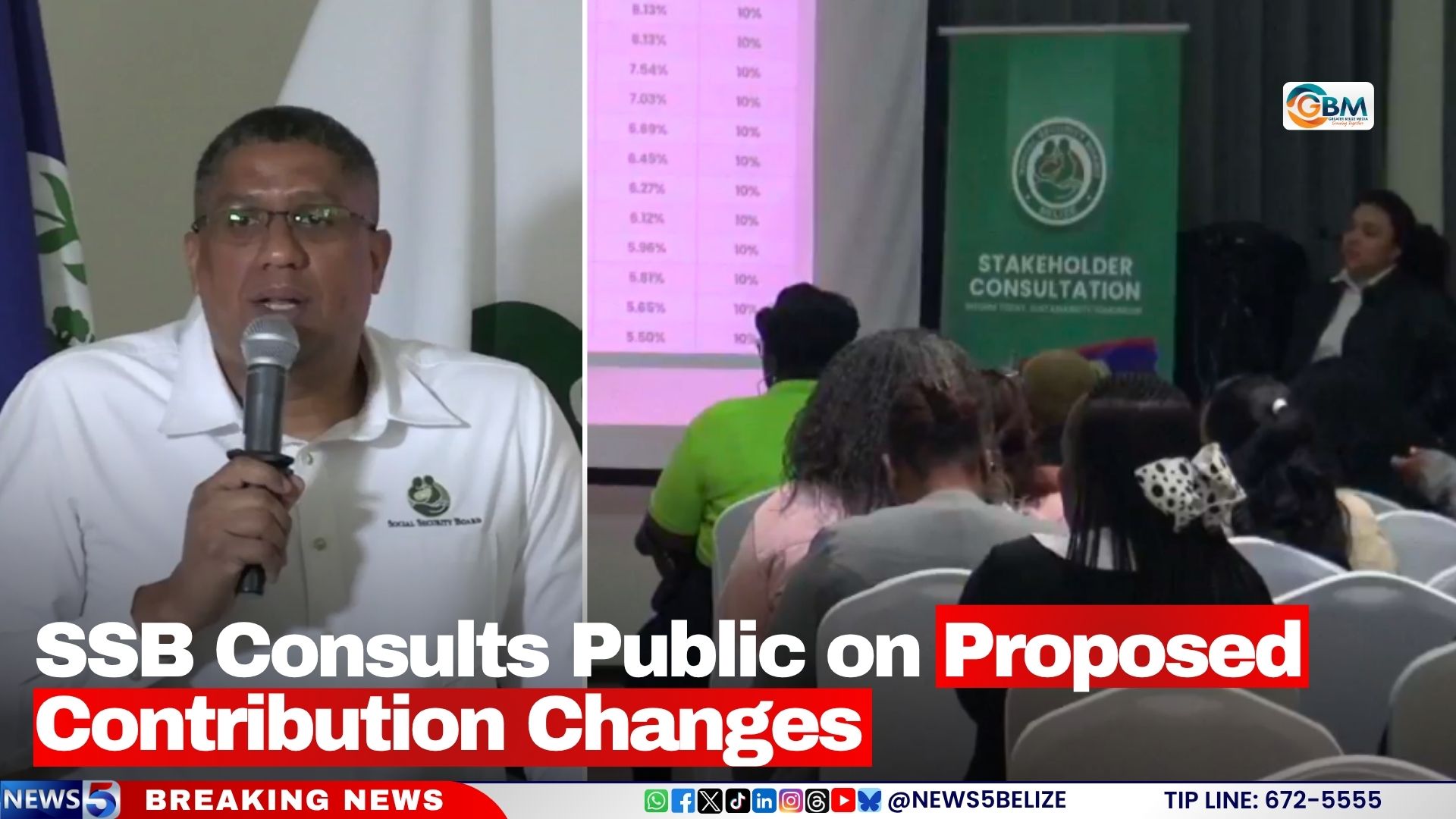
Nearly four and a half decades after Belize’s social security system was first established, the Social Security Board (SSB) is moving forward with sweeping proposed updates to the program’s contribution structure, and is gathering public input through a months-long series of national consultations. The most recent consultation session was hosted on the afternoon of April 16, 2026 at the Grand Resort and Residences in Belize City, marking one stop on a 12-meeting tour that has already brought discussions from the northern district of Corozal all the way south to Dangriga. The full consultation process is scheduled to conclude at the end of April, with three remaining public sessions planned for San Pedro on April 21, Punta Gorda on April 28, and Placencia on April 30.
At the core of the discussions are three key proposed revisions to the current contribution framework: updating the methodology used to calculate worker and employer contributions, adjusting the division of contribution responsibilities between employees and employers, and revisiting the minimum and maximum wage thresholds that determine how much contributors pay into the system. SSB Chief Executive Officer Jerome Palma emphasized that the reform effort comes as the 1981-originated framework has become outdated to match 2026’s economic and labor landscape. “A scheme that was developed in 1981, for a time and a condition that was appropriate in 1981, may need some reform in 2026 and moving forward,” Palma stated during the meeting. “In 1981, there were no call centres. The investment market was distinctly different. Technology has moved forward.”
One of the most pressing indicators of the current system’s obsolescence is the existing maximum weekly contribution cap of BZ$520, which Palma confirmed 25 to 30 percent of all contributors already reach annually. This figure signals that the cap has not been adjusted to keep pace with wage growth across Belize, leaving the system with uncollected revenue that could support long-term program stability.
Throughout the Belize City consultation, participants raised a range of targeted concerns and feedback to inform the board’s final policy decision. One attendee pushed back against the current practice of calculating contributions based on gross rather than net salary, pointing out that mandatory income taxes and other pre-paycheck deductions often reduce take-home pay by as much as 50 percent. “We don’t live on our gross salary,” the participant said. “By the time I actually get money in my pocket, it’s half of what it says on the payslip… When you are considering the split, please consider how heavily taxed we are.”
Another participant focused on equity for low-wage workers, highlighting disproportionate gaps between contribution bands across different income levels and calling for transparent, fair adjustments that do not place undue burden on lower-income contributors while neglecting higher earnings brackets. “That’s a big jump for workers at the lower end,” the participant said. “You have to be fair and transparent. You can’t look at the lower bands and not look at the higher bands.”
Palma responded directly to these concerns, reassuring attendees that the board has prioritized protecting the roughly 6,000 contributors currently in the lowest income band. He confirmed that the board intends to retain the existing split of contribution responsibilities, which requires employers to cover a higher share of contributions than employees, with this structure remaining especially intact for lower-wage bands. “It’s very important for us to have this split very similar to what it is at the moment, where the employer actually pays and contributes at a higher rate than the employee, especially at the lower bands,” he explained.