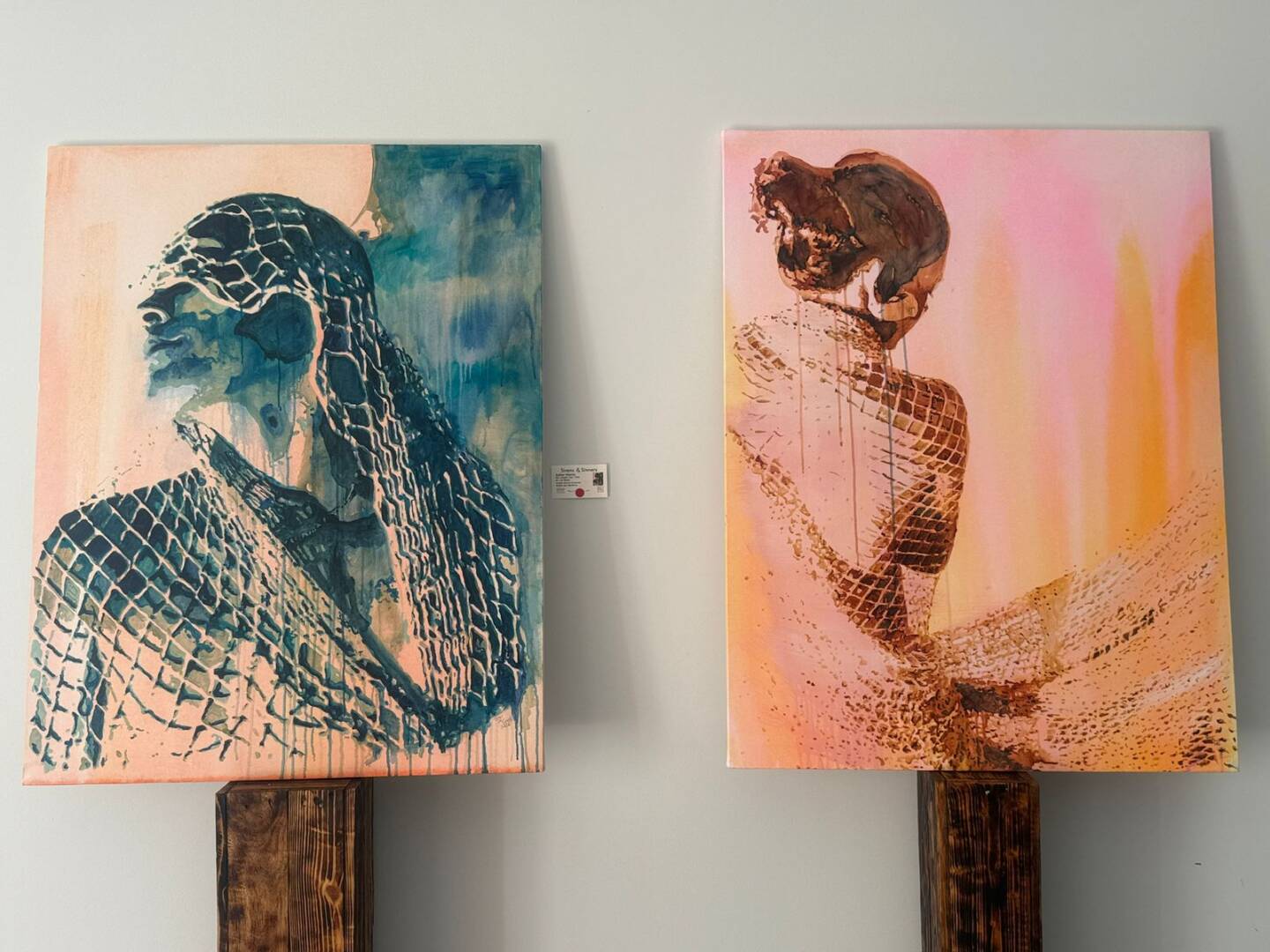
Tucked inside Art House 473, a former repurposed church that has been reinvented as a serene, chapel-like contemporary art space, the collaborative exhibition *Sirens and Sinners* from creators Asher Mains and Susan Mains unfolds not as a flashy public spectacle, but as a quiet, introspective reckoning with identity, morality and human experience.
Drawing on decades of creative exploration into masks and the layered personal stories they carry, the exhibition upends the binary moral framing suggested by its title, which evokes ancient myth, traditional morality, and the tension between temptation and transgression. Far from the seductive, dangerous figures of legend, the sirens depicted here do not lure viewers—they confront them. Likewise, the so-called sinners are not portrayed as condemned outsiders, but as deeply, tenderfully human. Most works center mask-like visages that are not generic pre-written archetypes, but cumulative identities shaped by lived experience, layered with the sediment of years of memory and struggle.
Susan Mains’ contribution to the show carries a particularly distinct sense of temporal layering. Her iconic “little faces” carry an uncanny, arresting weight: miniature in scale yet monumental in emotional impact, they read as both naive and knowing. Rooted in Caribbean masquerade traditions, the works transcend cultural reference to explore internal, psychological terrain, framing faces as thresholds of experience rather than static surfaces. Every small visage feels less like a finished art object than a residue of a lived moment, a faint, persistent trace that refuses to fade completely.
Asher Mains’ practice offers a compelling spatial and atmospheric counterpoint to Susan’s intimate works. His practice oscillates between abstraction and figuration, weaving the portrait-focused work into broader environmental and narrative contexts. He incorporates found ghost nets—discarded fishing gear that washes up on the beaches of the Grenadian fishing village Calliste—into both his installations and paintings, where the tangled nets hold, caress, and even trap the depictions of sirens. Drawing inspiration from Homer’s *Odyssey* and Derek Walcott’s *Omeros*, the St. Lucian poet’s reimagining of the Homeric epic, Asher crafts a unique magical realist narrative deeply rooted in Caribbean maritime life. If Susan’s pieces are quiet, intimate confessions, Asher’s installations are the resonant spaces where those confessions echo out for viewers to encounter.
What unifies the entire exhibition is its deliberate refusal to offer easy answers. There is no clear moral axis, no didactic narrative that draws a hard line between virtue and vice. Instead, *Sirens and Sinners* puts forward a far more unsettling core thesis: the categorical lines between good and evil, purity and corruption are porous, perhaps even entirely illusory. Viewers are left to navigate a creative landscape where allure and guilt, innocence and complicity coexist in the same quiet gaze.
It is this commitment to ambiguity that gives the exhibition its quiet, enduring power. In an era that constantly demands rigid clarity, quick labels, fixed positions and loud public declarations, *Sirens and Sinners* insists on the value of uncertainty. It does not invite viewers to judge the figures on display, but to recognize them—to see something uncomfortably familiar in their layered, weathered faces. In the end, the exhibition does not demand audiences answer who the sirens or sinners are. Instead, it poses a far more subtle, probing question: when you look long enough at these faces, can you still tell the difference between them?