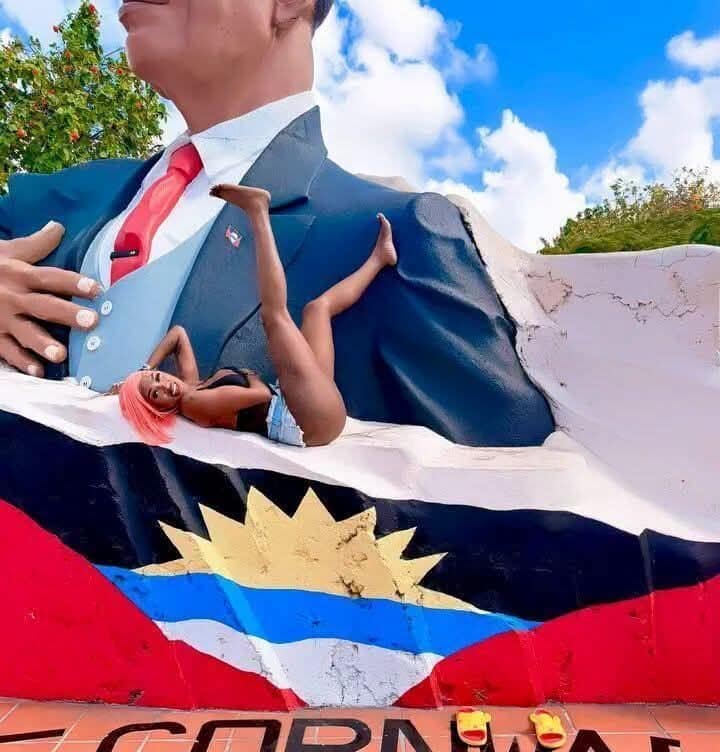
A photograph showing a female tourist reclining in a suggestive pose on a national monument honoring Antigua and Barbuda’s founding father has exploded across social media platforms, igniting a fierce, divided public conversation over cultural respect, public reaction, and the protection of heritage sites. The monument stands as a tribute to Sir Vere Cornwall Bird, a towering figure in the Caribbean nation’s modern history who guided Antigua and Barbuda to full independence from colonial rule in 1981. Widely celebrated as the country’s “Father of the Nation,” Bird’s legacy is a core source of national collective pride, imbuing the site with profound historical and cultural meaning that makes the viral photo all the more controversial.
In the wake of the image’s widespread circulation, thousands of online commenters have voiced sharp condemnation of the tourist’s actions, labeling them disrespectful, offensive, and deeply inappropriate for a site of such national significance. Many argue that sacred national landmarks demand universal reverence from all visitors, regardless of their origin. Some have gone further, demanding formal consequences for the woman, ranging from financial fines to deportation, while others have raised pointed questions about site management, asking how such a photo could be taken without intervention from on-site staff.
A consistent thread among critical voices emphasizes the responsibility of international travelers: all guests should take the time to research local cultural norms and sensitivities before visiting important heritage sites, especially those honoring revered national figures. This perspective argues that ignorance of local customs is not an excuse for behavior that insults a nation’s shared history.
However, a growing contingent of online users has pushed back against the widespread outrage, arguing that the response to the incident has been disproportionate. Supporters of this view note that the tourist herself has already taken accountability: she voluntarily removed the original image from her social media and issued a public expression of regret after seeing the scale of the negative reaction. Many argue that the woman’s willingness to correct her mistake should de-escalate the situation, and that the continued mass sharing of the photograph is actually what amplifies the disrespect to Bird’s legacy, rather than addressing it.
One social media user summed up this position, writing, “She’s a tourist taking a picture by a statue… she was respectful enough to remove the picture after she saw comments.” Multiple commenters have also criticized users who continue to repost the viral image, arguing that the ongoing circulation unnecessarily drags out the controversy and amplifies division for clout. Others have called for a more measured, constructive approach, framing the incident as a learning opportunity to educate travelers on cultural sensitivity rather than a moment for blanket condemnation.
Some members of the public have even downplayed the entire incident, describing it as either a harmless misstep or a lighthearted mistake that has been blown far out of proportion. This group also points to far more pressing systemic issues facing Antigua and Barbuda that deserve far more public attention and resources than a tourist’s bad photo op.
Beyond the immediate debate over the tourist’s actions, the incident has prompted broader institutional questions: it has forced policymakers and heritage site managers to reexamine how public monuments are protected, and whether clearer on-site signage, formal visitor guidelines, or enhanced staff training are needed to prevent similar missteps from happening in the future.