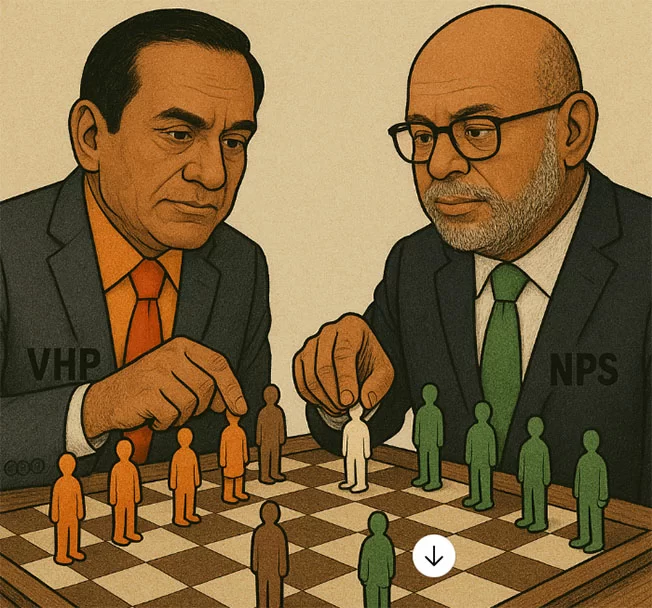
In Suriname’s Ministry of Education, Science and Culture, recent administrative reshuffling continues to be officially characterized as “policy restructuring” and “professionalization.” However, mounting evidence reveals these personnel changes represent nothing more than deeply entrenched political gamesmanship and ethnic patronage systems that have long plagued the nation’s governance.
The pattern emerges with striking clarity when examining recent political transitions. During the previous administration—when VHP and NPS parties collaborated—VHP Minister Henry Ori exploited the rupture with NPS to systematically replace predominantly non-Hindustani executives aligned with NPS with officials from his own Hindustani support base. Now, under a new power constellation, the identical maneuver unfolds in reverse: primarily Hindustani officials are being dismissed while some NPS-affiliated personnel previously ousted by Ori are being reinstated.
This cyclical pattern of removal, replacement, and reinstatement isn’t anomalous—it constitutes the fundamental operating system. Framing these changes as merit-based discussions inadvertently creates dangerous stigmatization by suggesting Hindustani experts are being replaced by non-Hindustani incompetents, or vice versa. The reality remains that expertise bears minimal consideration, overshadowed by partisan shortsightedness with strong ethnic motivations.
The dangerous fallacy lies in characterizing this musical chairs exercise as a debate about qualifications. Accepting this framing perpetuates the precise ethnic stigma society must avoid. While some suggest discrimination based on race and political affiliation, this not only misrepresents reality but creates an ethnic smokescreen obscuring the core issue.
For the officials appointed and replaced, the process becomes a mockery—they serve merely as political pawns deployed not based on competency but partisan grudges. What requires acknowledgment is that these have become political positions, and political positions inevitably change hands with administrative transitions. While not inherently unusual globally, Suriname’s process occurs without framework, transparency, and consistently along ethnic lines, rendering it particularly destructive.
Suriname might benefit from examining established democracies like the United States, which maintains a clear distinction between political appointees (temporary, administration-linked positions) and career officials (diplomats, civil servants, policy analysts who remain regardless of electoral outcomes). This system preserves both stability and neutrality.
Suriname lacks—or insufficiently defines—this crucial distinction. Consequently, bureaucratic functions and political appointments remain toys of political immaturity, with each new administration resetting progress while citizens bear the consequences. The time has arrived to definitively classify which positions are truly political and which are not, to terminate ethnically-charg appointment traditions, and to construct a professional, stable, and depoliticized apparatus where career civil servants serve based on expertise rather than partisan interests.
Until these reforms materialize, Suriname remains trapped in the same cycle: petty political games infused with ethnic tensions producing significant consequences. Ultimately, the nation invariably pays the price.