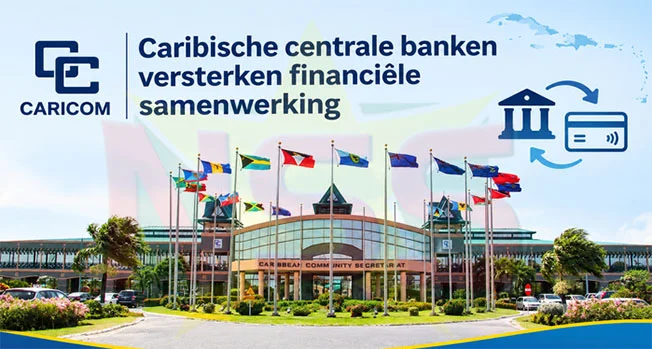
Top leadership from 14 CARICOM member central banks gathered in Belize City on November 19 and 20 for their 67th semi-annual summit, reaching a landmark agreement to fast-track interconnected regional payment infrastructure that will cut reliance on third-party intermediaries and external currencies for cross-border commercial transactions. Chaired by Kareem Michael, Governor of the Central Bank of Belize, the two-day closed-door deliberations included senior financial regulatory officials from across the Caribbean, including Maurice Roemer, Governor of the Central Bank of Suriname. The core mandate emerging from the summit tasks the Bank of Jamaica, with technical support from the Eastern Caribbean Central Bank, to develop a phased strategic roadmap to unify disjointed national payment systems across the bloc. The framework will lay the groundwork for a live pilot program that enables direct cross-border settlements in local Caribbean currencies, eliminating the current common practice of routing regional trade payments through U.S. dollar correspondent banks based outside the region. The move addresses longstanding pain points for regional small and medium-sized enterprises, for whom cross-border trade transactions between CARICOM markets are currently slow, opaque, and burdened by layers of intermediary fees that can add significant costs for both exporters and importers. Officials also reviewed the ongoing progress of the CARICOM Payment and Settlement System (CAPSS), a dedicated regional settlement platform currently in early trial stages, with plans to formally invite commercial banks across participating member states to join the pilot in the coming months. Delegates received a detailed presentation on the Pan-African Payment and Settlement System (PAPSS), the successful African regional local currency settlement infrastructure, as a proven benchmark for the Caribbean’s own development trajectory. Summit participants acknowledged that full deployment of the integrated system will require coordinated cross-border alignment on currency conversion protocols, shared liquidity frameworks, unified regulatory oversight, standardized technical specifications, and robust dispute resolution mechanisms, with no firm public launch date set for full operational rollout. For Suriname, one of CARICOM’s key commodity-exporting member states, the streamlined payment ecosystem stands to deliver tangible economic gains: domestic agricultural, food, and industrial exporters will face far lower barriers to accessing neighboring regional markets, while local importers will see reduced transaction costs and faster order processing times. Beyond payment system reform, the central bank governors signed off on a series of complementary regional cooperation initiatives: a unified shared framework to standardize cross-border economic and financial statistics to ensure data comparability and faster real-time data sharing, designed to help small Caribbean economies respond more nimbly to external economic shocks such as global energy price volatility. The agenda also included new coordinated commitments to strengthen regional financial cybersecurity defenses to mitigate rising risks of cyberattacks targeting digitized payment infrastructure, the development of a shared regional green finance taxonomy to identify and scale investments that advance climate resilience and sustainable economic activity, and enhanced collective frameworks to manage systemic banking sector risks. A high-profile proposal for a joint regional School of Central Banking and Monetary Policy, developed through a partnership between the Central Bank of Barbados and the University of the West Indies, received formal endorsement, with the institution set to deliver targeted, context-specific professional training for central bank staff across the bloc on priority issues including monetary policy design for small open economies, financial supervision, fintech governance, and institutional capacity building. Officials emphasized that deepened regional financial collaboration is a critical prerequisite for shielding the Caribbean’s highly vulnerable small economies from overlapping external pressures, from climate change to global economic uncertainty, while unlocking inclusive, long-term sustainable growth. The next semi-annual CARICOM central bank governors summit is scheduled for May 2027, to be hosted and chaired by Gobind Ganga, Governor of the Bank of Guyana.