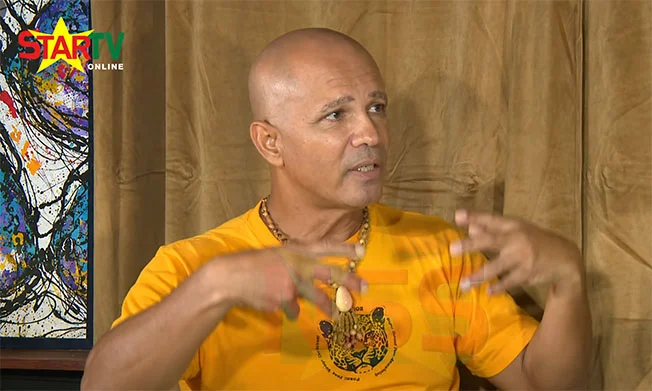
A heated national conversation has erupted in Suriname following President Jennifer Simons’ formal announcement of a policy to block new Mennonite community groups from establishing residence in the South American nation, paired with a directive to repatriate all Mennonite residents holding no valid legal immigration documentation. The policy gained public prominence during the 22 November broadcast of StarTV’s online talk show *StarTalk*, hosted by Wilfred Leeuwin, which featured three guest speakers representing competing stakeholder perspectives: Erlan Sleur, director of environmental non-profit ProBios; Lionel Blokland, head of Braganza Marketing Group, the firm behind a major local agricultural project; and Nina Jurna, veteran Latin America correspondent for Dutch outlets NOS and NRC Handelsblad.
President Simons recently oversaw the repatriation of more than 60 undocumented Mennonite residents, who were flown back to Bolivia on a state-chartered flight. The head of state stated the move was intended to send a clear deterrent signal to other Mennonite communities considering relocating to Suriname, framing the action as a critical first step to enforce uniform immigration rules. Blokland, whose firm partners with 11 legally documented Mennonite families from Belize (roughly 50 total people) on a commercial farming initiative, argued that the president’s stance must be codified into consistent, transparent national policy that draws a clear line between undocumented residents and legally admitted migrants who comply with all existing regulations. He emphasized that the Mennonite participants in his project hold full valid residency status, bring specialized agricultural expertise and heavy farming equipment to Suriname, and are not part of the recently deported group.
Braganza’s assigned state land parcels, Blokland explained, are allocated exclusively for approved maize and soy production, targeted primarily at the local market to cut Suriname’s reliance on imported animal feed. He projected the operation will generate 75,000 to 80,000 tons of output annually, delivering an estimated $50 million in yearly economic benefits that will lower production costs for local poultry farmers and boost domestic food security. He pushed back against unsubstantiated claims that the project clears old-growth rainforest, noting all three allocated parcels are located on secondary forest land, with full pre-project environmental suitability assessments completed prior to launch.
Sleur, a longstanding environmental activist, stressed his opposition is not targeted at Mennonites as a religious community, but at the unregulated expansion of industrial-scale agriculture into Suriname’s Amazon forest territories. Drawing on first-hand observations of Mennonite farming communities in Bolivia, he warned that widespread deforestation for commercial crops has already triggered severe cascading harm across South America’s Amazon basin, including prolonged droughts, critical freshwater shortages, ecosystem collapse, and heightened wildfire risk. He emphasized that intact rainforests play an irreplaceable role in regulating local water cycles and rainfall patterns, and that Suriname must learn from neighboring nations’ missteps to avoid repeating those harms.
A core point of contention raised by Sleur is the unresolved legal status of land rights for Suriname’s Indigenous and tribal communities, who have held traditional stewardship over forest territories for centuries. He raised credible concerns about potential irregularities in land and permit issuance processes that could allow foreign investors to seize control of vast forest tracts without consulting or compensating local Indigenous groups, calling for a full government audit of all existing agricultural land allocation procedures to root out any potential corruption, even if he cannot yet provide concrete proof of misconduct. He added that multiple existing Mennonite farming operations in Suriname have already cleared forest cover without securing the mandatory environmental impact assessments and official deforestation permits required by national law.
Correspondent Nina Jurna shared her on-the-ground reporting from Peru’s Masisea region, where a group of 63 Mennonite families from Bolivia purchased land via unvetted intermediaries to launch large-scale farming operations. The land was later confirmed to be part of the traditional ancestral territory of a local Indigenous community, whose residents rely on the forest for hunting and harvesting medicinal plants. The unregulated expansion of agricultural operations sparked escalating tensions that eventually boiled over into open conflict, forcing the Mennonite families to flee the area entirely. Jurna noted the Peruvian case serves as a stark cautionary tale for Suriname, highlighting the severe social and ecological risks of approving large agricultural projects without formal, free, prior, and informed consent from Indigenous land stewards.
The multi-stakeholder debate has now expanded far beyond immigration policy, forcing Suriname’s government to address overlapping, high-stakes national priorities: balancing economic development and food security goals with the legal protection of Indigenous land rights, the preservation of the country’s globally critical old-growth rainforest, and the establishment of fully transparent, uniformly enforced rules for all large-scale agricultural investment in forested territories.