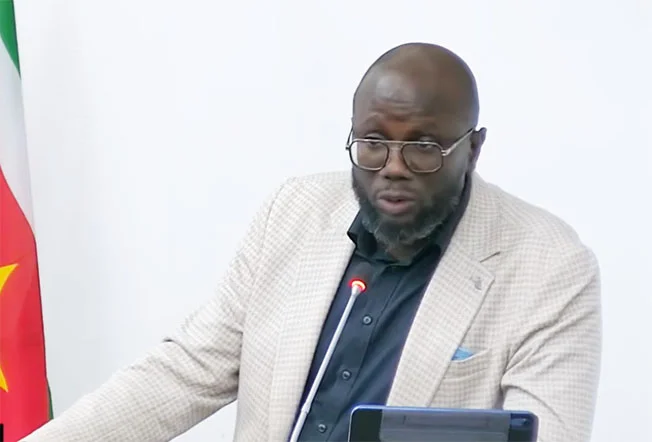
On November 18, local time, a heated debate unfolded in Suriname’s National Assembly (DNA) as lawmaker Ebu Jones of the National Democratic Party (NDP), a member of the assembly’s rapporteur committee, laid out a series of grave, detailed objections to a draft framework approving a bilateral agreement between Suriname and the United States focused on intercepting civilian aircraft suspected of involvement in transnational drug trafficking.
Jones opened his address by affirming that cross-border cooperation to curb illicit drug flows is a necessary priority for Suriname’s public safety, but emphasized that such collaboration must never come at the cost of the country’s constitution, national sovereignty, fundamental human rights, and independent decision-making authority. “Cooperation is not subjugation. Partnership is not dependency. And counter-narcotics efforts are never a blank check for the use of lethal force,” Jones stated firmly, noting that the proposed pact extends far beyond targeting drug smuggling flights to touch on core sovereign functions: the exercise of state authority, full control over national airspace, and the legal mandate to deploy national military resources.
The assembly member anchored his concerns in recent U.S. military operations across the Caribbean, pointing to a string of U.S.-led strikes targeting vessels Washington alleged were tied to global drug trafficking that have been carried out since September 2025. Jones noted that these maritime operations, which have resulted in hundreds of reported fatalities and drawn widespread international condemnation for the use of lethal military force against suspected non-violent drug offenders, do not fall under the scope of the current proposed air interception agreement – but the precedent set by these actions raises urgent, unaddressed questions about how U.S. security partners will choose to implement their support on foreign soil.
A core set of Jones’ objections centers on the ambiguous lines of operational control outlined in Article 1 of the pact, which frames U.S. assistance broadly to include not just hardware and technical data, but also intelligence sharing, communications infrastructure, and command and control support. Jones warned that the party that controls information pipelines and operational systems will effectively hold decisive sway over on-the-ground military decisions, and pressed the Surinamese government to clarify who retains final decision-making authority during any interception operation: Suriname’s own military commander, elected civilian national security authorities, or U.S. technical support personnel operating under the terms of the agreement. He stressed that foreign partners may offer resources and guidance, but must never be allowed to de facto seize control of Suriname’s national security command structure.
Jones also flagged significant risks to innocent civilian air travelers stemming from loose criteria laid out in Article 2, Section 4, which lists a range of circumstantial indicators for flagging a plane as suspected of drug trafficking, and does not require all listed indicators to be present to trigger an interception. He warned that routine navigational errors, technical malfunctions, or emergency in-flight adjustments that deviate from pre-approved flight paths or altitudes could easily lead to wrongful targeting of non-suspect civilian aircraft. He further demanded full clarity on narrow exceptions to the ban on damaging or destroying civilian aircraft outlined in Article 3, asking for explicit, public definitions of the circumstances under which lethal force would be permitted, and clear lines of legal accountability if an interception operation causes harm to innocent bystanders. “Even a suspected drug trafficker is entitled to legal protection. Even a person accused of a crime has an inherent right to a fair trial,” Jones emphasized.
Additional concerns focused on provisions in Article 4 that restrict information gathered via U.S.-provided support from being shared with third parties without explicit written approval from the U.S. Embassy in Suriname. Jones warned that this clause could force Suriname’s judicial system to rely on U.S.-sourced intelligence for prosecutions while denying defense teams and local judges access to full underlying evidence, making fair trials impossible and eroding the independent authority of Suriname’s public prosecution office and national judiciary. “Suriname’s justice system must never become dependent on the permission of a foreign embassy to carry out its core constitutional duties,” he argued.
Jones also issued sharp criticism of the opaque negotiation process used by the previous Surinamese government, which finalized the pact in October 2024 via an exchange of diplomatic notes rather than a formal, fully negotiable treaty. While this process is technically permitted under international treaty law, he noted that it puts the National Assembly in a position where it can only vote to approve or reject the full agreement, with no ability to propose targeted amendments, forcing lawmakers to vote on a fait accompli. He also flagged issues with Article 5, which grants the United States unilateral authority to suspend or terminate all forms of support under the pact at any time, with no reciprocal equivalent rights laid out for Suriname.
Jones submitted a formal list of questions to the sitting cabinet, demanding full disclosure of the exact equipment, training, and resources Suriname would receive under the agreement, formal assessments of its operational effectiveness, and a public explanation of why the U.S. was selected as a counter-narcotics partner over other potential supporting nations. He also called on the government to negotiate additional legally binding, reciprocal guarantees with U.S. counterparts to resolve all outstanding sovereignty, human rights, and judicial accountability concerns before any operational collaboration under the pact moves forward. Jones reaffirmed that he is not opposed to international counter-narcotics cooperation, noting that Suriname’s under-resourced domestic security forces already carry out valiant anti-trafficking work and deserve greater global support – but that any partnership must be rooted in full mutual respect, transparency, and adherence to international law. “Suriname must act firmly to stamp out transnational drug trafficking, but it must act just as firmly to defend its constitution, its national sovereignty, and the fundamental human rights of every person on its territory,” Jones concluded. The national assembly debate on the draft law is scheduled to resume on Thursday.
Jones: Drugsbestrijding mag geen vrijbrief worden voor dodelijk geweld