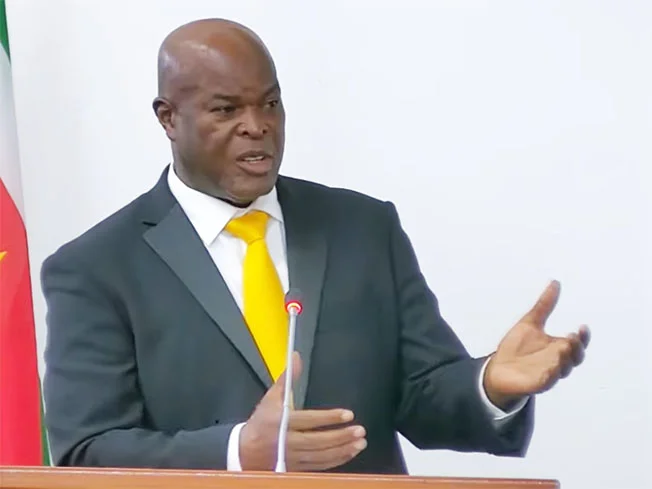
On November 18, 2024, senior Surinamese lawmaker Ronnie Brunswijk, who chairs the parliamentary rapporteurs’ committee and represents the ABOP political party, laid out four foundational objections to a bilateral agreement inked earlier this year between the Surinamese government and the United States, designed to facilitate interception of civilian aircraft suspected of participating in transnational drug trafficking.
Speaking during a public parliamentary debate in De Nationale Assemblee (DNA), Suriname’s national legislature, Brunswijk emphasized that while Suriname urgently requires international partner support to curb illicit drug flights traversing its airspace, the current text of the deal contains clauses that systematically erode the South American nation’s constitutionally enshrined national sovereignty and independent decision-making authority. He argued that the existing balance between cross-border anti-crime collaboration and protection of Suriname’s core national interests has been dangerously skewed, and urged the sitting administration to reopen negotiations with U.S. counterparts before parliament votes on formal ratification.
The most contentious provision, Brunswijk noted, is embedded in Article 4 of the agreement, which mandates that Suriname may not share any intelligence, operational data, or analytical insights collected with U.S. technical backing with any third party without prior written approval from the U.S. Embassy in Paramaribo. In practice, Brunswijk stressed, this clause grants a foreign diplomatic mission effective veto power over information tied directly to Suriname’s domestic law enforcement operations and national security, a clear violation of the national constitution’s Article 2 that guarantees full state sovereignty over all domestic governance and security matters.
A second critical flaw, he outlined, relates to operational implementation of the accord. While the Surinamese Air Force retains formal nominal responsibility for intercepting suspect aircraft, the deal ties the service’s operational capacity almost entirely to U.S.-supplied radar feeds, classified intelligence, and technical logistical support. Brunswijk warned this creates a structural dependency where U.S. authorities could unilaterally dictate what intelligence is shared with Surinamese forces, and what operational standards local crews are required to follow, effectively ceding de facto control over Suriname’s airspace security to a foreign government. He acknowledged that Suriname lacks the advanced surveillance infrastructure to monitor its vast national airspace independently, making U.S. support a valuable asset – but argued that this practical need should never come at the cost of surrendering sovereign oversight of national security policy.
The third major objection targets Article 5 of the agreement, which grants the United States unilateral authority to immediately suspend or terminate all promised support at any time Washington unilaterally judges Suriname to be in non-compliance with the pact’s terms. Brunswijk noted that no reciprocal provision is included to allow Suriname to pause or end the agreement if U.S. parties fail to uphold their obligations, creating a deeply unequal bilateral dynamic with no fair, mutually agreed dispute resolution mechanism.
Compounding these issues, Brunswijk revealed that the 2024 deal was finalized by the previous Surinamese administration via an exchange of diplomatic notes, with the Surinamese side sending a formal unqualified acceptance note dated October 15, 2024. Under Suriname’s constitutional Article 103, parliament cannot unilaterally amend the terms of an agreement already formalized via diplomatic note exchange, and is limited to a binary yes-or-no ratification vote with no ability to adjust problematic clauses.
Brunswijk explicitly clarified that his stance is not a rejection of U.S. anti-drug cooperation entirely: he repeatedly noted that Suriname’s under-resourced security forces cannot independently detect, track, and intercept illegal drug flights, and that U.S. radar systems and technical support would deliver tangible, much-needed progress in cracking down on transnational organized crime. Instead of voting down the entire agreement outright, he is pushing the government to return to the negotiating table to draft a supplementary protocol or formal amendment that removes the restrictive information-sharing veto, establishes reciprocal termination rights, and shores up all sovereign protections for Suriname. He added that if the problematic clauses remain unchanged, parliament must exercise extreme caution before approving the deal, to avoid failing its core constitutional duty to safeguard the nation’s sovereign independence.
Brunswijk wil heronderhandeling drugsverdrag met VS vanwege aantasting soevereiniteit