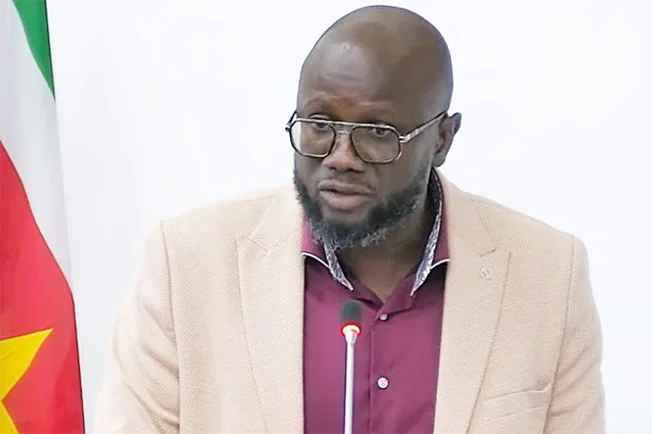
During a formal parliamentary interpellation session focused on national security held on a recent Friday in Suriname’s National Assembly (De Nationale Assemblee, DNA), Ebu Jones, a representative of the opposition National Democratic Party (NDP), tabled a sweeping set of formal requests compelling the sitting administration to disclose complete, unredacted records of all procurements for national security services spanning the 2020 to 2025 period. The requested assets cover law enforcement vehicles, specialized fire trucks, encrypted communication hardware, tactical gear, and all other operational materiel supplied to the national police force, municipal fire brigades, and affiliated public safety agencies.
Jones drew a clear demarcation between purchases processed directly through the President’s Cabinet and those administered by line ministries or independent government agencies, demanding granular details for every single transaction: the identity of contracted vendors, total disbursed sums, exact contract values, official delivery timelines, the government body tasked with tender oversight, financing, and project coordination, as well as the designated budget holder accountable for each purchase. Crucially, the parliamentarian insisted on documentation proving that every delivered item underwent rigorous pre-acceptance technical verification and financial auditing before final payment was issued, to confirm all goods met pre-defined operational specifications.
The NDP legislator also pushed for clarity on whether all 2020-2025 security procurements were rooted in verified, on-the-ground operational needs submitted by frontline public safety staff, and to what degree rank-and-file police officers, firefighters, and other end-users were consulted during the decision-making and tender drafting process. A core focus of his questioning centered on potential gaps inherited by the current administration when it took office, including unaddressed shortfalls in staffing, operational materiel, leadership frameworks, information sharing systems, and investigative capacity. Jones called on the government to explicitly link any identified current deficiencies to specific decisions or administrative negligence from the previous administration, supported by verifiable documentary evidence.
Expanding beyond materiel accountability, Jones demanded a comprehensive, disaggregated dataset tracking trends in serious, violent crime from 2020 through the end of October 2026, broken down by offense category, administrative district, number of filed police reports, case clearance rates, and successful prosecution outcomes. He also requested full disclosure of the root causes of ongoing public safety challenges identified by specialized security agencies, alongside the underlying research data that informed those conclusions, and pushed for the administration to adopt standardized, measurable performance indicators that would allow the legislature to objectively evaluate the tangible impact of anti-crime policies.
Jones laid out a clear timeline for actionable public safety interventions, asking the government to outline concrete, targeted measures to curb armed robberies, robbery-homicides, illegal firearms possession, and other high-priority violent offenses over 30-day, 60-day, and 90-day rolling windows. He sought details on the number of additional frontline police personnel, and where legally permissible, military troops that would be deployed, their targeted operational zones, and specific assigned mandates, alongside full clarification of the legal framework governing military support to civilian law enforcement, including clear protocols for chain of command, use of force guidelines, independent oversight mechanisms, and formal liability frameworks. Additional requests covered concrete plans to improve police response times, accessibility of emergency services, and on-site operational support across all remote and urban districts, as well as full disclosure of immediately available allocated funding for these interventions and a commitment to publish all 90-day performance results publicly.
The parliamentarian also pressed the administration to confirm whether it had finalized a comprehensive, integrated National Security Plan for the 2027–2031 period, and if so, to specify a timeline for submitting the full document—complete with line-item budgets, implementation schedules, assigned institutional responsibilities, and measurable performance metrics—to the National Assembly for review. He further asked for details on any transitional security plan inherited from the prior administration, and how that document had been handled by the current governing team. Additional areas of inquiry included the exact number of fully deployable operational police personnel, current staffing vacancies, multi-year targets for new recruit hiring and in-service training, planned investments in investigative capacity, forensic science laboratories, digital cybercrime investigation units, crime analysis teams, and border security infrastructure. Jones also emphasized the critical need to tackle systemic corruption within and surrounding public safety institutions, expand security coverage to underserved rural districts and the national interior, and integrate long-term education, youth engagement, social crime prevention, and offender reintegration programs into structural national anti-crime strategies.
In his closing remarks, Jones stressed that protecting the safety of Suriname’s citizens and their property is a non-negotiable core mandate of the state, and that the National Assembly has an inherent democratic right to conduct rigorous, evidence-based oversight of both past and proposed future national security policies to ensure public funds are deployed efficiently to deliver tangible safety outcomes for all residents.