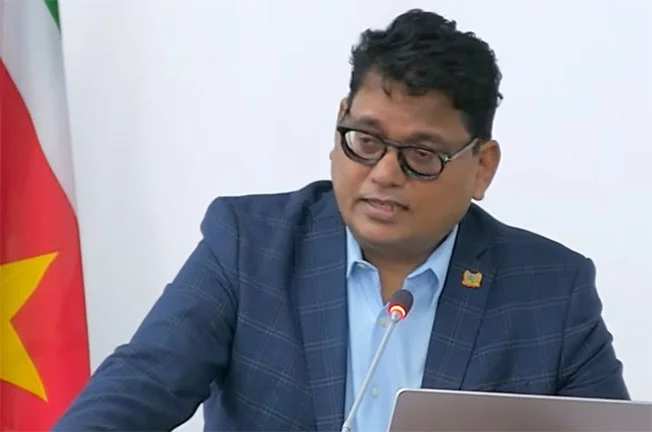
On November 14, senior VHP faction leader Asis Gajadien delivered a forceful address during a scheduled security interpellation session in Suriname’s National Assembly (DNA), calling on President Jennifer Simons to assume direct, personal oversight of a coordinated national response to the country’s spiraling violent crime crisis. Gajadien emphasized that the administration must produce a tangible, detailed security action plan that explicitly outlines targeted interventions, allocated financial resources, clear implementation timelines, and verifiable performance metrics, rather than relying on vague public announcements. The opposition lawmaker drew urgent attention to the recent surge in armed robberies, fatal robbery-homicides, and targeted gang retaliation killings that have paralyzed communities across the nation, noting that public trust in state institutions is eroding rapidly as families no longer feel safe in their own homes, small business owners face constant threats to their lives, and parents live in persistent fear for their children’s safety. “Security is not a charitable favor the state extends to its citizens; it is an inviolable fundamental human right and the core, non-negotiable responsibility of any functioning government,” Gajadien stressed. He formally questioned whether the ruling administration is prepared to reclassify public safety as the country’s top national priority, and align all relevant government ministries and law enforcement agencies under a single, unified operational framework. Gajadien also demanded full transparency regarding the status of the government’s existing national security plan, calling for a full public breakdown of which components are currently active, what measurable outcomes have been delivered to date, and how long-term policy continuity will be guaranteed. He argued that general, unenforced government promises are insufficient, and that parliament must be granted full visibility to confirm that stated measures are actually being rolled out and are driving a tangible reduction in violent crime rates, with the administration required to submit regular, public progress updates to legislators. The VHP leader dedicated significant attention to the unique security gaps in Suriname’s vast interior regions and the growing threat of cross-border criminal activity, pointing out that the country’s expansive, geographically challenging territory, poorly monitored border zones, rampant illegal gold mining, weapons smuggling, and transnational drug trafficking networks create severe, unaddressed national security vulnerabilities. “Across large swathes of the interior, the physical presence and legitimate authority of the Surinamese state are barely visible,” Gajadien stated, noting this gap exposes local residents, legitimate business operators, and even government officials to avoidable harm. He submitted formal questions to the government asking if it has completed a current, comprehensive national threat assessment focused on organized and cross-border criminal networks, what concrete steps are being taken to strengthen territorial control and state authority in underserved interior zones, and what formal bilateral agreements have been established with neighboring countries to support coordinated border patrols, shared intelligence, and joint operations to dismantle international criminal syndicates. Gajadien also called for enhanced operational coordination between the national police, defense forces, customs agency, and public prosecution office, while ensuring each institution retains its legally defined independent mandate. Shifting focus to budget allocations, Gajadien challenged the administration’s existing financial priorities, asking what ranking public security holds within the government’s broader fiscal and economic policy framework, and whether officials are willing to reallocate existing public funds to boost the operational capacity of police units, criminal investigation teams, and border security teams. He emphasized that line-item budget entries for security spending are meaningless if the funds are never actually disbursed to frontline agencies. The opposition leader also highlighted systemic bottlenecks across the entire criminal justice chain, from initial crime detection and investigation all the way through to the enforcement of court sentences, asking if the government has completed a full audit of these persistent gaps, and what structural reforms are being rolled out to increase the likelihood of criminal suspects being apprehended and improve the overall efficiency of the justice system. He also pressed for details on safeguards being implemented to prevent organized criminal groups from infiltrating state institutions and law enforcement agencies through corruption, intimidation, or financial bribery. Gajadien noted that targeted, scaled sentencing for severe violent offenses including armed robbery, robbery-murder, repeat aggravated violence, and organized crime-related felonies should be open for public debate, but cautioned that harsher penalties alone will not solve the crisis: a higher apprehension rate, timely, fair court proceedings, and consistent enforcement of imposed sentences are equally critical. He called on the government to conduct a full review of existing maximum sentencing guidelines and aggravating circumstance provisions, and to draft updated legislative proposals where gaps are identified. Gajadien added that the national security strategy must also be updated to address evolving new forms of organized crime, noting that traditional violent offenses are increasingly intertwined with cybercrime, complex money laundering schemes, encrypted digital communications, and transnational criminal networks. He asked for details on planned government investments in digital forensics units, specialized financial investigation teams, and expanded cross-border information sharing partnerships. Critically, he also emphasized that crime reduction efforts must be paired with parallel investments in public education, youth employment programs, and broader social policy to prevent vulnerable young people from being recruited into criminal networks due to a lack of legitimate economic opportunities. In closing, Gajadien stressed that public safety is not a partisan issue belonging exclusively to the ruling coalition or the opposition, and that the VHP stands ready to collaborate constructively on evidence-based policies that deliver real protection to citizens, while noting that full accountability for successful implementation and tangible results rests squarely with the administration. “Ordinary citizens do not ask which political party is responsible for keeping them safe – they simply expect the state to fulfill its basic duty to protect them,” he concluded, adding that public security cannot be reduced to empty campaign promises, and must be guaranteed through decisive action, consistent policy execution, and verifiable real-world results.
Gajadien wil dat president leiding neemt bij aanpak criminaliteit; veiligheidsplan nodig