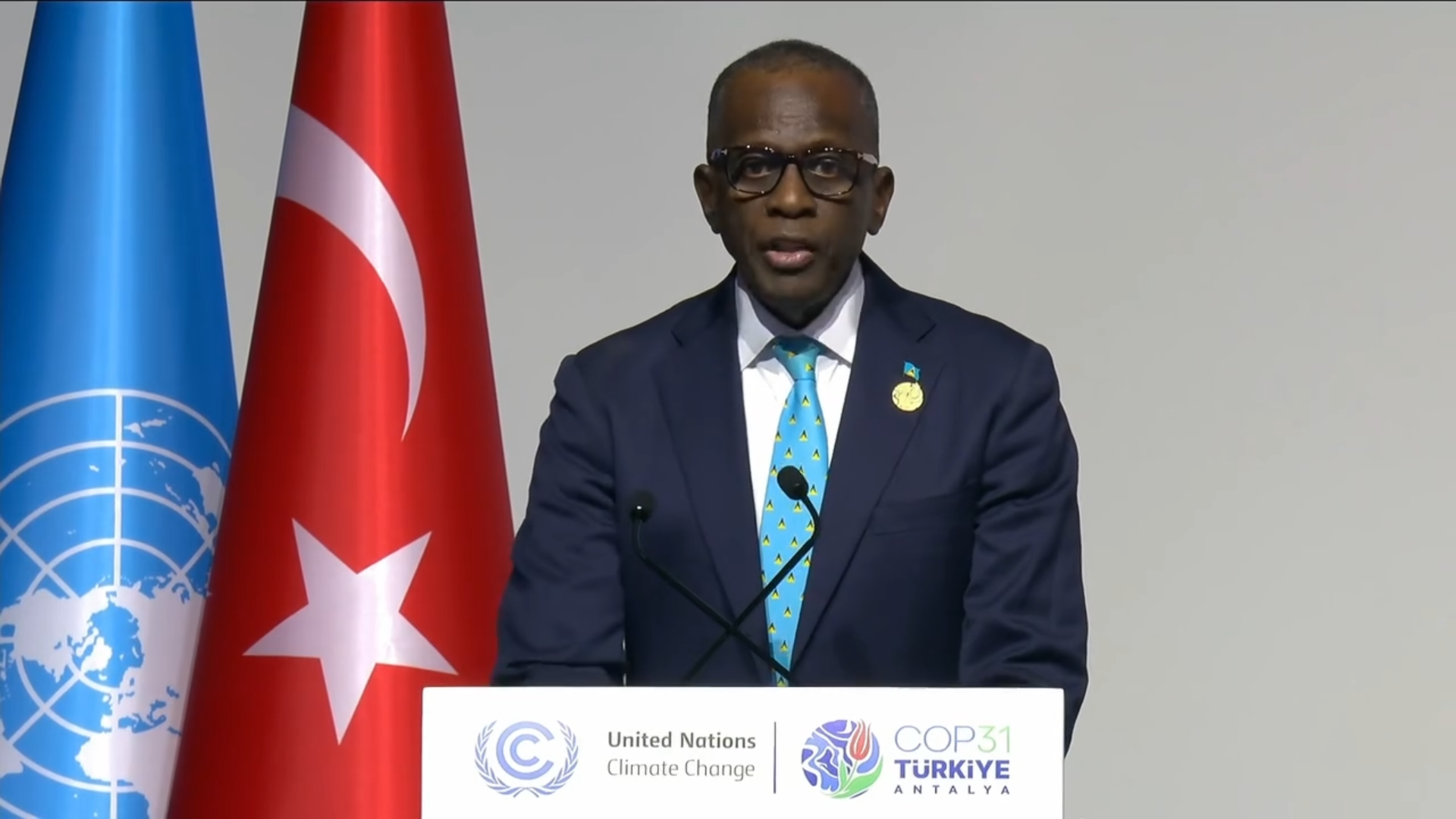
Delivering a forceful address at the COP31 global climate summit hosted in Antalya, Türkiye, Saint Lucia’s Prime Minister Philip J. Pierre has called on high-emitting wealthy nations to move beyond hollow rhetoric and deliver on long-overdue climate commitments, emphasizing that small island developing states (SIDS) should not be forced to bear the economic and social brunt of a planetary crisis they contributed almost nothing to create. Speaking in his dual capacity as Saint Lucia’s head of government and representative for the 15-nation CARICOM regional bloc, Pierre framed the Caribbean’s campaign to uphold the 1.5°C global warming threshold as an increasingly existential fight, as runaway global temperature rises push vulnerable communities to the breaking point. He recalled the landmark 2015 Paris Agreement negotiations, where Saint Lucia joined a coalition of SIDS to successfully enshrine the 1.5°C target as a non-negotiable core of global climate action, noting that 11 years on, collective global progress to meet that goal has been devastatingly sluggish. Pierre’s intervention comes as EU climate monitoring agency Copernicus confirms 2026 is on track to rank as the second hottest year ever documented, with the four-year average global temperature spanning 2023 to 2026 projected to permanently exceed 1.5°C above pre-industrial baselines, marking an unprecedented era of sustained extreme heat. To ground abstract global temperature data in tangible local reality, Pierre outlined the quiet, daily climate devastation reshaping Caribbean life that often flies under international media radars: small-scale farmers losing entire harvests to crippling multi-season droughts, households facing chronic water shortages due to drying aquifers, and artisanal fishermen grappling with warming, acidifying oceans that have collapsed fish stocks and degraded critical coral reef ecosystems. He emphasized that every climate-related disaster siphons limited public funds away from core national development priorities, with every dollar spent repairing storm damage or drought relief representing money that can no longer be allocated to expanding healthcare access, upgrading school infrastructure, building affordable housing, or rolling out anti-poverty programs. Climate finance has remained the most contentious deadlock in decades of UN climate negotiations. Official OECD data confirms that wealthy nations repeatedly missed their longstanding pledge to mobilize $100 billion in annual climate support for developing countries by 2020, only hitting that modest target two years later in 2022. While delegates at last year’s COP29 summit agreed to a new collective target of delivering at least $300 billion in annual climate finance to developing nations by 2035, alongside a broader goal to scale combined public and private climate investment to $1.3 trillion per year over the same timeframe, Pierre stressed that raw pledge numbers mean nothing if vulnerable nations cannot access the funds without taking on crippling new sovereign debt. He called on major historical emitters to replace the cycle of unfulfilled promises with tangible, accessible support structured around high volumes of no-repayment grants, low-interest concessional loans, and simplified application processes that cut through bureaucratic red tape that locks many SIDS out of existing funding streams. Pierre also renewed the Caribbean bloc’s longstanding policy demand that climate support eligibility be tied to a nation’s actual climate vulnerability, rather than the narrow, GDP-based income metrics that currently exclude many highly exposed middle-income SIDS from accessing concessional support. He noted that Saint Lucia is already taking proactive domestic action to cut its own emissions and build community resilience, including rolling out nationwide renewable energy infrastructure, transitioning public fleets to low-carbon transport, and retrofitting public buildings to withstand extreme weather. But he underscored that the scale of the unfolding climate crisis far outstrips the financial capacity of small island states, which cannot build the adaptive infrastructure their populations need using only limited domestic resources. “We cannot build national climate resilience on unmet promises alone,” Pierre told assembled delegates. “Our communities need direct, on-the-ground finance, accessible green technology transfers, and equitable cross-border partnerships that reach the most vulnerable households, not just bureaucratic negotiating teams in distant summits.” He closed his address with a stark warning that Caribbean populations cannot survive another decade of drawn-out, unproductive negotiations and half-measure climate action. “In Paris, we fought to put the 1.5°C survival threshold at the very center of the global climate agenda,” he said. “Here at COP31 in Antalya, our fight must be to put tangible delivery on existing promises at the heart of every decision we make.”
‘Progress has been too slow’: Pierre presses for climate action at COP31