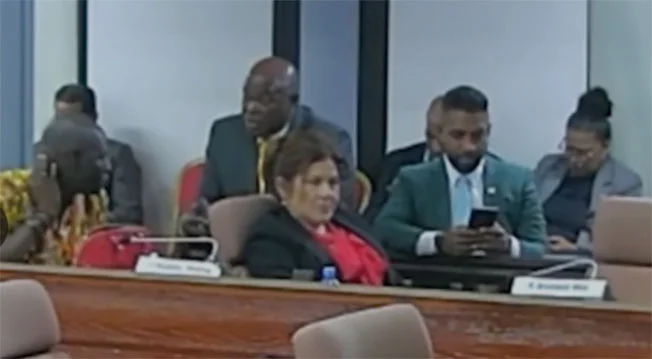
A scheduled interpellation meeting of Suriname’s National Assembly (DNA) focused on the country’s deteriorating public security landscape was abruptly delayed from its original Thursday, 12 November slot to 12:00 on Friday, 13 November, a last-minute adjustment that drew immediate public pushback from senior parliamentary leaders. VHP faction leader Asis Gajadien was the first to voice formal disapproval, demanding a full, public accounting from DNA Speaker Ashwin Adhin for the unannounced postponement, and quickly earned backing from DNA Vice President and ABOP faction leader Ronnie Brunswijk. Speaker Adhin later justified the move, stating the delay was unavoidable because the executive branch lacked the capacity to provide the full, accurate briefings parliament required in light of a fast-moving internal cabinet development: the pending forced resignation of Harish Monorath, the Minister of Justice and Security, whose position was no longer being upheld by the administration. Gajadien emphasized that the session, arranged specifically to address surging nationwide crime rates, had already secured the required quorum to proceed, noting that all parliamentary factions had collectively agreed just 48 hours prior that an urgent discussion of public safety was non-negotiable. He stressed that ordinary Suriname citizens face daily safety risks ranging from petty theft to violent armed crime, and that the government had a clear democratic obligation to answer legislative and public questions on the crisis without further delay, condemning the fact that the postponement was rolled out without any prior consultation with elected faction representatives. Adhin, in his formal defense, drew a clear procedural distinction between adjourning a session that had already been gaveled open and postponing a meeting that had not yet commenced, citing the National Assembly’s official Rules of Order that outline requirements for the executive branch to provide complete, verified information during interpellation proceedings. He explained that the cabinet had formally notified parliament it could not deliver the full scope of requested security briefings at the originally scheduled time, and that a meaningful, productive oversight session would be impossible without the relevant cabinet ministers present to testify, framing his decision as fully compliant with existing parliamentary protocols. Brunswijk, echoing Gajadien’s criticism, pointed out that the public security situation had reached a critical tipping point, and that Surinamese communities were desperate for clear, actionable answers from their elected representatives. He noted that Minister Monorath was physically present in the parliamentary chamber at the time the postponement was announced, pushing back on the administration’s claim that key stakeholders were unavailable, and pointing out that a cabinet minister retains full authority and official duties until their formal resignation is officially submitted and accepted. Following a temporary recess for closed-door negotiations between the speaker and all faction leaders, Adhin announced that a unanimous agreement had been reached to reschedule the interpellation for 12:00 the following day. All previously approved procedural permissions for the session remain in effect, meaning the discussion has not been removed from the parliamentary agenda, only shifted forward by 24 hours to accommodate the administration’s need to finalize internal arrangements related to the ministerial transition.