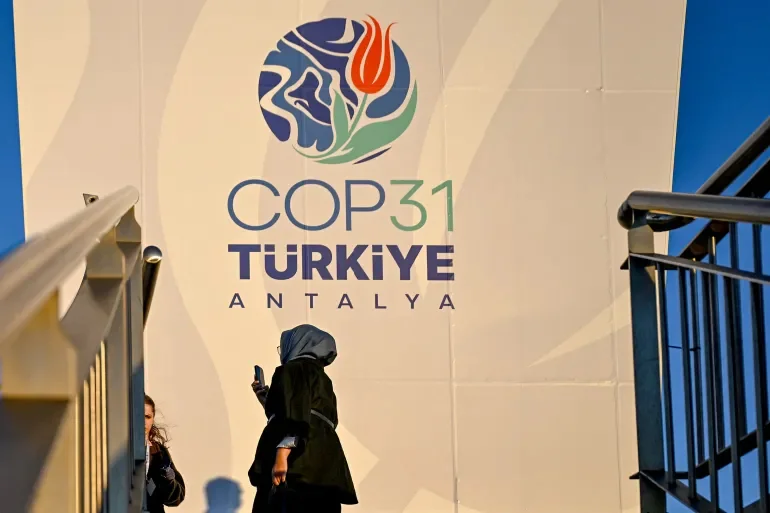
On November 9, 2026, the 31st United Nations Climate Change Conference (COP31) officially launched at the Antalya Expo Center in Turkey, marking the first time the country has hosted the landmark global climate summit. Spanning 12 days through November 20, the gathering brings together official delegations from 196 nations and the European Union, alongside 102 heads of state, government leaders, and senior representatives from 95 countries and 7 intergovernmental organizations, with the high-level leaders’ segment scheduled for November 11 and 12. A photo captured on November 8, 2026, shows a pedestrian walking past a COP31 event signage near the Antalya Expo Center, released via AFP ahead of the summit’s opening.
The conference’s core priorities are anchored in tangible delivery of previously agreed global climate pacts, scaled-up climate action financing, and targeted support for low-lying and climate-vulnerable nations that bear the brunt of extreme weather despite contributing minimally to historical greenhouse gas emissions. In his opening address, UN Climate Change Executive Secretary Simon Stiell issued a stark, renewed warning that current global emission reduction trajectories are drastically off track to meet the Paris Agreement’s core targets. Projections confirm the world is on course to breach the 1.5°C global warming threshold relative to pre-industrial levels, with 2026 widely expected to rank among the four hottest years ever recorded since systematic temperature monitoring began.
As the incoming COP presidency, Turkey has appointed its Minister of Environment, Urbanization and Climate Change Murat Kurum to lead the summit, with Australia tasked with steering formal negotiation processes. The Turkish presidency has laid out four non-negotiable focus areas to drive implementation: accelerated global energy transition, sharp cuts to methane emissions, rollout of climate-resilient urban infrastructure, and expanded cross-border climate collaboration. A key presidential target is to raise the global share of electricity in total end-use energy consumption to 35% by 2035, a milestone seen as critical to phasing out unabated fossil fuel reliance.
One of the most contentious sticking points in ongoing negotiations remains climate finance: developing economies are demanding that wealthy, historically industrialized nations fulfill and exceed long-overdue pledges to fund climate adaptation, post-disaster recovery, and affordable clean energy transitions in the Global South. Parallel priority agenda items include binding commitments to slash greenhouse gas output and phase out fossil fuels, all unfolding against a backdrop of worsening extreme weather events across every continent, including record heatwaves, catastrophic flooding, and intensified tropical cyclones. Notably, the United States is absent from formal government-level negotiation tracks at COP31, after the administration of President Donald Trump formally withdrew the country from international collective climate cooperation. Delegates are set to work through the closing day on November 20 to hammer out consensus frameworks to turn longstanding climate pledges into actionable, enforceable national policies.
Turkije: COP31 geopend onder druk om klimaatafspraken om te zetten in concrete actie