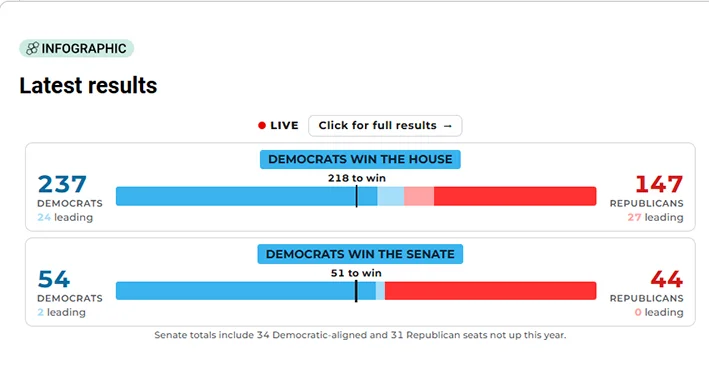
Washington, D.C. – November 5, 2024: A crushing electoral defeat for the U.S. Republican Party in the just-concluded midterm elections has significantly escalated political pressure on sitting President Donald Trump, with the administration and global stakeholders scrambling to assess the far-reaching ramifications of the shifted balance of power on Capitol Hill.
In the immediate 24 hours after polls closed, a clearer picture of a historic Democratic victory has emerged: per confirmed counts from the Associated Press, the party has secured enough seats to take majority control of both the U.S. House of Representatives and the U.S. Senate, flipping no fewer than seven previously Republican-held Senate seats and notching unexpected upsets in districts and states that have long been considered solid GOP strongholds. As of Wednesday, a handful of tight races remained uncalled: Democratic candidate Scott Colom held a razor-thin lead over incumbent Republican Senator Cindy Hyde-Smith in Mississippi, while vote tabulation was still underway in Alaska. Additional states including Arizona, California, Nevada, Pennsylvania, and Washington are expected to see delayed final results over the coming days or even weeks, due to rules governing mail-in ballots, ranked-choice vote tabulation, and mandatory runoff election protocols. House Democratic leader Hakeem Jeffries has formally announced his bid for the House Speakership; if elected, he will make history as the first Black presiding officer of the U.S. House of Representatives.
In a rare public acknowledgment, President Trump confirmed Wednesday that the ongoing U.S. conflict with Iran and its cascading economic fallout, most notably sharp spikes in domestic fuel prices, were key contributing factors to his party’s underperformance at the polls. Vice President JD Vance went a step further, explicitly framing the Iran war as the central cause of the Republican electoral loss. While Trump stated he remains open to cross-party collaboration with the new Democratic congressional majority, he also warned against partisan gridlock, noting he does not intend to rely exclusively on his presidential veto power to block congressional legislation for the remaining two years of his term. The incoming Democratic majority will hold sweeping authority to stall administration-backed bills, launch formal oversight investigations into White House policies, and shape the confirmation process for presidential nominees, though Trump retains broad unilateral executive powers over foreign policy and military decision-making.
Global financial markets reacted with marked caution to the election outcome in initial trading sessions: U.S. equity futures dipped in early post-election trading, with technology stocks facing downward pressure before markets recovered a portion of their losses. Investors are now pricing in the likelihood of stricter congressional regulatory oversight over the U.S. tech and artificial intelligence sectors under Democratic leadership, alongside heightened uncertainty over federal budget appropriations, the trajectory of the national debt, and ongoing energy market volatility tied to the Iran conflict. The U.S. dollar saw a temporary dip while yields on U.S. Treasury bonds declined, with analysts warning that intensified partisan division in Washington could introduce prolonged unpredictability for U.S. economic policy.
International actors across the globe have been closely monitoring the election results, with reactions ranging from cautious optimism to deliberate restraint. In Iran, parliament speaker and top nuclear negotiator Mohammad Bagher Ghalibaf framed the Democratic victory as a clear popular rejection of pro-war policies by U.S. voters, though Supreme Leader’s senior advisor Mojtaba Khamenei pushed back, noting that shifts in Washington’s political makeup would not alter Iran’s core stance toward the United States. European leaders expressed tentative hope that the new congressional dynamic could clear a path for expanded U.S. support for Ukraine, more ambitious climate action, and stronger transatlantic cooperation: Spanish Prime Minister Pedro Sánchez described the result as a public rebuke of policies that drive up household costs and deepen social division, while German Chancellor Friedrich Merz emphasized that Trump retains full use of his executive authorities regardless of congressional party control. Russia announced it would not adjust its core foreign policy to align with the U.S. election outcome, adding that Moscow hopes Trump’s stated commitments to resolving international conflicts will move forward. China characterized the U.S. midterms as an internal domestic affair for the United States, and reaffirmed its willingness to maintain open communication and cooperative engagement with Washington. South African President Cyril Ramaphosa went further, suggesting the new power balance in Washington could usher in a transformative new era for global diplomatic relations.
Beyond full control of Congress, the Democratic Party secured a string of historic breakthroughs in down-ballot races, including the election of the first Black female U.S. governor, the first Native American female governor and U.S. Senator, the first openly gay man elected to the U.S. Senate, and a new Muslim U.S. Senator, alongside key wins in gubernatorial contests. For the Republican Party, the dual loss of House and Senate majorities represents a significant erosion of its political positioning in the lead-up to the 2028 presidential election, with multiple high-profile incumbent GOP lawmakers losing their re-election bids. The reshuffled congressional power dynamic does not cut short Trump’s presidency, which is set to run through January 2029, but sets the stage for high-stakes partisan clashes over federal budget negotiations, immigration reform, the trajectory of the Iran conflict, U.S. military aid for Ukraine, and sweeping oversight of the executive branch for the remainder of his second term.
Trump onder druk na verkiezingsnederlaag, oorlog Iran speelt rol