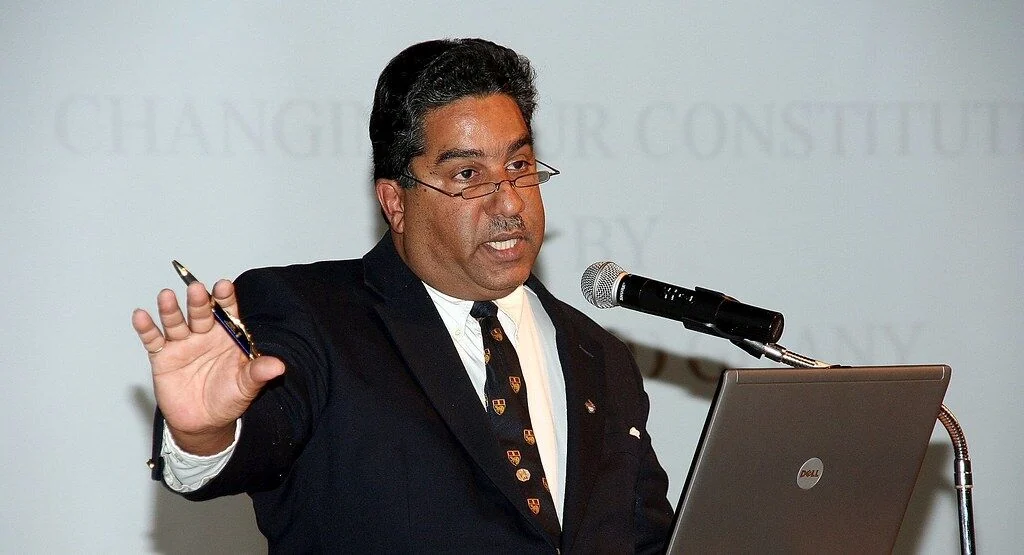
Leading Trinidad and Tobago political analyst Professor Hamid Ghany has laid out a clear framework for how US President Donald Trump will navigate the newly Democrat-controlled Congress following the Republican Party’s 2025 midterm election defeat, dismissing widespread speculation that the electoral shift will upend longstanding bilateral relations between Port of Spain and Washington, or create domestic political risks for Prime Minister Kamla Persad-Bissessar’s United National Congress (UNC) administration.
In a wide-ranging interview with the Trinidad Express, Ghany outlined that Trump will leverage sweeping executive powers enshrined in Article 2 of the US Constitution to advance his policy agenda, mirroring the playbook former Democratic President Barack Obama adopted in 2014 after his party lost control of Congress. Obama’s iconic “I’ve got a pen, and I’ve got a phone” approach, which relied heavily on executive orders and targeted vetoes to bypass legislative gridlock, will almost certainly be replicated by Trump, Ghany confirmed, noting the sitting president has already publicly signaled his intent to govern via these mechanisms to circumvent the opposition-held House and Senate where possible. For areas of policy that require formal Senate “advice and consent”, such as high-level diplomatic appointments or treaty ratifications, the administration will turn to targeted bipartisan deal-making, a standard practice for US presidents facing divided government, he added.
Crucially, Ghany emphasized that shifts in congressional control will not trigger major upheavals in US foreign policy, as presidential authority over diplomatic and national security matters remains largely intact under the US constitutional system. This stability will extend directly to Trinidad and Tobago’s bilateral relationship with the United States, he argued, pushing back against partisan local claims that Persad-Bissessar’s well-documented public support for Trump during his re-election campaign would now become a political liability for her UNC government.
Ghany contextualized this assessment by pointing to recent precedents: after President Joe Biden’s Democratic Party lost the 2022 midterms, then-Trinidad and Tobago Prime Minister Dr Keith Rowley’s People’s National Movement (PNM) administration faced no disruptions to governance or bilateral cooperation, and even moved forward to sign the landmark Status of Forces Agreement (SOFA) with Washington in December 2024, shortly after Trump won the November 2024 presidential election. That SOFA framework has since served as the foundation for deepened security collaboration between the Persad-Bissessar administration and US authorities, even though it was negotiated and signed by her political predecessor.
The analyst stressed that core US strategic priorities across the Caribbean – spanning regional energy partnerships, transnational security cooperation, and bilateral trade frameworks – have remained remarkably consistent across successive shifts in partisan control of the White House and Congress, as these interests are rooted in long-term national security calculations rather than short-term partisan political whims. While minor adjustments to policy implementation may occur under different administrations, no fundamental shifts to these core priorities are on the horizon, he noted.
Ghany also framed the Republican midterm losses as entirely consistent with an 80-year historical trend in US electoral politics, noting that nearly all sitting presidents have lost congressional seats in midterm contests since 1938, with only two rare exceptions: Democratic President Bill Clinton in 1998 and Republican President George W. Bush in 2002, in the immediate aftermath of the 9/11 attacks. He went on to explain that this dynamic of divided government is a core structural feature of the US presidential system, which operates very differently from Trinidad and Tobago’s Westminster parliamentary model, where the executive branch typically holds unbroken hegemonic control over the legislature via its parliamentary majority, and no equivalent of a presidential veto power exists to create legislative gridlock.
No trouble for UNC, says Ghany