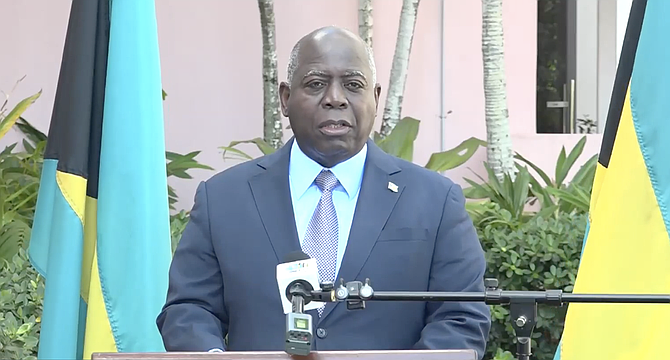
Delivering a landmark address at the 2026 14th Commonwealth Business Forum hosted in Antigua and Barbuda, Bahamas Prime Minister Philip “Brave” Davis rallied leaders across the 56-nation bloc to prioritize collective action to safeguard digital sovereignty, democratize access to emerging artificial intelligence economy opportunities, and prevent a repeat of centuries of historical resource exploitation that siphoned wealth from small developing nations to external actors.
Davis, who first laid out core digital sovereignty principles during his September 2025 address to the 81st United Nations General Assembly in New York, framed digital self-determination as the unfinished chapter of the Commonwealth’s long independence movement. “Digital sovereignty is not an abstract technical term: it is the fundamental right of every citizen to dictate how their personal data is collected, who profits from its use, and what legal guardrails govern its protection,” he told assembled business leaders and government representatives. “We fought for generations to win the right to govern our own lands and resources. That fight is not complete until we govern our own digital futures too.”
The prime minister drew a direct parallel between centuries of extractive colonial economic systems that stripped Global South nations of raw materials, processing all value-added manufacturing overseas and concentrating resulting wealth in wealthy northern economies, and the current unregulated global digital landscape. Today, he warned, the high-value resource being extracted without fair compensation is user data: every online search, shared photo, streamed video, and digital interaction generated by Commonwealth citizens feeds into global AI systems that generate billions in annual profits, nearly all of which flow to large multinational tech firms based outside of Caribbean, African, and Pacific small island developing states.
Compounding this risk, Davis noted, is a looming youth employment crisis across the bloc: 60% of the Commonwealth’s 2.7 billion total population is under the age of 30, translating to more than 1.5 billion young people, yet one in four of this demographic is currently locked out of work, formal education, or vocational training. Even qualified graduates who complete post-secondary programs face widespread barriers to secure stable, dignified employment, a gap that rapid AI adoption threatens to widen further as new tech-driven industries create wealth that local populations are locked out of accessing unless proactive policy interventions are put in place. Davis stressed that the same collective moral courage that united Commonwealth nations to dismantle apartheid in South Africa is required for this generation of leaders to ensure young people do not become passive consumers of foreign-owned technology, but active, compensated co-owners and participants in the global digital economy.
Beyond economic concerns, Davis highlighted the existential cultural stakes of unregulated digital control: foreign-owned global social media and AI platforms increasingly hold the power to curate, distort, or erase marginalized national histories, Indigenous languages, traditional music, and community cultural identities that carry the legacy of the Commonwealth’s painful pasts of enslavement and indentured labor. “Our young people are the custodians of a history that was too often erased by outside forces,” he emphasized. “They deserve the chance to be the authors of their own just future, not the subjects of someone else’s algorithm.”
To turn these commitments into actionable policy, Davis formally tabled the Bahamas’ proposed “Brave Architecture”, a four-pillar pan-Commonwealth collaborative framework designed to level the digital playing field for small and mid-sized member states. The first pillar, “skills that travel”, mandates mutual recognition of professional and academic qualifications across all Commonwealth nations, removing costly, redundant credential verification barriers that currently block young skilled workers from a Bahamian graduate in Freeport from accessing career opportunities in London, Toronto, New Delhi, or any other member state. The second pillar, “data that answers to national laws”, establishes unified cross-bloc standards for data collection, consumer protection, and targeted taxation of tech firms that profit from local user data, eliminating the need for individual small nations to negotiate on unequal footing with trillion-dollar global tech corporations. The third pillar creates shared, pooled investment in regional digital public infrastructure, including collectively owned data centers and cross-national cybersecurity systems that small island states could never afford to build and operate independently on their own limited national budgets. The final pillar, “stories that communities own”, sets up a dedicated Commonwealth cultural heritage fund to digitize at-risk historical archives, traditional languages, and creative works, ensuring local communities hold full decision-making authority over how their cultural assets are used to train AI models and are guaranteed an equitable share of any profits generated from that use.
Davis closed his address by emphasizing that the Commonwealth’s shared 2.7 billion population, overlapping legal traditions, and widespread use of the English language gives the bloc unprecedented collective bargaining power that no individual small nation could ever wield alone. “Alone, a tiny island state negotiates from a position of profound weakness against a tech giant with a larger annual budget than our entire national GDP,” he stated. “But together, 56 nations representing nearly a third of the global population do not beg for terms: we set the rules.” He formally called on all Commonwealth Heads of Government to commission a full, detailed implementation roadmap for the Brave Architecture framework in advance of their next scheduled biennial summit, confirming that the Government of the Bahamas stands ready to lead administrative and technical working groups to advance the initiative.