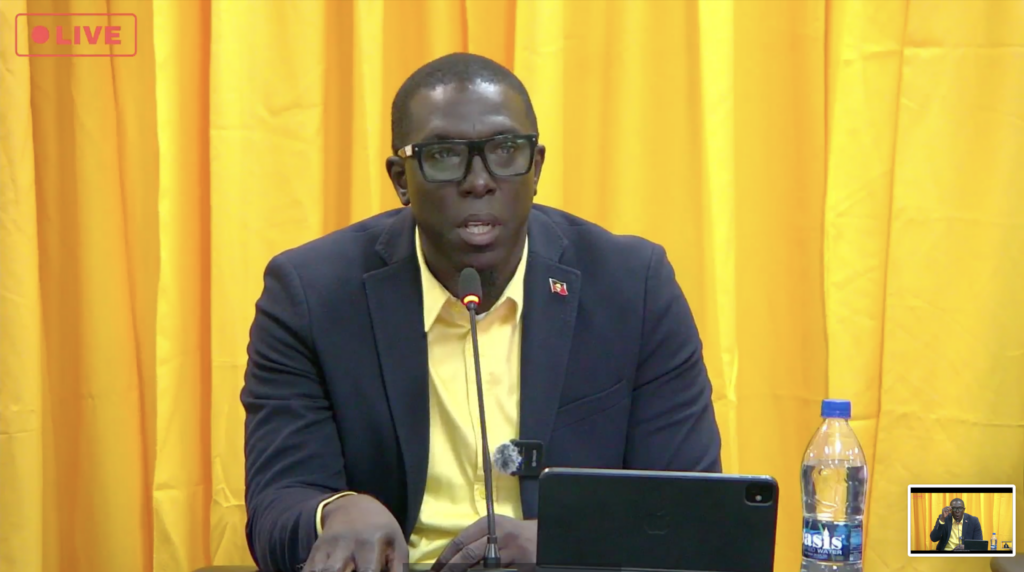
As Antigua and Barbuda prepares to welcome global leaders for the upcoming Commonwealth Heads of Government Meeting (CHOGM), a high-profile political dispute has erupted over the nation’s standing as a standard-bearer for shared Commonwealth democratic values. Opposition Leader Jamale Pringle, representing the United Progressive Party (UPP), delivered a sharp rebuke of sitting Prime Minister Gaston Browne’s administration during a public civic forum co-hosted by the UPP and the Barbuda People’s Movement, billed as “The People’s Message to the CHOGM Delegates.”
Pringle opened his address by framing CHOGM hosting status not merely as a diplomatic prestige point, but as a weighty accountability obligation that requires the host nation to embody the core democratic norms the 56-member Commonwealth bloc was founded to uphold. He posed a pointed rhetorical question to attendees: “Every single member state of the Commonwealth is bound to a shared commitment to liberal democratic governance, equal rule of law, and independent public institutions. How can we in good faith welcome heads of government from across the bloc when our own elected leadership is actively eroding the very systems that underpin those shared values?”
The opposition leader laid out specific, targeted criticisms of recent public statements made by Prime Minister Browne directed at two traditionally apolitical pillars of public governance: the independent judiciary and the civil service, including senior non-partisan administrative roles such as permanent secretaries. Pringle emphasized that these comments carry far greater diplomatic weight during the CHOGM period, as global delegates are closely observing the host nation’s governance track record, and risk sending a contradictory message about the Commonwealth’s collective democratic standards to smaller and newer member states.
Stressing that public trust in the justice system is non-negotiable, Pringle argued that residents of Antigua and Barbuda deserve absolute certainty that court rulings are rooted solely in statutory law and evidence, not shaped by implicit or explicit political intimidation from the executive branch. He also pushed back against a widespread public tendency to dismiss inflammatory or norm-breaking statements from top elected officials as merely a quirk of individual leadership style, warning that normalizing such behavior creates a slippery slope that gradually dismantles longstanding institutional safeguards.
Reaffirming the foundational principle of popular sovereignty, Pringle noted that all elected officials hold public power as temporary stewards acting on behalf of the voting public, and must face consistent, robust accountability for both their conduct in office and their stewardship of shared public resources. “No person who holds elected office gets to treat the power granted to them by the people as personal property,” he stated. “Every member of the governing party, from the prime minister down to the newest backbencher, must never forget that their authority is lent to them by the citizens they serve, not the other way around.”
Pringle also issued a direct call for government parliamentarians to exercise independent oversight and speak out against misconduct within their own ranks, rejecting unthinking partisan loyalty as a threat to national democratic health. In his closing demands, he renewed the UPP’s formal petition for Prime Minister Browne to publicly retract a widely reported threat to deport a sitting judge over rulings that the administration disagreed with, and issue a binding public pledge that the executive branch will never deploy its deportation or other discretionary powers to harass, penalize, or coerce judicial officers for carrying out their legally mandated duties.
Additionally, the opposition leader laid out a four-point governance reform roadmap: all substantiated evidence of public corruption must be immediately referred to independent anti-corruption and law enforcement bodies for full investigation; all unsubstantiated, publicly aired corruption allegations against public servants must be formally withdrawn; a formal public apology must be issued to the entire judiciary for recent inflammatory public remarks; and parliament must implement strengthened, transparent scrutiny frameworks to oversee executive actions and public spending. He closed his address with a definitive restatement of constitutional supremacy: “No prime minister, no matter their electoral mandate, is ever above the supreme law of this land.” No formal response from Prime Minister Browne’s office to Pringle’s allegations and demands was included in the official event transcript released to the public.
Opposition questions Antigua and Barbuda’s democratic example as CHOGM host